Hanna Digital Refractometers

A refractometer measures how much light bends as it passes through your sample. The more dissolved solids there are, the more the light bends, which makes one optical reading a direct measure of sugar, salt or total solids. There is no reagent, no electrode and nothing to consume.

Ecotao supplies the Hanna digital refractometers across South Africa from Cape Town, along with the Brix standards used to verify them.

  • Brix
  • % salt
  • Refractive index
  • Automatic temperature compensation
  • No reagents
  • Two second reading

Why Digital Beats a Hand Held Prism

The traditional refractometer is a brass tube you hold up to the light and read against a scale through an eyepiece. It works, it costs very little, and Ecotao stocks a wide range of them. What it cannot do is give two people the same answer, because reading a blurred boundary line against a printed scale is a judgement.

A digital refractometer replaces the eyepiece with a light source and a sensor. You put a few drops on the prism, press one button, and read a number off a screen in about two seconds. Two operators get the same number, and so does the same operator on a Monday morning.

The second difference is temperature. Refractive index changes with temperature, so a reading taken on a cold morning and one taken next to a hot kettle are not comparable unless the instrument corrects for it. The Hanna digital refractometers apply automatic temperature compensation, which removes the largest source of error in refractometry and the one that is hardest to notice.

The third is that there is nothing to consume. Unlike photometry, which needs a reagent for every test, a refractometer needs distilled water for zeroing and a cloth. Running cost is effectively nil, which makes these worth it where testing is frequent.

~2 secondsper reading
0 to 85 Brixrange on HI96801
Automatictemperature compensation
No reagentsdistilled water only

The Hanna Digital Refractometers

Hanna builds dedicated digital refractometers rather than one instrument with many scales, so each reads its own parameter directly in the units that trade uses. Ecotao holds these two and can order the other scales in the Hanna range.

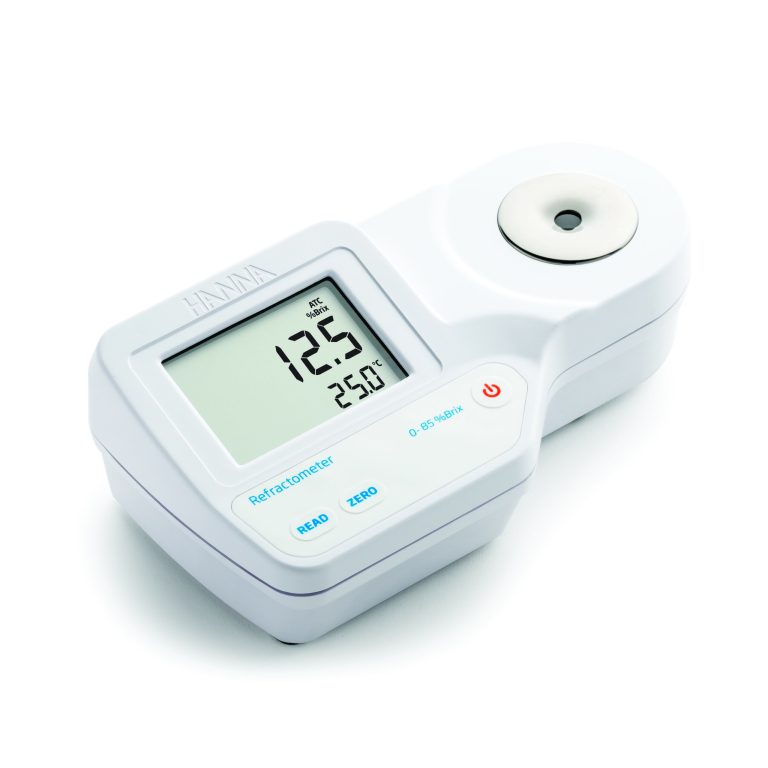
Hanna HI96801 digital refractometer measuring Brix in a sugar solution
HI96801

Digital Refractometer for Brix

The sugar instrument, reading 0 to 85 percent Brix, which covers everything from a dilute juice to a thick syrup. This is the one bought for juice, soft drinks, jam, honey, syrup, fruit at harvest and grape must at picking. Automatic temperature compensation means a reading in the vineyard at six in the morning matches one taken in the plant at midday.

  • 0 to 85 % Brix
  • Automatic temperature compensation
  • Reading in roughly two seconds
  • A few drops of sample required
  • Stainless steel well, easy to clean

Best for: juice and beverage, wine and grape harvest, jam, honey, syrup and fruit grading.
Hanna HI96821 digital refractometer for measuring sodium chloride in food
HI96821

Digital Refractometer for Sodium Chloride in Food

The salt instrument. Salt content is both a flavour specification and a labelling claim, which makes it one of the few numbers a food producer has to be able to defend. This reads sodium chloride directly in the units a recipe is written in, rather than leaving you to convert from a conductivity reading.

  • Reads sodium chloride directly
  • Automatic temperature compensation
  • Built for food and brine samples
  • Reading in roughly two seconds
  • Stainless steel well, easy to clean

Best for: food production, brines and curing, sauces, snacks and nutritional labelling.

Refractometer, Photometer or Meter

Refractometry, photometry and electrochemistry measure genuinely different things, and the overlap is smaller than people expect. This is where each one belongs.

Refractometer Photometer Electrode meter
MeasuresDissolved solids by light bendingA specific substance by colour reactionIon activity or conductivity
Typical useBrix, salt, total solidsAmmonia, chlorine, iron, phosphatepH, EC, ORP, dissolved oxygen
ConsumablesNoneA reagent per testBuffers, electrolyte, electrode
Time per readingAbout two secondsMinutesSeconds, plus calibration
Sample neededA few dropsA filled cuvetteEnough to cover the electrode
Specific to one substanceNoYesDepends on the sensor
Running costEffectively nilOngoingOngoing

Where Refractometers Get Used

Anywhere a concentration of dissolved solids is a specification rather than a preference.

๐Ÿ‡Wine & grapes
๐ŸงƒJuice & beverage
๐ŸฏHoney & syrup
๐Ÿ“Fruit & harvest
๐Ÿง‚Salt & brines
๐ŸฅซFood processing
๐ŸงชLaboratories
๐ŸบBrewing
๐Ÿง€Dairy
๐Ÿš›Incoming goods

Choosing and Using One

  1. Pick the scale, not the instrument

    Hanna builds dedicated refractometers, so the scale is the choice. Brix for sugar, percent salt for sodium chloride, refractive index where you want the raw optical value. Buying a Brix instrument and converting to salt by arithmetic is not the same measurement and will not survive scrutiny.

  2. Check the range covers your product at both ends

    A 0 to 85 Brix instrument reads a dilute juice and a thick syrup. A narrow range instrument resolves small differences better but will peg on anything outside it. If you measure both dilute and concentrated product, range beats resolution.

  3. Insist on temperature compensation

    Refractive index moves with temperature. Without automatic compensation, every reading carries an error that depends on the weather and on how long the sample sat out, and the error is invisible because the number still looks plausible.

  4. Zero with distilled water before each session

    Zeroing takes a few seconds and is the whole of the daily maintenance. Use distilled or deionised water, not tap water, because tap water has dissolved solids of its own and will offset every reading you take that day.

  5. Verify against a Brix standard periodically

    A zero check proves the instrument reads nothing correctly. A Brix standard of known value proves it reads something correctly, which is a different and more useful statement. If your results are reported to a customer or a regulator, keep a standard and record the checks.

Standards, Cleaning and Getting Consistent Readings

Clean the prism between every sample. Sugar dries to a film that is almost invisible and reads as extra solids on the next sample. Rinse with distilled water, then blot with a soft cloth or tissue rather than wiping hard, because the prism surface is an optical component.

Let the sample settle to room temperature where you can. Automatic temperature compensation corrects the optics, but it cannot correct a sample that is still changing temperature while you read it. Pour a sample, give it a moment, then measure.

Use enough sample to cover the whole well. A partial film gives a reading that drifts as the edges dry. A few drops is genuinely all that is needed, but they have to cover the prism.

Keep a Brix standard if the number leaves your premises. Ecotao stocks 500 ml Brix standards, which are what you use to prove the instrument was reading correctly on a given day. For anyone working to a customer specification this is the difference between a reading and a defensible reading.

If you also need the analogue route, we stock a wide range of hand held prism refractometers for Brix, salinity, alcohol, glycol and battery fluid in the laboratory section of the store. They are cheap enough to put one in every vehicle, and they pair well with a single digital instrument kept for the readings that matter.

Frequently Asked Questions

One degree Brix is one gram of sucrose in one hundred grams of solution, so twelve Brix means roughly twelve percent sugar by mass. In practice a refractometer measures all dissolved solids rather than sugar specifically, which is why the reading is called degrees Brix rather than percent sugar. In juice, syrup and grape must the dissolved solids are overwhelmingly sugar, so the two are close enough for trade. In a sample with a lot of non sugar solids they are not.

Hanna builds these as dedicated instruments, each reading its own scale directly. Both scales come from the same underlying refractive index, so a conversion is arithmetically possible, but it assumes your sample contains only the one substance and nothing else, which food samples never do. If you need both parameters properly, buy both instruments.

Because refractive index itself changes with temperature. That is physics rather than a fault. The Hanna digital refractometers apply automatic temperature compensation, so the instrument corrects for it and reports the value at the reference temperature. Without that correction, the same syrup genuinely reads differently at fifteen and at thirty degrees.

Zero with distilled water at the start of each session, and after anything sticky. That takes seconds. Verify against a Brix standard on a schedule that suits how much the results matter, which for most food and beverage customers means monthly, or before any batch whose result goes to a customer. Record the checks, because an unrecorded check is of no use in an audit.

It depends on what the number does. For deciding whether fruit is roughly ready, a hand held prism refractometer at a fraction of the price is fine, and we stock a full range of them. For a number that goes on a label, into a batch record, or to a customer, the digital instrument is worth it because two operators get the same answer and temperature is corrected automatically. Most customers end up with several hand held units and one digital.

Yes. We hold 500 ml Brix standards for verification, and we can order the other scales in the Hanna digital refractometer range. We also stock a broad range of analogue refractometers under laboratory equipment, covering Brix in several ranges, salinity, brine, alcohol, glycol, antifreeze and serum protein. Tell us the product and the range you need and we will match it.

Related Pages

Tell us the product and the scale you need

Say what you are measuring, the range your product sits in and whether the result goes to a customer. We will match the instrument to the scale and quote the Brix standards to verify it.