
Thermohygrometers — Digital Temperature & Humidity Meters
A thermohygrometer is an instrument that simultaneously measures two critical environmental parameters: air temperature and relative humidity (%RH). By combining a thermometer and a hygrometer into a single device, it gives you the complete picture of ambient air conditions — including the ability to calculate dew point, assess comfort levels, monitor cold chain compliance, and flag condensation risk. Ecotao stocks eight models, from economy wall-mount units to professional data loggers with PC export and barometric pressure measurement.
Thermohygrometers Available from Ecotao
Eight digital thermohygrometer models — from budget desktop units to professional logging instruments. All stocked through our Cape Town store with South Africa–wide delivery. Lead time 2–4 weeks.
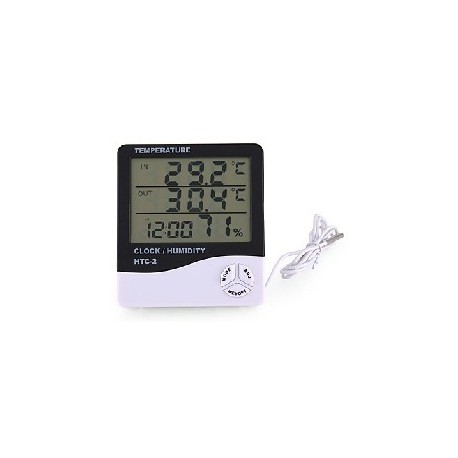
HTC-2 Indoor Thermohygrometer with External Temperature
Budget wall or desktop unit that reads both indoor and a remote location simultaneously via a 1.5m probe cable — plus a built-in 12/24hr clock.
- Temp (in) -10 to +50°C ±1°C
- Temp (ext) -50 to +70°C ±1°C
- RH 10–99% ±5%
- Probe 1.5m cable
- Power 1 × AAA battery
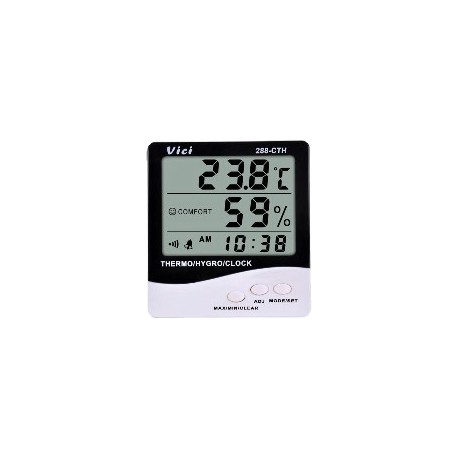
288-CTH Indoor Thermohygrometer
Slim desk or wall unit with an exceptionally wide temperature span and a comfort index icon. The widest temperature range of any economy model in the range.
- Temp -50 to +70°C ±1°C
- RH 10–99% ±5%
- Extra Comfort index icon
- Min/Max With reset
- Power 1 × AAA battery
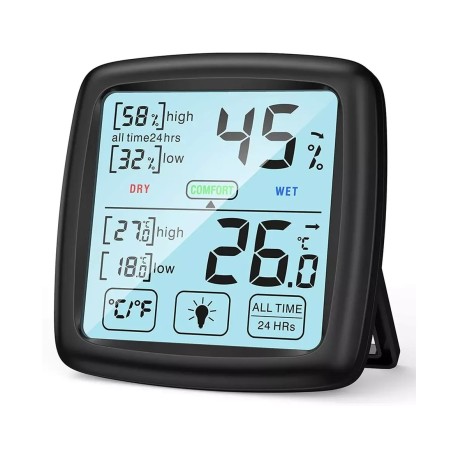
LDTH-98 Large Display Thermohygrometer with Backlight
Square, magnetic-mount unit with a wide-angle backlit LCD and touch-screen buttons. Tracks both 24-hour and all-time Min/Max — ideal for at-a-glance monitoring in low-light spaces.
- Temp -10 to +60°C ±0.5°C
- RH 10–98% ±3% (30–75%)
- Memory 24hr + all-time Min/Max
- Mount Desk, wall, or magnet
- Power 2 × AAA batteries
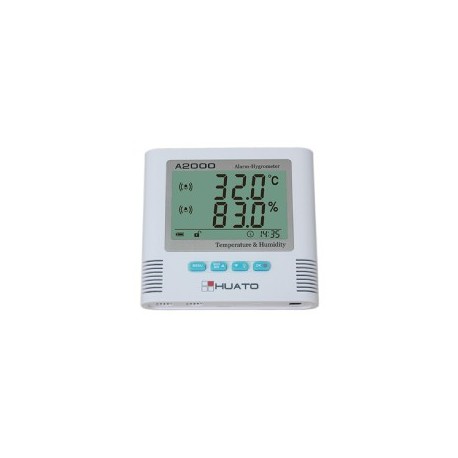
A2000-TH Large Display Thermohygrometer — Internal Sensors
When readings drift outside your set limits, the A2000-TH triggers a red indicator light and audible buzzer. User offset calibration makes it suitable for quality-control environments.
- Temp -20 to +70°C ±0.5°C
- RH 0–100% ±5%
- Alarm Hi/Lo — light + buzzer
- Calibration User offset
- Power 9V alkaline battery
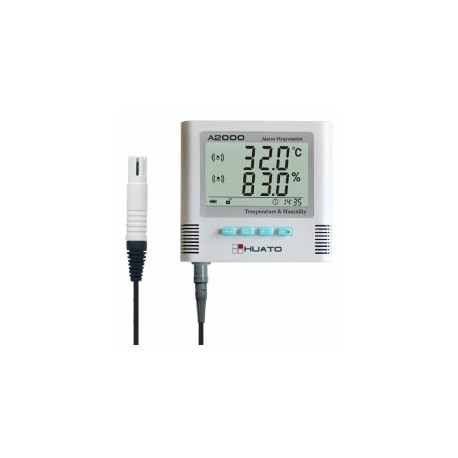
A2000-EX Large Display Thermohygrometer — External Probe
Same alarm and calibration features as the A2000-TH, but with a 3-metre external probe so the display can be mounted outside a cold room, cabinet, or enclosure while the sensor measures conditions inside.
- Temp -40 to +85°C ±0.5°C
- RH 0–100% ±5%
- Probe 3m cable
- Alarm Hi/Lo — light + buzzer
- Power 9V alkaline battery

LSTH-1306 Large Display Sound Meter and Thermohygrometer
The only model in the range that combines sound level measurement with temperature and humidity. The large colour LED display shows noise comfort icons alongside T/RH — one instrument covers both an occupational noise check and an environmental reading.
- Sound 30–130dB ±1.5dB
- Frequency 50Hz–8kHz
- Temp -10 to +50°C ±1°C
- RH 20–85% ±5%
- Power 5VDC + Li battery backup

TA622C Thermohygrometer / Logger
Professional handheld logger using a Swiss SHT C3 capacitive sensor. Calculates dew point and wet bulb temperature in addition to T and RH. Stores 8000 data groups with USB transfer and free PC software — supplied with carry case.
- Temp -40 to +80°C ±0.5°C
- RH 0–100% ±3% (SHT C3)
- Derived Dew point, Wet bulb
- Memory 8000 groups (USB export)
- Probe 2m cable; c/w carry case
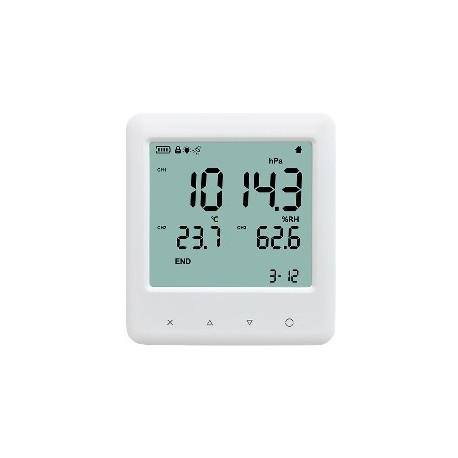
YEM-70L Digital Barometer Thermohygrometer with Data Logging
Three measurements in one: barometric pressure, temperature, and humidity — all logged to 22,528 records and exported as CSV or XLS directly from MicroUSB with no software needed. The highest-accuracy humidity reading in the range (±3%) with a battery life of approximately one year on 3 × AAA cells.
- Pressure 300–1100hPa ±1hPa
- Temp -30 to +65°C ±0.3°C
- RH 0–100% ±3%
- Memory 22,528 records
- Export MicroUSB → CSV/XLS (no driver)
How to Choose the Right Thermohygrometer
All eight models measure temperature and relative humidity — the differences are in where the sensor is placed, what extra parameters are needed, and whether readings need to be stored for later analysis. Use the questions below to narrow down the right instrument for your application.
Do you need to measure at a remote location?
Yes: Choose the HTC-2 (1.5m probe, economical) or
A2000-EX (3m probe, with alarm). The HTC-2 is ideal when the remote
point is nearby — a second room or outside. The A2000-EX is better when the sensor
goes inside a cold room, oven, or duct while you read it from outside.
No: Any model with an internal sensor.
Do you need audible or visual alarms?
Yes: The A2000-TH and A2000-EX both
include high/low setpoint alarms with a red indicator light and buzzer. This is the right
choice for server rooms, medicine storage, or any space where you need staff to be
alerted if conditions drift.
No: Any of the other models are sufficient.
Do you need to log and review data over time?
Yes, with PC software: Choose the TA622C — USB transfer and
free downloadable software with 8000-group memory.
Yes, direct to spreadsheet: Choose the YEM-70L — it
appears as a USB disk and exports directly to CSV or XLS, no software or driver needed.
No: Any model with Min/Max memory is sufficient.
Do you also need to measure barometric pressure?
Yes: The YEM-70L is the only model in the range that measures air pressure (300–1100hPa). It is also the only one that measures absolute barometric pressure, useful for HVAC commissioning, meteorological monitoring, or altitude-aware fieldwork across South Africa's varied terrain from sea level to the Highveld.
Do you need to measure dew point?
Yes: The TA622C calculates and displays dew point and wet bulb temperature directly from the combined T and RH reading. Dew point is important in cold rooms, insulated buildings, and industrial environments where surface condensation causes corrosion or product damage.
Do you also need noise level measurement?
Yes: The LSTH-1306 is the only model that adds a calibrated sound level meter (30–130dB, 50Hz–8kHz) to full thermohygrometer capability. It is ideal for occupational health assessments, factory floor noise compliance checks, and school or office environment surveys where noise and comfort conditions need to be recorded at the same time.
Thermohygrometer Comparison Table
Side-by-side specification comparison of all eight models. Key figures are taken directly from manufacturer datasheets. RH accuracy is specified at the calibrated mid-range; accuracy degrades toward the extremes of the measurement span.
← Scroll to see full table →
| Model | Sensor Type | Temp Range | Temp Accuracy | RH Range | RH Accuracy | Special Functions | Data Logging |
|---|---|---|---|---|---|---|---|
| HTC-2 | External probe (1.5m) | Indoor -10 to +50°C External -50 to +70°C |
±1°C | 10–99% | ±5% | Clock (12/24hr), Min/Max | No |
| 288-CTH | Internal | -50 to +70°C | ±1°C | 10–99% | ±5% (35–75%) | Comfort icon, Min/Max | No |
| LDTH-98 | Internal | -10 to +60°C | ±0.5°C | 10–98% | ±3% (30–75%) | Backlit touch, 24hr + all-time Min/Max, magnetic mount | No |
| A2000-TH | Internal | -20 to +70°C | ±0.5°C | 0–100% | ±5% | Hi/Lo alarm (buzzer + light), user calibration, button lock | No |
| A2000-EX | External probe (3m) | -40 to +85°C | ±0.5°C | 0–100% | ±5% | Hi/Lo alarm (buzzer + light), user calibration, button lock | No |
| LSTH-1306 | Internal + condenser mic | -10 to +50°C | ±1°C | 20–85% | ±5% | Sound level 30–130dB ±1.5dB, 50Hz–8kHz, colour LED, fast/slow response | No |
| TA622C | External probe (2m) — Swiss SHT C3 | -40 to +80°C | ±0.5°C | 0–100% | ±3% (10–90%) | Dew point, wet bulb, K-type TC input, dual LCD, carry case, USB + free software | 8 000 groups |
| YEM-70L | Internal | -30 to +65°C | ±0.3°C | 0–100% | ±3% | Barometric pressure 300–1100hPa ±1hPa, alarm, view Min/Max/Average of log | 22 528 records → CSV/XLS |
Applications of Thermohygrometers in South Africa
South Africa's varied climate — from the Cape's wet winters and dry summers, to the Highveld's dry winter months and humid summer thunderstorm season, to the subtropical KwaZulu-Natal coast — creates distinct humidity monitoring challenges across different industries and building types.
Cold Rooms and Food Storage
Temperature and relative humidity both affect shelf life and food safety. A thermohygrometer with an external probe — such as the A2000-EX — allows staff to monitor conditions inside a cold room continuously from outside the door, triggering an alarm if temperature or humidity drifts above the safe range before product is affected.
Server Rooms and Data Centres
ASHRAE guidelines recommend server room relative humidity between 20% and 80%RH with temperature in the 15–32°C range. Too dry and static electricity risk increases; too humid and condensation can form on circuit boards. The YEM-70L or TA622C log continuous records so facilities managers can prove compliance and identify problem periods after the fact.
Pharmaceutical and Laboratory Storage
Medicines, reagents, and biological samples often have defined storage conditions specified by regulatory bodies. A data-logging thermohygrometer provides the documented record of temperature and humidity excursions needed for cold chain compliance and quality management systems such as ISO 9001 or GMP certification.
HVAC Commissioning and Building Inspection
HVAC technicians use thermohygrometers to verify that conditioned air is being delivered at the designed temperature and humidity setpoints. The YEM-70L's barometric pressure reading is particularly useful at South Africa's higher altitudes — Johannesburg at 1,750m and Pretoria at 1,339m have significantly lower atmospheric pressure than sea level, which affects HVAC system sizing calculations.
Agricultural Storage and Grain Handling
Grain, seed, and dried produce stored at relative humidity above 65–70%RH are at risk of fungal growth and mycotoxin contamination. A wall-mounted thermohygrometer in a grain silo or packing house gives a continuous reading that operators can act on — either by running drying equipment or improving ventilation — before grain quality deteriorates.
Buildings, Museums, and Archive Storage
High indoor humidity in Cape Town's winter months promotes mould on walls, condensation on windows, and degradation of paper, textiles, and artworks in museum and archive storage. A thermohygrometer with Min/Max memory allows building managers to identify the hours during which conditions are most problematic and to assess whether a dehumidifier or ventilation improvement is working.
Occupational Health and Factory Environments
The LSTH-1306 simultaneously monitors noise levels and environmental conditions — a practical combination for occupational health practitioners carrying out a workplace survey. A single instrument covers both the noise compliance check (against OHSA Section 8 exposure limits) and the thermal comfort assessment without swapping devices.
Condensation and Dew Point Assessment
Before painting, coating, or applying adhesives to metal surfaces, contractors must verify that the substrate temperature is at least 3°C above the dew point — otherwise moisture will condense on the surface and cause coating failure. The TA622C calculates dew point directly, eliminating the need for manual psychrometric chart lookups on site.
Poultry Houses, Greenhouse and Hydroponics
High-density poultry housing requires humidity control to prevent respiratory disease and litter quality problems, with optimal ranges typically 50–70%RH. Greenhouse and hydroponics growers similarly need to keep humidity below the threshold for fungal disease while maintaining conditions conducive to healthy transpiration. A desktop or wall unit with trend indicators and 24-hour memory gives the farm manager a quick daily environmental audit.
Frequently Asked Questions — Thermohygrometers
What is a thermohygrometer?
A thermohygrometer is an instrument that simultaneously measures two environmental parameters: air temperature (in °C or °F) and relative humidity (as a percentage, %RH). It combines a thermometer and a hygrometer into a single device with a shared display. Most models also record minimum and maximum readings, and some add dew point calculation, data logging, barometric pressure, or audible alarms.
What is the difference between a hygrometer and a thermohygrometer?
A hygrometer measures only relative humidity. A thermohygrometer measures both temperature and relative humidity simultaneously. In practice this matters because humidity and temperature are always interpreted together — dew point, comfort conditions, and mould risk all depend on the combination of both readings, not on either measurement in isolation.
What is dew point and why does it matter?
Dew point is the temperature at which air becomes fully saturated with water vapour and condensation begins to form on surfaces. It is calculated from the combination of air temperature and relative humidity. In buildings, cold rooms, server rooms, and industrial environments, knowing the dew point is critical to preventing surface condensation, corrosion, and mould growth. The TA622C calculates dew point and wet bulb temperature directly alongside the live T and RH readings.
What is the difference between the A2000-TH and the A2000-EX?
Both models share the same display unit and features — audible and visual High/Low alarms, user offset calibration, button lock, Min/Max memory, and 9V battery power. The only difference is sensing configuration. The A2000-TH uses internal sensors (temperature range -20 to +70°C), while the A2000-EX uses an external probe on a 3-metre cable with a wider range of -40 to +85°C. Choose the A2000-EX when the display must be mounted away from the measurement point — through a wall, into a cold room, or inside a duct.
Which thermohygrometer is best for a server room or cold room in South Africa?
For a server room where you need to review temperature and humidity trends over time, the YEM-70L or TA622C are the best choices — both log data continuously and export to spreadsheet files. For a cold room where the display must remain outside while the sensor monitors inside, the A2000-EX is ideal: its 3m probe passes through the door seal while the display and alarms remain in the ambient area. The A2000-TH or A2000-EX are recommended when you need instant alerts if conditions exceed safe limits.
Which thermohygrometer can transfer data to a PC?
Two models support data transfer to a computer. The TA622C stores up to 8000 data groups and transfers them via USB with free downloadable software. The YEM-70L stores 22,528 records and exports directly to TXT, CSV or XLS files via MicroUSB — no software or driver installation is required, as the device appears as a USB disk on any computer.
What is the LSTH-1306 used for?
The LSTH-1306 is a combined sound level meter and thermohygrometer. It measures noise levels from 30 to 130dB across a frequency range of 50Hz to 8kHz, while simultaneously monitoring temperature (-10 to +50°C) and relative humidity (20–85%RH). It is used in occupational hygiene assessments, factory floor noise compliance checks, school or office environment surveys, and anywhere noise and environmental conditions need to be evaluated together in a single measurement.
How accurate are thermohygrometers for measuring humidity?
Accuracy varies by model and measurement range. Economy models such as the HTC-2 and 288-CTH achieve ±5%RH across their standard range, suitable for comfort monitoring. The LDTH-98 achieves ±3%RH in the 30–75%RH band. Professional models like the TA622C use a Swiss SHT C3 capacitive sensor and achieve ±3%RH from 10–90%RH with 0.01%RH resolution. The most reliable readings are always obtained in the calibrated mid-range; uncertainty increases toward the extremes (below 10%RH or above 90%RH) in all electronic capacitive sensors.
Need Help Selecting the Right Thermohygrometer?
Our test and measurement team in Cape Town can advise on the best instrument for your application, accuracy requirements, and budget. We supply throughout South Africa with same-day quotations on request.