
Extech Instruments at Ecotao
Browse the complete Extech test & measurement range
View the full Extech range →Thermometers are one of more than 25 Extech categories supplied from our Cape Town base — alongside thermal imaging cameras, thermohygrometers, calibrators and heat index meters.
Extech Thermometers
A thermometer is an instrument that reports the temperature of a substance or surface by converting a physical response — the voltage across a thermocouple junction, the resistance of a platinum element, or the infrared radiation leaving a surface — into a temperature reading. Extech's thermometer range covers all three sensing principles, from a pocket food probe to a twelve-channel datalogger writing directly to SD card.
The distinction that governs almost every purchase decision is contact versus non-contact. A contact thermometer — thermocouple, RTD or stem — must physically touch or be immersed in the target, and in return it reports the temperature of the target, including inside a liquid, a food product or a duct. A non-contact infrared thermometer reads only the outer skin of a surface, but does so instantly, from a safe distance, on live electrical gear, rotating machinery or a 900 °C kiln wall. Most sites need one of each.
Ecotao supplies Extech thermometers throughout South Africa, Namibia, Botswana, Zimbabwe, Mozambique, Lesotho and Eswatini. If you are unsure which model fits your application, the selection guidance below is written to answer that directly — or email sales@ecotao.co.za.
How to choose a thermometer
Work through these five questions in order. They eliminate most of the range within a minute.
1. Can you touch the target?
If the target is energised, moving, above roughly 250 °C, or physically out of reach, the decision is made for you: infrared. If you need the core temperature of something rather than its surface — a chicken breast, a bearing oil bath, air inside a duct — infrared cannot give it to you and you need a probe. Instruments such as the IR267 and VIR50 carry both a non-contact sensor and a Type-K input precisely so you do not have to carry two instruments.
2. What is the highest and lowest temperature you will ever measure?
Buy for the extreme, not the average. A mini infrared thermometer topping out at 332 °C is perfect for HVAC and electrical panels and useless at a furnace door. The Extech range spans roughly −200 °C on a Type-K input up to 1000 °C non-contact on the 42545, so the range is rarely the limitation — but choosing one notch too low is the most common regret.
3. Do you need a record, or just a reading?
This is the question most buyers underestimate. If anyone will ever ask you to prove a temperature — a food safety auditor, an insurer after a cold-chain loss, a client disputing a commissioning result — you need a datalogger, not a handheld. A handheld gives you a number you then have to write down; a logger gives you a timestamped file. The TH30, RHT30, SD200, SDL200, SDL500 and TM500 all produce Excel or PDF output.
4. How many points at once?
Single reading: EA11A or a stem thermometer. Differential between two points, such as flow and return on a chilled water line: EA10 or 421502-class dual input. Three to four points such as a cold room's corners: SD200 or SDL200. A full oven survey, a heat-treatment profile, or a whole distribution board: TM500 with twelve channels.
5. Does it need certification for food contact?
If the probe enters food destined for sale, an NSF certified instrument such as the TM55 avoids an argument with an environmental health practitioner that a generic probe will not.
Sensor technologies compared
Every temperature instrument on this page uses one of four sensing methods. The differences are not academic — they determine what the instrument can physically measure and how much you should trust the number.
← Scroll to see full table →
| Technology | How it senses | Typical range | Strengths | Limitations | Extech models |
|---|---|---|---|---|---|
| Infrared (non-contact) | Measures thermal radiation emitted by a surface through an optical system | −50 to 1000 °C | Instant reading; safe on live, hot or rotating equipment; no wear | Surface only; accuracy depends entirely on correct emissivity; cannot see through glass, steam or dust | IR320, IR400, IR267, 42510A, 42545, VIR50 |
| Thermocouple (Type K, J, E, T, R, S) | Voltage generated at the junction of two dissimilar metals | −200 to 1600 °C depending on type | Widest range of any contact sensor; probes are cheap and interchangeable; fast response on fine wire | Lower absolute accuracy than RTD; requires cold-junction compensation; probe must reach the target | EA10, EA11A, SD200, SDL200, TM500, IR267, VIR50 |
| RTD / Pt100 | Change in the electrical resistance of a platinum element | −200 to 600 °C | Highest stability and repeatability; the reference of choice where drift matters | Narrower range than thermocouples; slower response; more expensive probes | SDL200 (two Pt100 channels) |
| Thermistor / digital stem | Semiconductor resistance change, packaged into a sealed stem | −40 to 250 °C | Excellent resolution over a narrow band; inexpensive; ideal for food and ambient work | Limited high-temperature capability; probe is not interchangeable | 39240, TM55, 401014 |
Which thermocouple type? Type K (−200 to 1372 °C) is the general-purpose default and the type nearly all Extech probes are supplied in. Type J suits older plant and reducing atmospheres to about 750 °C. Type T holds accuracy down to −250 °C for cold and food work. Type E gives the highest output per degree. Types R and S are platinum-rhodium for furnace and kiln work above 1000 °C. The SDL200 and TM500 accept all six, which is why they suit mixed sites where legacy probes of several types are already installed.
Infrared thermometers
An infrared thermometer collects the thermal radiation leaving a target through a lens, focuses it onto a detector, and converts the resulting signal into a surface temperature. Because nothing touches the target, the reading is available in well under a second and the operator can stay outside the arc-flash boundary of a live switchboard, clear of a rotating shaft, or several metres from a furnace door.
Two specifications decide whether a given infrared thermometer will work for your job, and neither is the temperature range. The first is distance-to-spot ratio, which sets how small a target you can measure from how far away. The second is emissivity adjustment, which determines whether the instrument can be corrected for shiny metal surfaces. Both are explained in detail further down this page.

Extech IR320: Dual Laser IR Thermometer
IP65 waterproof and 3 m drop-proof, with dual-laser spot indication
The IR320 is the model to specify when the instrument itself is going to take punishment. It is rated IP65 against dust and water jets and tested to survive a 3 metre drop, which makes it the practical choice for wash-down areas, wet plant rooms, mines and construction sites where a standard handheld is a consumable. Two converging lasers bracket the target rather than marking a single point, so the operator can see the roughly 25 mm measured area instead of guessing at it — a meaningful accuracy improvement when measuring small components. Programmable high and low alarms drive a red or blue LED, letting a technician sweep a run of bearings or terminations and be alerted by colour instead of reading every value.
- Temperature range: −20 to 650 °C (−4 to 1202 °F)
- 12:1 distance-to-spot ratio; dual laser marks a ~25 mm target area
- Adjustable emissivity 0.10 to 1.00 for metallic and non-metallic surfaces
- IP65 rated; 3 m (9.8 ft) drop tested
- Programmable Hi/Lo alarms with red and blue LED visual alert
- Lock function for continuous scanning; 0.1 ° resolution

Extech 42545: High Temperature IR Thermometer
50:1 optics reaching 1000 °C — small targets, measured from a safe distance
The 42545 exists for the measurements that cannot be taken up close. Its 50:1 optical system means that at 2 metres it is reading a circle only 40 mm across, so an operator can stand well clear of a furnace door, a molten metal launder or a kiln shell and still resolve an individual hot spot rather than an average of the whole wall. The 1000 °C ceiling covers foundry, glass, ceramic, cement and heat-treatment work that puts every other instrument on this page out of range. Adjustable emissivity is essential at these temperatures, where oxide layers form and change the surface's radiating behaviour during the process itself.
- Wide temperature range: −50 to 1000 °C (−58 to 1832 °F)
- 50:1 distance-to-spot ratio — ~40 mm spot at 2 m standoff
- Adjustable emissivity for oxidised, coated and refractory surfaces
- Built-in laser pointer for targeting; large backlit LCD
- High resolution of 0.1 ° up to 199.9 °
- High and low alarm setpoints

Extech 42510A: Wide Range Mini IR Thermometer
The general-purpose 12:1 workhorse, with full emissivity adjustment
The 42510A is the model most maintenance departments settle on, because it covers −50 to 650 °C in a pocket-sized body and — unlike cheaper mini instruments — lets you set emissivity anywhere from 0.10 to 1.00. That single feature is what allows it to be used honestly on bare copper busbar, galvanised ducting and painted steel in the same walk-through. At 12:1 it resolves a roughly 85 mm circle at 1 metre, which is comfortably smaller than a motor bearing housing, a contactor or a pipe elbow. Audible high and low setpoints turn a routine inspection round into a pass-fail exercise rather than a note-taking one.
- IR temperature range: −50 to 650 °C (−58 to 1200 °F)
- 12:1 distance-to-spot ratio; built-in laser pointer
- Adjustable emissivity 0.10 to 1.00 for accuracy on varied surfaces
- High resolution of 0.1 ° up to 199.9 °
- High/Low setpoints with audible alarm
- Data Hold, Min/Max, overrange indication, auto power off
- Supplied with 9 V battery and pouch case

Extech IR267: Mini IR Thermometer with Type-K Input
Non-contact and contact measurement in one pocket instrument
The IR267 solves the most common frustration with infrared measurement: the moment you meet a surface infrared cannot read honestly — polished steel, a glass window, the inside of a duct — you need a probe, and you have left it at the workshop. A Type-K input extends contact measurement to 1000 °C while the infrared sensor covers 600 °C non-contact, and the display carries the ambient air temperature alongside whichever measurement you are taking. For HVAC commissioning that combination is close to ideal: read supply air with the probe, register temperature with infrared, and log the room condition, without changing instruments.
- Infrared range to 600 °C (1112 °F); Type-K contact range to 1000 °C (1832 °F)
- Simultaneous display of ambient air temperature and IR or Type-K reading
- 12:1 distance-to-spot ratio with single laser targeting
- Adjustable emissivity 0.05 to 1.00
- Programmable alarm; MAX/MIN/AVG/DIF functions
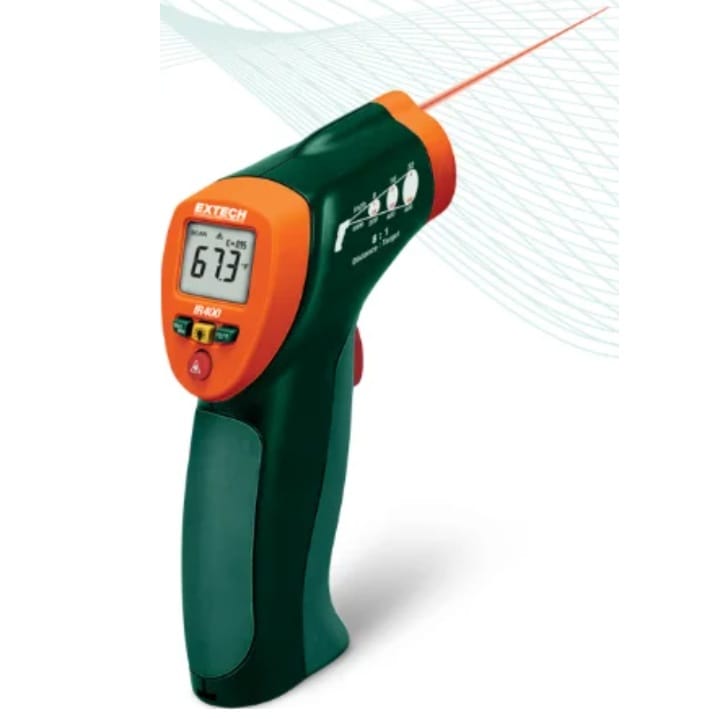
Extech IR400: Mini IR Thermometer
Compact 8:1 instrument for HVAC, plumbing and general facilities work
The IR400 is the sensible choice where infrared is a convenience rather than a core measurement — checking a radiator, a supply grille, a hot water line or a fridge shelf. Its fixed 0.95 emissivity is not a limitation for that work, because it matches roughly 90% of the surfaces such jobs involve: painted metal, plastic, rubber, concrete, brick, fabric and water. The 8:1 optics mean you measure from close in, typically under a metre, which is how these checks are done anyway. Backlighting makes it usable in a dark plant room or ceiling void, where a lot of this work actually happens. It is also the closest current equivalent to the discontinued IR100.
- Temperature range: −20 to 332 °C (−4 to 630 °F)
- 8:1 distance-to-spot ratio with single laser pointer
- Fixed 0.95 emissivity covers approximately 90% of surface applications
- Backlit display for low-light plant rooms and ceiling voids
- 0.1 ° resolution; supplied with 9 V battery and case

Extech VIR50: Dual Laser IR Video Thermometer
2.2″ colour TFT display and built-in camera — the reading and the evidence together
The VIR50 is what to reach for when the reading has to be defensible after the fact. A built-in VGA camera writes JPEG images and 3GP video to microSD alongside the measurement, so an inspection report shows the hot terminal rather than describing it — which matters when a client, an insurer or a contractor disputes a finding weeks later. Two lasers converge to mark a 1″ target spot, removing the guesswork about what was actually measured. A 150 millisecond response and colour LED bargraph make it fast enough to sweep a distribution board for trends, while the Type-K input and integrated humidity sensor cover the contact and condensation-risk measurements that infrared alone cannot.
- Built-in VGA (640 × 480) camera; JPEG image and 3GP video capture to microSD
- Dual lasers converge to indicate a 1″ (25 mm) target spot at ideal distance
- Fast 150 ms response time; colour LED bargraph for trend viewing
- Type K thermocouple input for contact measurement
- Air temperature and relative humidity measurement
- Adjustable emissivity; programmable Hi/Lo audible alarms
- MAX/MIN/AVG/DIF, USB interface, rechargeable 3.7 V battery, carrying case
Thermocouple & multi-channel thermometers
A thermocouple generates a small, predictable voltage where two dissimilar metal wires are joined; the instrument reads that voltage, compensates for the temperature at its own terminals, and converts the result to a temperature. The practical consequence is that the sensing element can be made tiny and cheap, put on the end of a long lead, and replaced when it is damaged — which is why thermocouples dominate industrial contact measurement despite being less accurate than platinum RTDs.
The instruments below differ mainly in channel count. Buy on that basis: one channel for spot checks, two for differentials across a heat exchanger or a chilled water circuit, and three or more where you are profiling a process over time rather than taking a single reading.

Extech EA11A: EasyView™ Type K Single Input Thermometer
One channel, 150 stored readings, −50 to 1300 °C
The EA11A is a single-channel Type-K thermometer built around one useful idea: the ability to manually store and recall up to 150 readings. That turns a survey round — twenty bearings, forty terminations, a row of ovens — into a job one person can do without a clipboard, recalling the values at the desk afterwards. The offset key zeroes the display against a reference so you can work in relative terms, which is often more informative than absolute temperature when you are looking for the one point that is running hot. The high-contrast display is legible in the sort of lighting a plant room actually has.
- Temperature range: −50 to 1300 °C (−58 to 1999 °F), 0.1 °/1 ° resolution
- Manually store and recall up to 150 readings
- Records Max/Min/Avg readings for later recall
- Offset key for zero function and relative measurement
- Compact rugged design with high-contrast large LCD
- Data Hold, auto power off

Extech EA10: EasyView™ Dual Input Thermometer
Two Type-K channels, −200 to 1360 °C, supplied with both probes
Two inputs change what you can measure, not just how many readings you get. With the EA10 you attach one probe upstream and one downstream and read the difference across a coil, a heat exchanger, a compressor or a chilled water circuit — the number that actually tells you whether the plant is performing. The −200 °C lower limit covers cryogenic and deep-freeze work that most handhelds cannot reach, while 1360 °C at the top handles furnace and exhaust measurements. It ships with two bead wire probes, a protective holster and a built-in stand, so it is ready to use rather than needing a probe order alongside it. Extech lists the EA10 as the replacement for the discontinued 421502.
- Dual Type-K inputs; temperature range −200 to 1360 °C (−200 to 1999 °F)
- Basic accuracy ±0.3% (+1 °C); 0.1 ° resolution
- Data hold, auto power off, low battery and overrange indication
- Supplied with two Type-K bead wire probes, protective holster and built-in stand
- Extech's listed replacement for the discontinued 421502

Extech SD200: 3-Channel Temperature Datalogger
Three Type-K channels recorded to SD card in Excel format
The SD200 is the practical entry point into multi-point recording. Three Type-K channels displayed simultaneously on a triple LCD is exactly what a cold room needs — one probe at the evaporator, one at product level, one at the door — and the readings write straight to an SD card as an Excel file, so there is no proprietary software to install or licence to maintain. Sampling from 5 seconds to 10 minutes covers both a fast commissioning run and a fortnight of unattended monitoring. Because it ships with a mains adaptor and a mounting bracket, it is genuinely intended to be left installed rather than carried, which is the difference between a logger you use and one that stays in the cupboard.
- Triple LCD displays three Type-K temperature channels simultaneously
- Records to SD card in Excel format — no proprietary software required
- Selectable sampling rate: 5, 10, 30, 60, 120, 300, 600 seconds or Auto
- Supplied with six AAA batteries, 2 GB SD card and universal AC adaptor
- Includes three Type-K bead wire probes and mounting bracket

Extech SDL200: 4-Channel Datalogging Thermometer
Six thermocouple types plus two Pt100 RTD channels, logged to SD card
The SDL200 is the instrument for a site that has not standardised on one sensor. It accepts J, K, E, T, R and S thermocouples across four channels and, uniquely in this range, two Pt100 RTD channels — so existing platinum sensors in a process line can be read without buying a second instrument. The differential T1−T2 display gives you the temperature drop across a component directly, without arithmetic. Capacity is the other reason it gets specified: 20 million readings on a 2 GB SD card, with sampling from 1 second to 1 hour, will record a heat-treatment profile at high resolution or a season of ambient data at low. Supplied in a hard case with four Type-K probes.
- 4-channel datalogging with six thermocouple types (J, K, E, T, R, S)
- 2-channel datalogging with Pt100 (100 Ω) RTD probes
- Displays T1, T2, T3, T4 or differential T1−T2
- Stores 99 readings manually and up to 20 million readings via 2 GB SD card
- Records with real date and time stamp; sampling 1 to 3600 seconds
- Offset adjustment for relative measurement; Min/Max, Data Hold, auto power off
- Built-in PC interface; supplied with four Type-K probes, SD card and hard case

Extech TM500: 12-Channel Datalogging Thermometer
Twelve simultaneous channels for oven surveys and heat-treatment profiling
Twelve channels is a different category of work. A single-point reading tells you a temperature; twelve tell you a distribution — which corner of an oven runs cold, where a curing profile lags, whether a distribution board has one termination out of line with its neighbours. The TM500 records all twelve simultaneously to SD card in Excel format, displaying channels 1–8 or 9–12 on screen, and accepts all six thermocouple types so a mixed installation can be surveyed as it stands. It arrives complete with twelve Type-K bead wire probes and a hard carrying case, which matters: sourcing twelve matched probes separately is both expensive and slow.
- 12 channels recorded simultaneously to SD card in Excel format
- Six thermocouple types supported: J, K, E, T, R, S
- Displays CH1–CH8 or CH9–CH12 on screen
- Type J range −100 to 1150 °C; Type E range −100 to 900 °C; 0.1 ° resolution
- Basic accuracy ±0.4% of reading (+1 °C)
- Supplied with 8 AA batteries, twelve Type-K probes, SD card and hard case
Stem, pocket & food thermometers
Stem thermometers put the sensor at the tip of a rigid stainless probe, which is inserted directly into what is being measured. For liquids, pastes, semi-solid foods and soft materials this is the only honest way to get a temperature, because the surface reading an infrared thermometer would give you can differ from the core by tens of degrees. The models below are sealed for washing down and sized to live in a pocket, since a food thermometer that lives in a drawer does not get used.

Extech 39240: Waterproof Stem Thermometer
Pocket thermometer with sealed 70 mm stainless stem, −40 to 200 °C
The 39240 covers the everyday penetration measurement: into a stockpot, a fridge shelf, a compost heap, a bag of chilled produce, a bucket of dosing solution. Being genuinely waterproof means it survives the sink and the wash-down that a food or laboratory environment subjects it to, which is the usual cause of death for pocket thermometers. Max/Min recall lets you leave it in place during a process and read the extremes afterwards rather than watching it. At 0.1 ° resolution and ±1 °C accuracy it is precise enough for cold-chain spot checks against the 5 °C threshold.
- 2.75″ (70 mm) stainless steel stem
- Temperature range: −40 to 200 °C (−40 to 392 °F)
- MAX/MIN recall of high and low temperatures
- ±1 °C accuracy, 0.1 °/1 ° resolution
- Data Hold and auto power off; waterproof housing
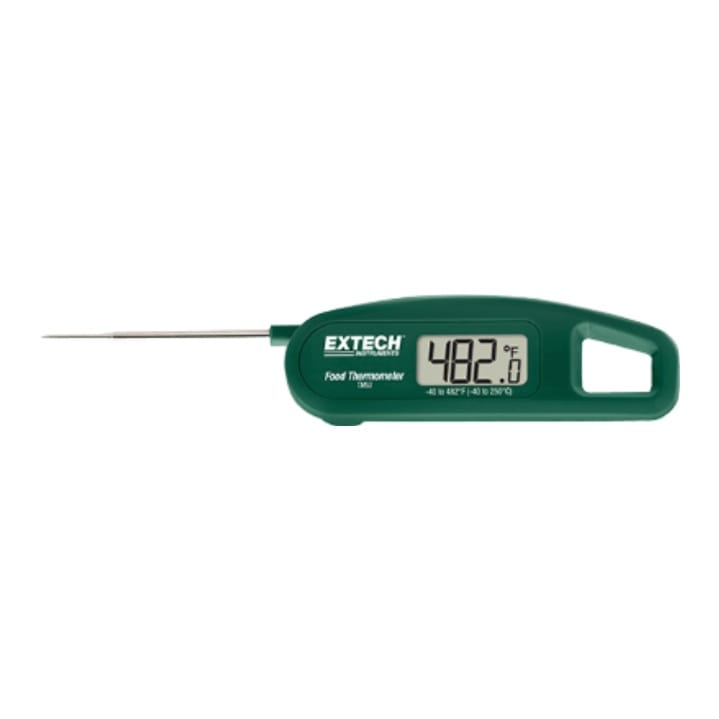
Extech TM55: Pocket Fold-Up Food Thermometer, NSF Certified
NSF certified for food contact, ~4 second response, magnetic fridge mount
The TM55 is the model to specify where the probe enters food that will be sold. NSF certification is the difference between demonstrating compliance and arguing about it, and for a restaurant, butchery, bakery or catering operation being inspected under R638 that is the whole point. Response of roughly four seconds in moving liquids means the reading settles while the lid is off rather than after, which keeps the check practical during service. The probe folds into the body so it survives a pocket, and the magnetised strip keeps it on the fridge door where staff will actually reach for it. ±0.5 °C accuracy across the critical −20 to 150 °C band comfortably resolves the 5 °C and 65 °C control points.
- NSF certified for measuring liquids, pastes and semi-solid food
- Temperature range: −40 to 250 °C (−40 to 482 °F)
- ±0.5 °C accuracy from −20 to 150 °C; 0.1 ° resolution
- Response time approximately 4 seconds in moving liquids; 2 readings per second
- 61 mm (2.4″) stainless steel fold-up probe
- Built-in magnetised strip for fridge mounting; CR2032 battery included

Extech 401014: Big Digit Indoor/Outdoor Thermometer
25 mm digits, simultaneous indoor and outdoor display, Min/Max memory
The 401014 is a fixed indicator rather than a test instrument, and it earns its place wherever a temperature has to be readable across a room at a glance — a greenhouse, a workshop, a store room, a reception, a nursery. Showing indoor and outdoor simultaneously answers the question that actually gets asked, which is not what the temperature is but how much it differs inside and out. The Min/Max memory turns it into a passive record of overnight extremes, which for a grower or a storekeeper is often the only monitoring they need. The waterproof outdoor sensor covers −50 to 70 °C, wide enough for anywhere in Southern Africa.
- Large LCD with 1″ (25 mm) digits, readable across a room
- Simultaneous display of indoor and outdoor temperature
- Indoor range: −10 to 60 °C (14 to 140 °F)
- Outdoor range: −50 to 70 °C (−58 to 158 °F) via waterproof sensor
- Built-in memory stores Min/Max temperature readings
- ±1 °C accuracy; 0.1 ° resolution
Temperature dataloggers
A datalogger differs from a handheld thermometer in one respect that matters more than any specification: it produces a record without anyone present. Left in a cold room, a vaccine fridge, a shipping container or a curing enclosure, it captures a timestamped series that can be handed to an auditor, an insurer or a client. Where a handheld reading is a claim, a logger file is evidence.
Choose between USB and SD-card logging on how the data will be retrieved. USB loggers plug directly into a PC and generate the report themselves; SD-card instruments write an Excel file you can pull without connecting anything, which suits equipment left permanently installed.

Extech TH30: USB Dual Temperature Datalogger
Air and external probe channels, 48,000 readings, exports straight to PDF or Excel
The TH30 removes the step where most logging projects fail: getting the data out. Plugged into any PC it presents itself as a drive and generates a PDF or Excel report directly, with no software installation, no driver hunt and no licence — which means the report can be produced on a client's laptop or an auditor's machine on the spot. Two channels are the reason to choose it over a single-channel logger: an internal sensor records the air while an external probe records the product or the wall, and the difference between those two is what tells you whether a cold room is genuinely holding or merely reading cold at the sensor. Password-protected log-in prevents the record being tampered with after the fact.
- Dual channel: internal air temperature plus external probe, 24,000 readings each
- Temperature range: −30 to 70 °C (−22 to 158 °F), ±0.5 °C accuracy
- Direct PDF or Excel export on plug-in — no software required
- Programmable sampling interval from 30 seconds to 2 hours
- Adjustable alarm; colour-coded smart LED reading status
- 8-location logger bookmark; 6 language options; password-protected log-in

Extech RHT30: USB Humidity/Temperature Datalogger
Humidity and temperature to 48,000 readings, PDF or Excel on plug-in
Temperature alone is only half the story in a store room, an archive, a museum, a server room or a shipping container — humidity is what determines mould growth, corrosion, condensation and product spoilage. The RHT30 logs both from a capacitive humidity sensor and an NTC thermistor in a single rugged housing with a standard USB connector, and produces the same self-generating PDF or Excel report as the TH30 with no software to install. Extech lists it as the replacement for the discontinued 42270 and 42275 dataloggers, and it does the same job with considerably less handling: no docking station, no RS-232 cable, no Windows utility to keep working across operating system upgrades.
- Logs relative humidity and temperature; up to 48,000 readings
- Relative humidity range: 0.1 to 99.9% RH
- Direct PDF or Excel export on plug-in — standard USB connector
- Programmable sampling interval from 30 seconds to 2 hours
- Adjustable alarm; colour-coded smart LED status; 8-location bookmark
- Password-protected security log-in; 6 language options
- Extech's listed replacement for the discontinued 42270 and 42275

Extech SDL500: Hygro-Thermometer/Datalogger
Humidity, temperature, dew point and wet bulb, plus a Type K/J input
The SDL500 is the instrument for condensation and comfort work, because it calculates the two values that actually drive those decisions: dew point and wet bulb. Dew point tells you the surface temperature at which moisture will form — the number that governs whether a chilled pipe will sweat, a coating will fail, or a cold-store door will ice. Wet bulb underpins evaporative cooling and drying calculations. Everything writes to SD card in Excel format for later analysis, and a Type K/J thermocouple input lets the same instrument take a high-temperature contact reading on a duct or a coil without swapping tools. Supplied in a carrying case with the humidity/temperature probe.
- Measures relative humidity, temperature, dew point and wet bulb
- Type K/J thermocouple input for high-temperature contact measurement
- Records to SD card in Excel format; adjustable sampling rate
- Stores 99 readings manually and up to 20 million readings via 2 GB SD card
- Large backlit dual LCD; Record/Recall MIN and MAX, Data Hold, auto power off
- Built-in PC interface; supplied with SD card, carrying case and RH/temperature probe
Emissivity and spot size: getting infrared readings right
Almost every incorrect infrared reading comes down to one of two errors, and both are avoidable.
Spot size — the target must fill the spot
Distance-to-spot ratio tells you how large the measured circle becomes as you move away from the target. If that circle is bigger than the object you are aiming at, the instrument averages the object with whatever is behind it, and a hot target will read low. The fix is either to step closer or to use higher-ratio optics.
← Scroll to see full table →
| Distance-to-spot ratio | Spot at 0.5 m | Spot at 1 m | Spot at 2 m | Extech models |
|---|---|---|---|---|
| 8:1 | 63 mm | 125 mm | 250 mm | IR400 |
| 12:1 | 42 mm | 83 mm | 167 mm | IR320, IR267, 42510A |
| 50:1 | 10 mm | 20 mm | 40 mm | 42545 |
Read the table as a rule of thumb: to measure a 40 mm terminal lug from 2 metres away you need 50:1 optics. To measure the same lug with an 8:1 instrument you must be within about 300 mm of it — which may be inside an arc-flash boundary you should not be crossing.
Emissivity — how much radiation the surface actually emits
Emissivity is the fraction of thermal radiation a surface emits compared with a perfect emitter, on a scale of 0 to 1. Most non-metallic materials sit near 0.95, which is why fixed-emissivity instruments work well for general facilities work. Bare and polished metals sit far lower, emit very little of their own radiation, and instead reflect their surroundings — which is why an infrared thermometer set to 0.95 will read a polished aluminium busbar dramatically below its true temperature.
← Scroll to see full table →
| Surface | Typical emissivity | Practical note |
|---|---|---|
| Polished aluminium | 0.05 – 0.10 | Do not measure directly — tape or paint the target, or use a contact probe |
| Polished copper | ~0.05 | Busbar and terminations: use a Type-K surface probe such as the 881602 |
| Polished stainless steel | 0.15 – 0.20 | Set emissivity manually; readings otherwise fall well low |
| Galvanised steel | ~0.28 | Common on ducting — a frequent source of low HVAC readings |
| Oxidised copper | ~0.65 | Oxide layers raise emissivity substantially over polished metal |
| Oxidised or rusted steel | 0.80 – 0.95 | Usually safe at a default setting |
| Concrete, brick, asphalt | 0.92 – 0.95 | Reliable at fixed 0.95 — suits civil and roads work |
| Paint (non-metallic), plastic, rubber | 0.90 – 0.95 | The 90% of surfaces a fixed-emissivity instrument covers |
| Water | ~0.96 | Accurate at default settings |
| Human skin | ~0.98 | Requires a purpose-built clinical instrument, not an industrial one |
The masking tape trick. Where you cannot set emissivity — or do not trust the value — stick a patch of matt masking tape on the target, wait a minute for it to reach the same temperature, and measure the tape at an emissivity of about 0.95. A patch of flat black paint does the same job permanently on a survey point you will revisit. This costs nothing and eliminates the single largest source of infrared error.
Probes & accessories
The probe determines what a thermocouple thermometer can actually measure, and it is usually the cheapest part of the system to change. Bead wire probes respond fastest and suit air and surface work; immersion probes are sheathed for liquids; surface probes present a flat or sprung contact face to a solid; penetration probes are sharpened for solids and semi-solids; pipe clamps attach without holding. All of the following are Type-K and interchangeable across the Extech thermocouple instruments on this page.
← Scroll to see full table →
| Model | Type | Range | Best suited to |
|---|---|---|---|
| TP873 | Bead wire Type-K | −30 to 300 °C (−22 to 572 °F) | General air and surface work; fastest response of any probe type |
| TP870 | Bead wire Type-K | −40 to 250 °C (−40 to 482 °F) | HVAC duct and coil measurements at moderate temperatures |
| TP875 | Bead wire Type-K | −50 to 538 °C (−58 to 1000 °F) | Higher-temperature air and exhaust work |
| TP873-5M | Extra-long bead wire Type-K | As TP873 | Reaching into ducts, ovens and enclosures without moving the instrument |
| 871515 | General purpose Type-K | General purpose | Everyday spare — the probe to keep in the case |
| 881605 | Immersion Type-K | −200 to 700 °C (−328 to 1292 °F) | Liquids, baths, tanks; widest range in the immersion set |
| 881603 | Immersion Type-K | −50 to 700 °C (−58 to 1292 °F) | Process liquids and oil baths |
| 881602 | Surface Type-K | −40 to 500 °C (−40 to 932 °F) | Flat solid surfaces — the honest alternative to infrared on bare metal |
| 881616 | Magnetised surface Type-K | −40 to 200 °C (−40 to 392 °F) | Attaches itself to ferrous pipe and plant for hands-free logging |
| TP882 | Penetration Type-K | −46 to 538 °C (−50 to 1000 °F) | Solids, semi-solids and packed material |
| TP200 | Pipe clamp Type-K | −20 to 93 °C (−4 to 200 °F) | Chilled and domestic hot water lines; clamps and stays put |
| TP400 | High-temperature pipe clamp Type-K | −20 to 232 °C (−4 to 450 °F) | Steam, heating flow and return, refrigeration discharge lines |
| 39272 | Pocket fold-up thermometer, adjustable probe | Pocket food range | Standalone pocket check where a full instrument is not warranted |
South African applications and verification
Altitude changes your boiling-point reference
The boiling-water check is the most common way of verifying a thermometer in the field, and in South Africa it is the most commonly misapplied. Water boils at 100 °C only at sea level. Atmospheric pressure falls with altitude, and boiling point falls with it — by roughly 1 °C for every 285 metres of elevation. A thermometer checked against boiling water on the Highveld and expected to read 100 °C will appear to be reading almost 6 °C low when it is in fact perfectly accurate.
← Scroll to see full table →
| City | Approx. elevation | Approx. boiling point of water |
|---|---|---|
| Cape Town | ~25 m | ~99.9 °C |
| Durban | ~10 m | ~100.0 °C |
| Gqeberha (Port Elizabeth) | ~60 m | ~99.8 °C |
| Kimberley | ~1225 m | ~96.0 °C |
| Polokwane | ~1310 m | ~95.7 °C |
| Pretoria | ~1340 m | ~95.6 °C |
| Bloemfontein | ~1395 m | ~95.4 °C |
| Johannesburg | ~1750 m | ~94.2 °C |
Use the ice point instead where you can. A slurry of crushed ice and clean water sits at 0 °C regardless of altitude, which makes it the more reliable of the two field checks anywhere above the coast. Stir the mixture, insert the probe without touching the sides of the container, and allow the reading to settle. Neither check substitutes for traceable calibration where a quality system requires it — we also supply Extech calibrators for that work.
Cold chain and food safety under R638
Regulation R638 of 2018, made under the Foodstuffs, Cosmetics and Disinfectants Act, requires that potentially hazardous foodstuffs be held at or below 5 °C when refrigerated or at or above 65 °C when hot-held, and requires food premises to keep records demonstrating that they have done so. That second requirement is what drives the choice of instrument. A handheld thermometer gives a reading someone must transcribe; a datalogger produces a timestamped file that stands on its own. In practice a food business is usually best served by both — a TH30 or RHT30 logging the cold room continuously, and an NSF certified TM55 for the product spot checks that an inspector will ask to see performed.
Monitoring through load shedding
Scheduled outages create a specific measurement problem: the temperature excursion happens while nobody is watching, and the question afterwards is how far the product actually rose and for how long. That is a logging problem rather than a measurement one. Battery-powered USB loggers such as the TH30 and RHT30 keep recording through an outage and produce a report showing the excursion profile, which is what an insurer or a customer will want to see. Where several points matter at once — multiple cold rooms, a staging area, a vehicle bay — the SD200 logs three Type-K channels to SD card and runs on a mains adaptor with battery backup so it survives the switchover.
Other Southern African applications
In electrical maintenance, infrared inspection of distribution boards, transformers and motor terminations catches loose or corroded connections before they fail, and the 42510A or IR320 will do that work from outside the arc-flash boundary. In mining and heavy industry, the IR320's IP65 and drop rating survive conditions that destroy standard handhelds, while the 42545 covers furnace and smelter work at up to 1000 °C. In agriculture, grain and produce storage temperature is a spoilage indicator, and the SD200's multi-point logging maps a silo or store rather than sampling it. In HVAC commissioning, the SDL500's dew point calculation predicts where condensation will form on chilled water reticulation — a recurring problem in humid coastal installations in Durban and along the KwaZulu-Natal coast.
Discontinued models and current replacements
Several models that appeared in earlier Extech catalogues have now been withdrawn from production. If you are standardising on one of them, the table below shows the current equivalent. Where a replacement is listed by Extech we have said so; where the match is our own assessment based on specification, we have said that too.
← Scroll to see full table →
| Discontinued model | What it was | Current equivalent | Basis |
|---|---|---|---|
| 42270 | Temperature/Humidity Datalogger | RHT30 USB Humidity/Temperature Datalogger | Replacement listed by Extech |
| 42275 | Temperature/Humidity Datalogger Kit with PC Interface | RHT30 — USB direct, no docking station required | Replacement listed by Extech |
| 421502 | Type J/K Dual Input Thermometer with Alarm | EA10 EasyView Dual Input Thermometer | Replacement listed by Extech |
| IR100 | Mini IR Thermometer, 1:1 optics | IR400 Mini IR Thermometer | Closest current equivalent — no direct successor listed |
| 392050 | Penetration Stem Dial Thermometer | 39240 waterproof stem, or TM55 where NSF certification is needed | Closest current equivalent — no direct successor listed |
Full range comparison
← Scroll to see full table →
| Model | Type | Temperature range | Channels | Logging | Best for |
|---|---|---|---|---|---|
| IR320 | Infrared, dual laser | −20 to 650 °C | 1 (IR) | — | Wet, dusty or drop-prone sites; IP65 and 3 m drop rated |
| 42545 | Infrared, 50:1 | −50 to 1000 °C | 1 (IR) | — | Furnace, kiln and foundry work from a safe distance |
| 42510A | Infrared, 12:1 | −50 to 650 °C | 1 (IR) | — | General maintenance with full emissivity adjustment |
| IR267 | Infrared + Type-K | IR to 600 °C; contact to 1000 °C | 2 (IR + TC) | — | Contact and non-contact in one pocket instrument |
| IR400 | Infrared, 8:1 fixed ε | −20 to 332 °C | 1 (IR) | — | HVAC, plumbing and facilities spot checks |
| VIR50 | Infrared video + Type-K | High-range IR; Type-K contact | 2 (IR + TC) | Image / video to microSD | Inspection reporting where the reading must be documented |
| EA11A | Thermocouple, Type K | −50 to 1300 °C | 1 | 150 manual readings | Survey rounds without a clipboard |
| EA10 | Thermocouple, Type K | −200 to 1360 °C | 2 | — | Differential measurement across coils and exchangers |
| SD200 | Thermocouple, Type K | Type-K range | 3 | SD card, Excel | Cold room monitoring left permanently installed |
| SDL200 | Thermocouple + Pt100 RTD | Per thermocouple type | 4 TC + 2 RTD | SD card, Excel | Mixed-sensor sites and high-resolution process profiling |
| TM500 | Thermocouple, 6 types | To 1150 °C (Type J) | 12 | SD card, Excel | Oven surveys and heat-treatment distribution mapping |
| 39240 | Digital stem, waterproof | −40 to 200 °C | 1 | Max/Min recall | Everyday penetration and cold-chain spot checks |
| TM55 | Digital stem, NSF certified | −40 to 250 °C | 1 | — | Food premises inspected under R638 |
| 401014 | Indoor/outdoor indicator | Indoor −10 to 60 °C; outdoor −50 to 70 °C | 2 | Min/Max memory | Fixed display in stores, greenhouses and workshops |
| TH30 | USB datalogger | −30 to 70 °C | 2 (air + probe) | USB, PDF/Excel direct | Cold chain evidence with no software required |
| RHT30 | USB datalogger, RH + temp | 0.1 to 99.9% RH | 2 (RH + temp) | USB, PDF/Excel direct | Stores, archives, containers and server rooms |
| SDL500 | Hygro-thermometer + Type K/J | Per probe and thermocouple | RH, temp, dew point, wet bulb | SD card, Excel | Condensation risk and psychrometric analysis |
Frequently asked questions
What is the difference between an infrared thermometer and a thermocouple thermometer?
An infrared thermometer measures the thermal radiation leaving a surface and reports a surface temperature without touching anything. That makes it fast, safe on live or moving equipment, and completely dependent on knowing the emissivity of the surface. A thermocouple thermometer measures the small voltage generated where two dissimilar metals meet, so the probe must physically touch or be immersed in whatever is being measured.
Use infrared when the target is hot, energised, rotating or out of reach. Use a thermocouple when you need the temperature inside a liquid, a duct, a food product or a bearing housing rather than just the outside skin of it. The IR267 and VIR50 carry both sensor types in one instrument.
What does a 12:1 or 50:1 distance-to-spot ratio mean?
Distance-to-spot ratio describes how the measured circle grows as you step back. At 12:1 the instrument averages a spot one twelfth the size of the distance to the target, so at 2 metres it reads a circle of roughly 167 mm. At 50:1 the same 2 metre standoff reads a circle of only 40 mm.
The rule that matters in practice is that the target must completely fill the spot. If the spot is larger than the object, the reading blends the object with whatever is behind it, and a hot target reads low. High ratios such as the 50:1 on the 42545 exist so small hot components can be measured from a safe distance.
Why does my infrared thermometer read shiny metal incorrectly?
Polished and bare metals have very low emissivity, often between 0.05 and 0.20. They emit very little of their own thermal radiation and instead reflect the radiation of everything around them, so an instrument set to a typical 0.95 will read a polished aluminium busbar far below its true temperature.
There are two fixes. Use an instrument with adjustable emissivity — the 42510A, 42545, IR320, IR267 or VIR50 — and set the correct value. Or apply a patch of matt masking tape or flat black paint, let it reach thermal equilibrium, and measure that patch at about 0.95. For critical work on bare metal, a contact Type-K surface probe such as the 881602 is more reliable than any infrared reading.
How do I check a thermometer is still accurate without sending it away?
Two field checks catch most drift. The ice-point check is the more useful: fill a container with crushed ice, top it with clean water, stir, and insert the probe without touching the sides. It should read 0 °C within the instrument's stated accuracy, and this reference does not change with altitude.
The boiling-point check does change with altitude, which matters in South Africa — water boils near 100 °C at the coast but only around 94 °C on the Highveld. Use the altitude table above rather than assuming 100 °C. Neither check replaces traceable calibration where a quality system requires it.
Which thermocouple type should I use — J, K, E, T, R or S?
Type K is the default for general industrial work: roughly −200 to 1372 °C, with inexpensive and widely available probes. Type J suits older equipment and reducing atmospheres up to about 750 °C in practice. Type T is the choice for cold work and food, holding good accuracy down to −250 °C. Type E gives the highest output per degree, which helps when resolving small differences.
Types R and S are platinum-rhodium and are used above 1000 °C in furnaces and kilns where base-metal thermocouples degrade. The SDL200 and TM500 accept all six types, so one instrument covers a mixed site.
What temperature must refrigerated food be kept at in South Africa?
Regulation R638 of 2018 under the Foodstuffs, Cosmetics and Disinfectants Act requires potentially hazardous foodstuffs to be held at or below 5 °C when refrigerated, or at or above 65 °C when hot-held, and premises are required to keep records demonstrating it.
That record-keeping requirement is why an SD card or USB datalogger such as the TH30, RHT30 or SD200 is usually more useful to a food business than a handheld reading: it produces a timestamped file rather than a manual logbook entry. An NSF certified probe thermometer such as the TM55 covers the spot checks on the product itself.
Which Extech thermometer is best for monitoring cold chain through load shedding?
For unattended monitoring through scheduled outages you want a logger that runs on its own battery, timestamps every reading, and produces a file you can hand to an auditor or insurer. The TH30 records both an internal air channel and an external probe channel to 48,000 readings and exports directly to PDF or Excel when plugged into a PC — useful in a cold room where you want both air and product temperature. The RHT30 does the same for temperature and humidity.
Where several points matter at once, such as multiple cold rooms or a delivery staging area, the SD200 logs three Type-K channels to SD card and runs on an AC adaptor.
Do you still supply the Extech 42270, 42275, 421502, 392050 or IR100?
These models have been withdrawn from the Extech catalogue and are no longer in production. Extech lists the RHT30 as the replacement for the 42270 and 42275, and the EA10 as the replacement for the 421502. The IR100 has been removed from the range, with the IR400 the closest current equivalent. The 392050 penetration stem dial thermometer has no direct successor; the 39240 or the NSF certified TM55 cover the same penetration measurements digitally.
See the discontinued models table above, or email sales@ecotao.co.za if you need help matching a replacement to an existing installation.
Can an infrared thermometer measure body temperature?
Not reliably. The instruments on this page are industrial infrared thermometers, calibrated and specified for surface measurement across wide temperature ranges, not for the narrow band and tight accuracy that clinical measurement requires. Human skin also sits at roughly 0.98 emissivity, and readings are strongly affected by ambient conditions, perspiration and measurement site.
For human temperature screening, see our separate infrared body thermometer range, which covers purpose-built non-contact instruments for that application.
What is the difference between the SD200, SDL200 and TM500?
They are the same idea at three scales. The SD200 records three Type-K channels to SD card and is the sensible choice for monitoring a single space such as a cold room. The SDL200 adds a fourth thermocouple channel, support for all six thermocouple types, two Pt100 RTD channels and a differential T1−T2 display, which makes it the choice where a site has mixed sensor types or where you need the temperature difference directly. The TM500 records twelve channels simultaneously and exists for distribution work — oven surveys, heat-treatment profiling, mapping a large enclosure — where the pattern across many points is the result you are after.
Extech thermometers supplied across South Africa
Not sure which model suits your application? Tell us what you need to measure, how hot it gets, and whether you need a record — we will point you at the right instrument.
Head Office +27 21 911 5835 · Zak 086 142 8716 · Zaid 082 390 3989
sales@ecotao.co.za · aqua@ecotao.co.za
39 Olienhout Avenue, Plattekloof, Cape Town · Delivery throughout South Africa, Namibia, Botswana, Zimbabwe, Mozambique, Lesotho and Eswatini