
Laboratory Cooling Baths
A laboratory cooling bath is an insulated, temperature-controlled stainless steel tank used to hold a liquid medium at a precise low temperature — from -20°C up to +100°C — for sample cooling, digestion research, and circulating temperature-controlled fluid to external process equipment. Ecotao supplies 304 stainless steel cooling baths with digital PID electronic control, PT100 sensing, and a built-in circulating pump for both internal and external use, available in 10 litre and 20 litre capacities.
Key features
PID electronic control
Digital indication of both setpoint and actual process value, for precise, repeatable temperature control rather than a single analogue dial.
PT100 temperature sensor
High-accuracy platinum resistance sensing holds temperature variation at a given point to within ±0.5°C at 25°C ambient.
Internal & external pumping
A built-in circulating pump, rated at approximately 6 L/min at 1m head, can keep the bath medium uniform internally, or pump it out to jacketed reactors, condensers or other equipment.
304 stainless steel tank
Corrosion-resistant construction with a removable lid and a reliable refrigeration system built around a high-quality compressor.
-20°C to +100°C range
One bath covers deep cooling and near-boiling work, removing the need for separate hot and cold equipment on the bench.
Solid state control relay
Rapid response switching for optimum reliability under continuous lab use, in place of a mechanical relay prone to wear.
Cooling bath models
Both models share the same -20°C to +100°C range, PID control, PT100 sensor and ≈6 L/min circulating pump. They differ in tank capacity, refrigeration wattage and footprint — see the comparison table below for full specifications.

10L Cooling Bath
10 Litre · 1000 Watt- Temperature range-20°C to +100°C
- Sensor / controlPT100, PID digital
- Circulating pump≈6 L/min @ 1m head
- Opening dimensions200 x 150 mm
- Weight (crated)30 kg
- Lead time2–3 weeks
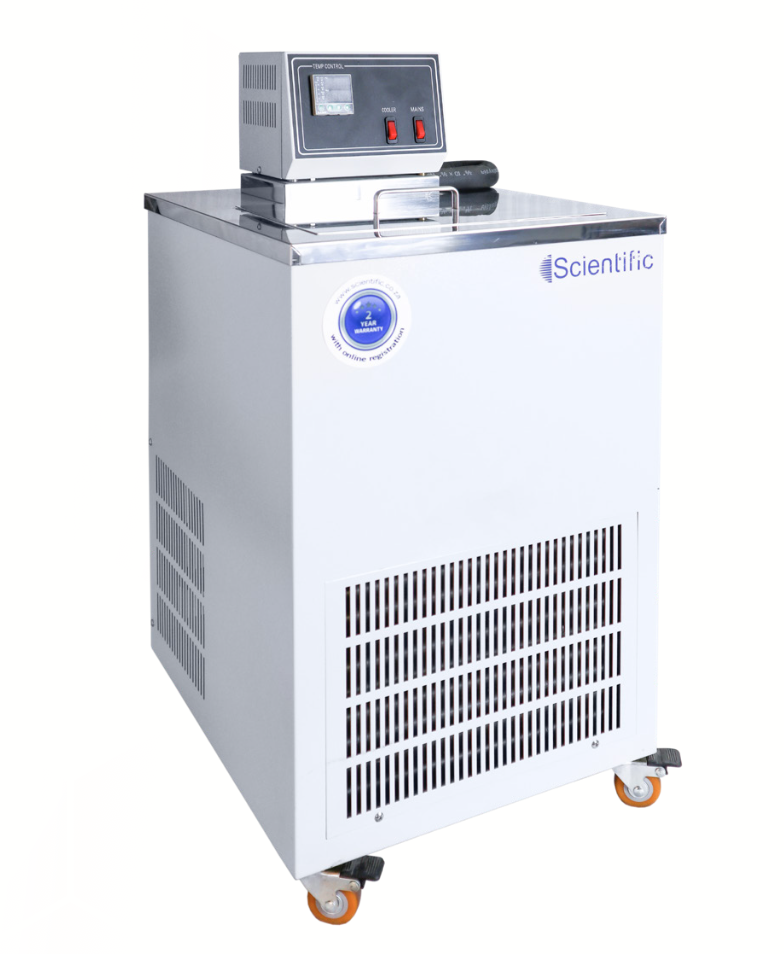
20L Cooling Bath
20 Litre · 1500 Watt- Temperature range-20°C to +100°C
- Sensor / controlPT100, PID digital
- Circulating pump≈6 L/min @ 1m head
- Opening dimensions250 x 180 mm
- Weight (crated)40 kg · fitted with castors
- Lead time2–3 weeks
10L vs 20L: side-by-side comparison
← Scroll to see full table →
| Specification | 10L Cooling Bath (SCI170) | 20L Cooling Bath (SCI175) |
|---|---|---|
| Tank capacity | 10 litres | 20 litres |
| Tank material | 304 stainless steel | 304 stainless steel |
| Refrigeration power | 1000 watt | 1500 watt |
| Temperature range | -20°C to +100°C | -20°C to +100°C |
| Temperature stability (at 25°C ambient) | ±0.5°C | ±0.5°C |
| Sensor | PT100 | PT100 |
| Control | Electronic PID, digital setpoint & process display | Electronic PID, digital setpoint & process display |
| Internal/external circulating pump | ≈6 L/min @ 1m head | ≈6 L/min @ 1m head |
| Opening dimensions | 200 x 150 mm | 250 x 180 mm |
| Weight (crated) | 30 kg | 40 kg |
| Crate dimensions | 38 x 57 x 74 cm | 57 x 60 x 87 cm |
| Mobility | — | Fitted with castors |
| Lid | Removable | Removable |
| Lead time | 2–3 weeks | 2–3 weeks |
How to choose between the 10L and 20L bath
Both models share the same ≈6 L/min circulating pump and temperature range, so the choice comes down to tank capacity, recovery power and how the bath will be used day to day:
Sample volume & batch size
If you're cooling or heating small vessels one at a time, the 10L bath's tank is usually enough. Larger jacketed vessels, multiple simultaneous samples, or a bigger circulating loop favour the 20L tank.
Recovery time under load
The 20L bath's 1500 watt refrigeration system recovers setpoint faster after a large or frequently-opened vessel disturbs the bath temperature, which matters for repeated-cycle protocols.
Vessel size at the opening
The 20L bath's larger 250 x 180mm opening accepts bulkier flasks and vessels than the 10L bath's 200 x 150mm opening.
Bench space & mobility
The 10L unit has the smaller footprint. The 20L unit is fitted with castors, so it suits a shared lab where the bath needs to move between benches or process lines.
Applications
Digestion research and sample preparation: Ecotao cooling baths are widely used to hold digestion vessels and reaction flasks at a stable low temperature during multi-hour protocols, where a fluctuating temperature would invalidate results.
External circulation to process equipment: rather than only cooling what's inside the tank, the internal pump can be routed out to jacketed reactors, rotary evaporators, condensers or viscometers that need a steady flow of temperature-controlled liquid — the bath becomes the temperature source for a separate piece of equipment, not just a standalone vessel.
Cold incubation and low-temperature experimentation: the -20°C floor supports work that needs sustained sub-zero conditions without the ramp-up and defrost cycles of a chest freezer, while the PID controller holds the exact setpoint rather than cycling around it.
Pilot-scale process cooling: the 20L model's greater tank capacity and higher refrigeration wattage make it suitable for small pilot loops where a 10L tank would run dry or fall behind on recovery time.
A note for South African labs: ambient temperature affects performance
All performance specifications above — including the ±0.5°C stability figure — assume a 25°C ambient environment. In un-air-conditioned labs on the Highveld in summer, or in poorly ventilated plant rooms, ambient temperatures regularly exceed this, and the refrigeration system has to work harder to reach and hold low setpoints, which can extend pull-down time to the lowest temperatures. Siting the bath in a ventilated, climate-controlled room keeps its real-world performance closer to the rated specification. Ecotao's Cape Town-based team can advise on siting for your specific lab environment before you order.
Frequently asked questions
What is a laboratory cooling bath used for?
It holds a liquid medium at a precise low temperature for sample cooling, digestion research, and circulating temperature-controlled fluid to external process equipment such as reactors and condensers.
What is the difference between the 10L and 20L cooling bath?
The 10L bath (SCI170) has a 1000 watt system and a 200 x 150mm opening. The 20L bath (SCI175) has a 1500 watt system, a larger 250 x 180mm opening, and is fitted with castors. Both share the same -20°C to +100°C range, PT100/PID control, and a circulating pump rated at ≈6 L/min at 1m head.
What temperature range can an Ecotao cooling bath reach?
-20°C to +100°C, controlled electronically via PID with digital indication of setpoint and process value. At 25°C ambient, variation at a point is within ±0.5°C.
Can a cooling bath pump fluid to external equipment?
Yes. The built-in circulating pump, rated at ≈6 L/min at 1m head on both models, can run internally or externally, feeding temperature-controlled medium to reactors, condensers or other process equipment.
How does ambient temperature in South Africa affect performance?
Specifications assume 25°C ambient. Warmer or poorly ventilated environments make the refrigeration system work harder and can lengthen pull-down time to the lowest setpoints — siting the unit in a ventilated, climate-controlled space helps.
What is the lead time on Ecotao cooling baths?
Typically 2–3 weeks. Contact Ecotao to confirm current stock for the 10L and 20L models.
Need help choosing, or ready to order?
Speak to the Ecotao team about stock, lead time and application fit for your lab.
- Head Office: +27 21 911 5835
- Zak: 086 142 8716
- Zaid: 082 390 3989
- Email: sales@ecotao.co.za