
Tachometers and stroboscopes are one part of the wider Extech test and measurement range supplied by Ecotao.
View the Full Ecotao Extech Range Multimeters · Clamp Meters · Thermal & IR · Environmental · Electrical Testers & moreExtech Tachometers & Stroboscopes
Rotational speed measurement instruments for maintenance, production and quality control teams — supplied across South Africa and neighbouring countries from our Cape Town base.
A tachometer is an instrument that measures the rotational speed of a shaft, disc, fan or wheel and displays it in revolutions per minute (rpm). It does this by counting rotation events over an accurately timed interval, either by touching the rotating part with a contact tip or wheel, or by detecting a reflective marker optically from a distance.
A stroboscope solves a different problem. It fires a xenon or LED flash lamp at an operator-adjustable rate, measured in flashes per minute (FPM). When the flash rate is synchronised with the rotation rate of the machine, each flash illuminates the part in the same angular position, and the part appears to stand perfectly still while it continues to run at full speed. That frozen image lets an inspector examine a moving component — a fan blade, a printing cylinder, a textile spindle, a coupling — without stopping the line. Because the synchronised flash rate equals the rotation rate, a stroboscope also functions as a non-contact tachometer.
Use a tachometer when you need a number
Verifying a motor against its nameplate rpm, commissioning a variable speed drive, checking pump or fan speed after a belt change, confirming conveyor belt speed for a weightometer calibration, or logging shaft speed as part of a condition monitoring route.
Use a stroboscope when you need to see
Inspecting a fan or impeller for cracks and fouling while it runs, checking print registration and web behaviour on a press, watching a coupling or belt for wobble and slip, or examining vibration behaviour on rotating equipment that cannot be stopped for inspection.
The four measurement methods, and when each one is right
Every instrument on this page uses one or more of four methods. Choosing the wrong one is the most common reason a tachometer purchase disappoints, so it is worth understanding the trade-off before comparing models.
Contact — shaft tip
A rubber cone or flat tip is pressed into the centre of an exposed shaft end. Works on any surface finish, in poor light, and needs no preparation of the machine. Requires safe physical access to the shaft end, which rules it out on guarded or high-speed equipment.
Contact — surface wheel
A knurled wheel is held against a moving surface and reads linear speed directly in m/min, ft/min or yd/min rather than rpm. This is the correct method for conveyor belts, web and film lines, wire drawing and paper machines, where the number you actually want is belt speed, not shaft speed.
Non-contact — photo and laser
A strip of retro-reflective tape is applied to the rotating part and the instrument counts light pulses returned from the beam. Safe on guarded, hot or fast machines, and the only practical option where the shaft end is inaccessible. Visible-light models work within about 150 mm; laser models reach 500 mm to 2 m.
Stroboscopic
The flash rate is tuned until the part appears stationary, at which point the displayed FPM equals the rotation rate. Needs no tape and no contact at all, and uniquely allows visual inspection of the part while it is running. Requires an operator to judge synchronisation, and can be fooled by harmonics if the first stationary image is accepted without checking.
A practical warning about stroboscope harmonics. A rotating part also appears frozen at exact sub-multiples of its true speed — half, a third, a quarter. An operator who stops at the first stationary image can therefore record a speed that is a whole-number fraction of the real one. The standard technique is to start at the highest flash rate and reduce it: the first stationary image encountered on the way down, with a single feature visible rather than a repeated pattern, is the true rotational speed. On a symmetrical part such as a four-blade fan, mark one blade with tape or chalk so a false image is immediately obvious.
How to choose the right tachometer
Work through these five questions in order. In our experience the first two eliminate most of the range before rpm specifications are even considered.
- Can you safely touch the shaft end? If yes, a contact instrument such as the 461750 or 461891 is the simplest and cheapest answer, and it needs no consumables. If no — guards, hot surfaces, high speed, awkward access — you need a non-contact model and you can stop considering contact-only units.
- How far will you be standing from the target? This is the specification most often overlooked. The 461895 uses visible light and needs to be within roughly 150 mm. The 461920, RPM33 and RPM250W are laser guided to about 500 mm. The RPM10 and 461995 reach 2 m, which is what you want when a fixed guard or walkway keeps you back from the machine.
- Do you need rpm, or linear surface speed, or both? Belt, web and wire applications need the surface wheel accessory, which comes as standard on the 461750, 461891, 461895, 461995 and RPM10. Laser-only models such as the 461920 and RPM250W cannot measure linear speed.
- Do you need to see the part, or only measure it? Crack detection, print registration, spindle and coupling inspection all require a stroboscope: the 461825 for a portable battery unit, or the 461830 for a fixed mains-powered installation on a production line.
- Does the reading need to be recorded? If measurements feed a condition monitoring record, the RPM33 stores ten data sets with maximum, minimum and average values, the RPM250W streams live readings to the free ExView app on iOS and Android, and the TA503C kit logs 2,000 records for USB download.
Extech tachometers — contact models

Extech 461750PocketTach® Mini Contact Tachometer
A shirt-pocket contact tachometer for spot checks where an instrument has to be carried all day and used one-handed. The protective finger guard is a genuine safety feature rather than a styling detail: it keeps fingers clear of the shaft while the cone tip is seated. Interchangeable surface wheels convert it to a linear speed meter for belt and web work.
- Contact rpm10 to 20,000 rpm
- Surface speed1 to 1,999.9 m/min
- Accuracy±(0.1% rdg + 2 digits)
- Power9 V battery
Choose it when: shaft ends are accessible, budget matters, and the instrument needs to live in a pocket rather than a case.

Extech 461891High Precision Contact Tachometer
The precision contact instrument in the range, resolving to 0.1 rpm at 0.05% of reading and reading from as low as 0.5 rpm — slow enough for gearbox output shafts, mixer drives and geared agitators that a 10 rpm minimum instrument simply cannot see. Supplied with cone tip, flat tip and a spare surface wheel, so the consumable wear item is covered from day one.
- Contact rpm0.5 to 20,000 rpm
- Resolution0.1 rpm
- Surface speed0.05 to 1,999.9 m/min
- Accuracy±0.05% of reading
Choose it when: you measure slow shafts, or when a QC procedure demands tighter accuracy than a general-purpose tachometer provides.
Extech tachometers — non-contact laser models

Extech 461920Mini Laser Photo Tachometer Counter
A compact laser tachometer for safe measurement on running machinery, reading a strip of reflective tape from up to 0.5 m away. Beyond rpm it also works as a totaliser, counting up to 99,999 revolutions — useful for batch counting, run-in cycles and any test where the number of turns rather than the rate is what has to be recorded. The double-moulded housing survives being dropped in a plant room.
- Non-contact rpm2 to 99,999 rpm
- Counter1 to 99,999 revolutions
- Range to targetup to 0.5 m
- Accuracy±0.05%
Choose it when: you need non-contact rpm at a sensible price, and revolution counting is a useful bonus.

Extech RPM250WLaser Tachometer with ExView® App Connectivity
The connected instrument in the range. Readings appear on the backlit LCD as usual, but are also streamed over Bluetooth to the free ExView app on iOS and Android at up to 90 m line of sight, where they can be trended, alarmed on and exported as a report. That matters for two practical reasons on a South African plant: the operator can stand clear of the machine while a colleague reads the phone, and the measurement leaves site as a dated record rather than a number written on a clipboard.
- Non-contact rpm10 to 99,999 rpm
- Measuring distance50 to 500 mm
- Measuring angle±30° from perpendicular
- Accuracy±0.04%
- WirelessBluetooth®, to 90 m LOS
Choose it when: readings must be logged, trended or reported rather than just read, or when the measurement position is awkward enough that a 30° off-axis tolerance helps.
Extech tachometers — combination contact and non-contact
Combination instruments carry both a contact tip and an optical head in one body, so a single tool covers the accessible shaft ends and the guarded ones. For a maintenance team buying one tachometer, this is almost always the right category.

Extech RPM33Combination Contact/Laser Photo Tachometer
The value entry into combination measurement: contact and laser in one instrument, with a backlit five digit display that stays readable in a dim plant room. Ten data sets are stored, each holding the measurement together with its maximum, minimum and average — enough to walk a small route and record the results afterwards without carrying a notebook. Runs from a single 9 V battery.
- Contact rpm2 to 20,000 rpm
- Non-contact rpm2 to 99,999 rpm
- Range to targetup to 500 mm
- Memory10 sets × 4 parameters
Choose it when: you want both measurement methods without paying for the longer 2 m laser reach or an integrated thermometer.
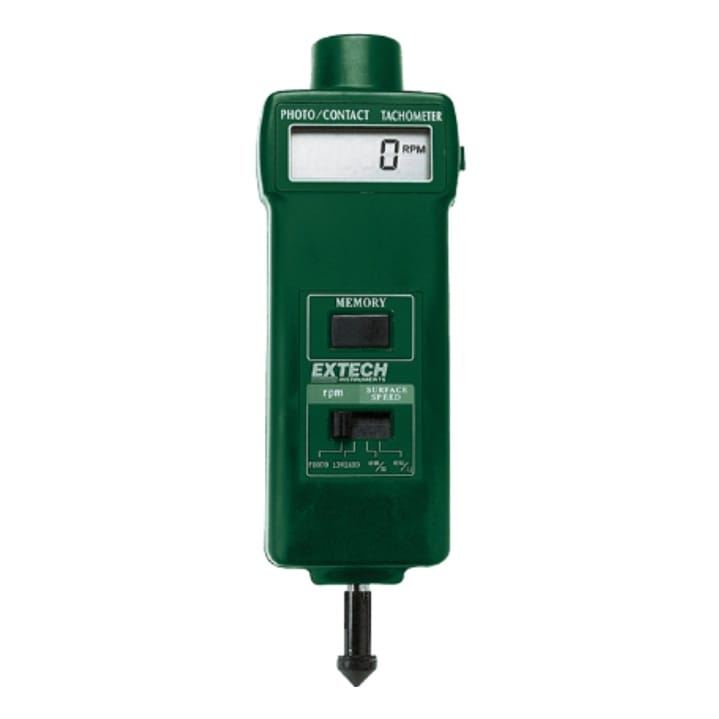
Extech 461895Combination Contact/Photo Tachometer
A visible-light combination tachometer holding 0.05% accuracy across both measurement modes. The optical head works to about 150 mm, so it suits close-quarters work at a bench or on an open machine rather than reading across a guard. Full surface wheel set is included for linear speed, making it a strong single-instrument choice for a workshop that handles both rotating and web applications.
- Contact rpm0.5 to 19,999 rpm
- Non-contact rpm5 to 99,999 rpm
- Range to targetup to 150 mm
- Surface speed0.05 to 1,999.9 m/min
Choose it when: targets are close and accessible, and you want contact, non-contact and linear surface speed in one case.

Extech 461995Combination Contact/Laser Photo Tachometer
The long-reach combination instrument. Laser guidance extends non-contact measurement to 2 m, which is the specification that matters when a fixed guard, a hot casing or a marked walkway keeps the technician away from the shaft. Contact measurement and the full surface wheel set are retained, so nothing is given up for the extra range.
- Contact rpm0.5 to 19,999 rpm
- Non-contact rpm10 to 99,999 rpm
- Range to targetup to 2 m
- Accuracy±0.05% of reading
Choose it when: guarded or hot machinery prevents you from getting within half a metre of the rotating part.

Extech RPM10Photo/Contact Tachometer with built-in InfraRed Thermometer
The most capable single instrument on this page for condition monitoring work. Alongside contact and 2 m laser rpm measurement it carries an infrared thermometer reading −20 to 315 °C, so one walk-round captures both the speed and the surface temperature of a motor, bearing housing or gearbox. Speed and temperature read together are far more diagnostic than either alone: a bearing running hot at normal speed points somewhere quite different from one running hot because the drive is over-speeding.
- Contact rpm0.5 to 20,000 rpm
- Non-contact rpm10 to 99,999 rpm
- Range to targetup to 2 m
- IR temperature−20 to 315 °C
- Surface speed0.05 to 1,999.9 m/min
Choose it when: the tachometer will be used on a preventive maintenance route and bearing or motor temperature is part of the same inspection.
Extech stroboscopes and panel instruments

Extech 461825Combination Photo Tachometer/Stroboscope
A battery-powered two-in-one instrument: a photo tachometer for the rpm number, and a stroboscope for freezing the part so it can be inspected while it runs. Coarse and fine flash rate adjustment across three ranges is what makes the strobe usable in practice — coarse to find the approximate synchronisation point, fine to lock it in without overshooting. The display reverses character direction according to the active mode, so there is no ambiguity about which reading you are looking at, and the microprocessor and quartz crystal oscillator hold the flash rate stable while you work.
- Tachometer5 to 99,999 rpm
- Flash rate100 to 100,000 FPM
- Accuracy±0.1% of reading
- Display10 mm 5 digit LCD
- Power4 × AA batteries
Choose it when: you need stroboscopic inspection anywhere on site without a mains socket — and this is also the current replacement for the discontinued 461831 mains StroboTach.

Extech 461830Digital StroboTach 115VAC, 60Hz
A mains-powered stroboscope built for sustained inspection rather than a quick spot check. Because it draws from the wall rather than a battery it delivers a brighter, more consistent flash over a 5 to 30 minute duty cycle, and the tripod mount lets it be set up permanently over a production line so an operator can watch a process continuously. A crystal-controlled time base and microcomputer LSI circuit hold the flash rate accurate across the full range.
- Flash rate100 to 10,000 FPM/rpm
- Accuracy±(0.05% rdg + 1 digit)
- Duty cycle5 to 30 minutes
- Display4 digit LED
- Supply115 VAC 60 Hz
Choose it when: a strobe stays with one line for extended inspection. South African note: this is the 115 V unit — a suitably rated step-down transformer is required on 230 V mains. Ask us to confirm supply options before ordering.

Extech 461950Panel Mount Tachometer
Where the other instruments on this page are carried to the machine, the 461950 is built into it. A 1/8 DIN panel cut-out gives a permanent rpm readout on a control panel or MCC door for a motor, fan, pump, gear drive or propeller device. Two pickup types are supported: a proximity sensor at 3 mm target distance reading to 36,000 rpm (600 Hz), or a photoelectric sensor at 10 mm reading to 6,000 rpm (100 Hz). Choose the proximity pickup for high speed and dirty environments where an optical sensor would foul.
- Proximity pickupto 36,000 rpm (600 Hz)
- Photoelectric pickupto 6,000 rpm (100 Hz)
- Panel size1/8 DIN
- Supply115/230 VAC 50/60 Hz
Choose it when: speed needs to be permanently visible to an operator rather than measured on a maintenance round. Accepts 230 V 50 Hz, so no transformer is required in South Africa.
Extech tachometer and stroboscope comparison
All specifications below are manufacturer figures for the current Extech catalogue. Where a model offers both measurement methods, both ranges are shown.
← Scroll to see full table →
| Model | Type | Contact range | Non-contact range | Measuring distance | Accuracy | Distinguishing feature |
|---|---|---|---|---|---|---|
| 461750 | Contact | 10 – 20,000 rpm | — | — | ±0.1% +2d | Pocket size, finger guard, surface wheels |
| 461891 | Contact | 0.5 – 20,000 rpm | — | — | ±0.05% | 0.1 rpm resolution, reads very slow shafts |
| 461920 | Laser | — | 2 – 99,999 rpm | 0.5 m | ±0.05% | Revolution counter to 99,999 |
| RPM250W | Laser | — | 10 – 99,999 rpm | 50 – 500 mm | ±0.04% | Bluetooth to ExView app, ±30° angle |
| RPM33 | Contact + laser | 2 – 20,000 rpm | 2 – 99,999 rpm | 0.5 m | ±0.05% +1d | 10 stored data sets, backlit display |
| 461895 | Contact + photo | 0.5 – 19,999 rpm | 5 – 99,999 rpm | 150 mm | ±0.05% | Visible light, full surface wheel set |
| 461995 | Contact + laser | 0.5 – 19,999 rpm | 10 – 99,999 rpm | 2 m | ±0.05% | Longest laser reach with contact retained |
| RPM10 | Contact + laser + IR | 0.5 – 20,000 rpm | 10 – 99,999 rpm | 2 m | ±0.05% +1d | Built-in IR thermometer, −20 to 315 °C |
| 461825 | Photo tach + strobe | — | 5 – 99,999 rpm | Strobe: line of sight | ±0.1% | 100 – 100,000 FPM strobe, battery powered |
| 461830 | Stroboscope | — | 100 – 10,000 FPM | Line of sight | ±0.05% +1d | Mains 115 VAC, tripod mount, 4 digit LED |
| 461950 | Panel mount | — | to 36,000 rpm | 3 mm / 10 mm pickup | — | 1/8 DIN permanent install, 115/230 VAC |
Also available from the Ecotao online store
Two further rotational speed instruments are stocked outside the Extech range and can be ordered directly online. Both are worth considering where data logging or battery-powered stroboscopy is the priority.

TA503CDigital Laser Non-Contact and Contact Tachometer Kit
The data-logging option. Where the Extech combination instruments store a handful of readings, the TA503C holds 2,000 records with minimum, maximum and average values, high and low alarms and USB transfer to free PC software — which makes it a practical choice for a formal condition monitoring programme or for anyone who has to produce a report rather than a reading. Colour LCD, and a complete kit with soft case, contact adapter, surface wheel, rubber cones and reflective tape.
- Non-contact rpm3 to 99,999 rpm
- Contact rpm3 to 19,999 rpm
- Memory2,000 records, USB
- Also measuresSurface speed & distance

DT-2018EBattery Powered LED Stroboscope
A dedicated battery-powered LED stroboscope for field inspection where no mains supply is available at the machine. LED flash technology avoids the lamp replacement and warm-up behaviour of xenon units, and battery operation means the instrument can be taken to a pump station, a wind pump or a remote conveyor drive rather than the machine being brought to the instrument.
- TypeLED stroboscope
- PowerBattery
- Best forField & remote inspection
Applications across South African industry
The instruments above are used in the same broad way everywhere, but the specific reason for the measurement changes with the industry — and that reason is what determines which model actually suits.
Mining, quarrying and bulk materials handling
Conveyor belt speed is the measurement that recurs most often. A weightometer computes tonnage from belt speed multiplied by belt load, so an error in assumed belt speed becomes a direct error in reported tonnage. A contact tachometer with a surface wheel — the 461750, 461891, 461895, 461995 or RPM10 — reads belt speed directly in m/min and is the standard field check against the installed speed sensor. On drive motors and gearbox output shafts behind guards, the 2 m laser reach of the 461995 or RPM10 lets the reading be taken without removing the guard, which matters both for permit-to-work reasons and for time.
Agriculture, irrigation and food processing
Irrigation pump sets, grain handling augers, milling equipment and packing line drives all depend on running at design speed. Under-speed on a centrifugal irrigation pump reduces head disproportionately — head falls with the square of speed — so a pump that seems only slightly slow can be badly short on delivery pressure. Checking actual shaft rpm against the pump curve before condemning an impeller is a five-minute measurement that regularly saves a stripdown. Slow-turning augers and mixer drives are where the 0.5 rpm minimum of the 461891 earns its keep.
Printing, packaging and textiles
This is stroboscope territory. Print registration problems, web flutter, doctor blade behaviour and textile spindle condition are all visible only while the machine runs, and only a stroboscope makes them visible. The 461825 handles this portably across a print floor; the 461830 is set up on a tripod over one line for continuous watching. The 461825's coarse and fine flash adjustment is the feature that matters here — registration faults appear as small periodic movements that are lost unless the flash rate can be trimmed precisely onto synchronisation.
HVAC, building services and facilities maintenance
Fan and pump speeds drift after belt changes, pulley swaps and drive resets, and an air handling unit running below design speed under-delivers airflow with no obvious symptom until a space fails to hold temperature. Non-contact measurement is essential here because fan shafts sit inside AHU casings behind guards. The RPM10 is a particularly efficient choice for building services rounds: it captures fan speed and motor or bearing temperature in one pass, which halves the number of instruments carried up a plant room ladder.
Manufacturing, workshops and quality control
Machine tool spindle speeds, mixer and agitator speeds, centrifuge speeds and test rig calibration all require a verified rpm figure rather than a dial setting. Where the figure feeds a quality record, the 0.05% accuracy of the 461891 or the logging capability of the TA503C is what makes the measurement defensible. Where a technician simply needs to confirm a variable speed drive is doing what the controller claims, the RPM33 or 461920 is enough.
Getting an accurate reading in practice
Instrument accuracy is rarely the limiting factor on a real measurement. These are the errors that actually show up in the field.
- Use one tape strip per revolution. Two strips on the same shaft double the reading. If a shaft already carries a reflective marking from a previous job, check for a second one before trusting the number.
- Keep the tape strip narrow. A wide strip on a slow shaft can register as two pulses as it passes through the beam. Extech supplies replacement reflective tape as the 461937 roll, which is worth stocking — tape is a consumable that gets used up marking machines.
- Mind the angle. Most laser tachometers want to be roughly perpendicular to the tape. The RPM250W tolerates up to 30° off perpendicular, which is a real advantage in cramped plant rooms where a square-on position is not available.
- Press contact tips squarely and steadily. A cone tip held at an angle, or a surface wheel held too lightly against a polished belt, will slip and under-read. Light steady pressure perpendicular to the surface is the technique.
- Check the shiny-surface trap. A polished or chrome shaft can return enough light to trigger a false pulse without any tape at all. If a non-contact reading looks impossibly high, that is usually why.
- Work down, not up, with a stroboscope. Start at the highest flash rate and reduce until the first stationary image appears. Starting low and increasing will find a harmonic first and give a reading that is a fraction of the true speed.
Frequently asked questions
What is the difference between a tachometer and a stroboscope?
A tachometer returns a number: it counts rotations over a timed interval and displays the result in revolutions per minute. A stroboscope returns a picture: it fires a flash lamp at an adjustable rate, and when that flash rate matches the rotation rate the moving part appears frozen in space.
Use a tachometer when you need a speed value to compare against a nameplate or setpoint. Use a stroboscope when you need to see the part while it is running — to inspect a fan blade for cracks, check a printing register, or watch a coupling for wobble. The Extech 461825 does both in one battery-powered instrument.
What is the difference between a contact and a non-contact tachometer?
A contact tachometer is pressed against the end of a rotating shaft using a cone or flat tip, or against a moving surface using a wheel. It works on dull, dark or wet surfaces and needs no preparation, but the shaft end must be reachable and safe to touch.
A non-contact photo or laser tachometer reads a strip of reflective tape stuck to the rotating part, measured from a distance, so it is the safer choice on guarded machines, high speed shafts and hot equipment. Combination models such as the 461995, RPM33 and 461895 carry both methods in one instrument, which is why they are the most common choice for a general maintenance toolkit.
Do I need reflective tape to use a laser tachometer?
Yes, in almost every real case. A photo or laser tachometer detects the change in reflected light as a marker passes the beam once per revolution. Machined steel, painted casings and rubber couplings do not give a reliable pulse on their own, so a short strip of retro-reflective tape is applied to the rotating part. One strip per revolution gives a direct rpm reading.
Extech supplies reflective tape with most of its non-contact models and also sells it separately as the 461937 replacement roll, which is worth keeping in the toolbox because the tape is consumed as machines are marked.
Will the Extech 461830 StroboTach work on South African 230 V mains?
Not directly. The 461830 is built for a 115 VAC 60 Hz supply, so on a South African 230 V 50 Hz socket it requires a step-down transformer of adequate rating.
The 220 VAC 50 Hz version, the Extech 461831, has been discontinued by the manufacturer, and Extech names the 461825 Combination Photo Tachometer and Stroboscope as its replacement. For most South African users the practical answer is the battery-powered 461825, which carries no mains constraint at all and can be walked to any machine on site. Contact us before ordering a mains stroboscope so the supply voltage is confirmed against your site.
How far away can an Extech laser tachometer measure from?
Measuring distance varies significantly across the range and is often the deciding specification. The 461895 uses visible light and works to about 150 mm. The 461920, RPM33 and RPM250W are laser guided to roughly 500 mm. The RPM10 and 461995 reach up to 2 m, which matters when a guard, walkway or hot surface prevents you from getting close to the shaft.
If the shaft you need to read sits behind a fixed guard, size the instrument on measuring distance first and on rpm range second — almost every model covers far more rpm range than a typical industrial drive will ever need.
How accurate are Extech tachometers?
Most of the range is specified at 0.05% of reading, which on a 1,500 rpm motor is under one revolution per minute. The RPM250W is tighter at 0.04%, and the entry level 461750 PocketTach is specified at 0.1% of reading plus 2 digits.
In practice, tachometer error is rarely the limiting factor. Poorly applied reflective tape, a tape strip wide enough to be counted twice per revolution, or a contact wheel slipping on a polished surface will each introduce far more error than the instrument specification.
Can a tachometer measure conveyor belt speed?
Yes. Contact tachometers fitted with a surface wheel read linear speed directly rather than rotational speed, which is the correct way to check a conveyor, a web line or a wire drawing machine. The 461750 covers 1 to 1,999.9 m/min, and the 461891, 461895, 461995 and RPM10 cover 0.05 to 1,999.9 m/min.
Hold the wheel against the belt surface with light steady pressure and perpendicular to the direction of travel. On mining and quarry conveyors this is the standard method for verifying belt speed against a weightometer calibration.
Which Extech tachometer should I buy for general motor and pump maintenance?
For a general maintenance toolkit, a combination contact and laser instrument covers the widest set of situations from a single purchase. The RPM33 is the value option, reading 2 to 20,000 rpm by contact and 2 to 99,999 rpm by laser to 500 mm with ten stored data sets.
The RPM10 adds a built-in infrared thermometer reading −20 to 315 °C, so one instrument checks both the speed and the bearing or housing temperature on the same walk-round — a common choice for condition monitoring routes. If your team already records readings on a phone, the RPM250W streams live rpm to the free ExView app for trending and reporting.
Are any of the Extech tachometers on this page discontinued?
No. Every Extech tachometer and stroboscope listed on this page is current in the manufacturer catalogue as at September 2026.
The one discontinued model worth knowing about is the Extech 461831, the 220 VAC 50 Hz version of the StroboTach, which is no longer manufactured and for which Extech recommends the battery-powered 461825 as the replacement. If you are replacing an older instrument, quote the model number on the label when you contact us so the closest current equivalent can be identified.
Not sure which model fits your machine?
Tell us the shaft speed range, whether the shaft end is accessible, and how far back you have to stand — that is usually enough for us to narrow the range to one or two models. Supplied across South Africa, Namibia, Botswana, Zimbabwe, Mozambique, Lesotho and Eswatini.
Email sales@ecotao.co.za Call +27 21 911 5835
- Head Office: +27 21 911 5835
- Zak: 086 142 8716
- Zaid: 082 390 3989
- sales@ecotao.co.za
- aqua@ecotao.co.za