
Extech Power Analyzers & Power Clamp Meters
Three-phase power quality analysers, datalogging power meters and true RMS power clamp meters for single-phase, 3-phase/3-wire and 3-phase/4-wire systems. Supplied across South Africa and neighbouring countries from our Cape Town base.
What a power analyzer measures, and why it is not a clamp meter
A power analyzer is an instrument that samples voltage and current on every phase simultaneously and derives the relationships between them — real power (kW), apparent power (kVA), reactive power (kVAR), power factor, phase angle, accumulated energy (kWh) and harmonic distortion. Because voltage and current are captured together rather than one after the other, the instrument can report not only how much energy a load consumes but how cleanly it consumes it.
An ordinary clamp meter answers one question at a time: how many amps are flowing right now. That is adequate for confirming a motor is drawing roughly what its nameplate says. It cannot tell you why your municipal account shows a maximum demand charge far above your metered consumption, why a transformer runs hot at two-thirds of its rated load, or why a neutral conductor is warmer than the phases feeding it. Those questions are all about the relationship between voltage and current — phase displacement, waveform shape, imbalance between phases — and answering them requires simultaneous multi-channel sampling.
The practical consequence is that a power analyzer is a diagnostic and datalogging instrument rather than a spot-check tool. The three-phase Extech models write measurements continuously to a removable SD card in Excel format, so a fault that appears for ninety seconds at 04:00 on a Tuesday is captured and timestamped rather than missed. This is what makes the category useful for energy audits, tariff disputes, generator commissioning and intermittent-fault investigations, none of which can be resolved by standing at a distribution board with a handheld meter.
The three instrument types on this page
Three-phase analysers and dataloggers — the PQ3450 family, PQ3350-3 and 382100 — connect to all three phases and neutral at once, measure up to 35 parameters, and log to SD card over days or weeks. These are the instruments for energy audits, maximum demand studies and power quality investigations.
Power clamp meters — the PQ2071 and 380976-K — are handheld single-instrument tools that measure true power, apparent power, reactive power and power factor on single-phase and balanced three-phase loads. They are for the electrician who needs a power reading during a service call, not a week-long recording.
AC voltage and current dataloggers — the DL150 and DL160 — record voltage or current over time without deriving power. They answer questions about load profile, cycling behaviour and voltage stability at a fraction of the cost and complexity of a full analyser.
How to choose an Extech power analyzer
Four decisions determine which instrument is right. Work through them in order — each one eliminates part of the range.
1. How many phases, and do you need them simultaneously?
If the load is single-phase, or three-phase and genuinely balanced, a power clamp meter such as the PQ2071 is sufficient and far quicker to deploy. If the phases are unbalanced — which is normal in any installation with a mix of single-phase and three-phase loads — a clamp meter measuring one phase and multiplying by three will give you a materially wrong answer. Unbalance itself is often the fault you are looking for, and only a true three-phase analyser measures it.
2. What is your maximum current, and what shape is the conductor?
Match the probe range to your expected maximum rather than buying the largest available — a 3000 A probe used on a 40 A circuit wastes most of its resolution. Below 200 A, the PQ34-2 probes with their 19 mm jaw are the right choice. Up to 1200 A, the rigid PQ34-12 clamps bundled with the PQ3450-12 and the 382100's included clamps both work. Above 1200 A, or where the conductor is a busbar, a bundle of parallel cables, or simply awkwardly placed in a crowded panel, you need the flexible PQ34-30 probes supplied with the PQ3450-30 — a flexible coil wraps around what a rigid jaw cannot close over.
3. Are you measuring energy, or diagnosing power quality?
These are different jobs. An energy or demand study asks how much and when: log kW and kVA over a week, find the peak, calculate the cost. Any of the PQ3450 family or the 382100 does this well. A power quality investigation asks what shape the waveform is: harmonic spectrum, THD, transient dips and swells, unbalance factors. The PQ3350-3 is built around this, displaying harmonics and waveform simultaneously on one screen so you can see distortion and its effect at the same moment rather than switching between screens.
4. How long must it record, and does it need to be unattended?
The PQ3450 family and 382100 store 30,000 measurement sets on a removable SD card with sample intervals from two seconds to two hours. At a one-minute interval that is roughly three weeks of continuous unattended logging — enough to capture a full billing cycle's load pattern. If you only need voltage or current over time and not derived power, the DL150 (100,000 readings, one channel) and DL160 (256,000 readings, two channels) are purpose-built dataloggers that cost and weigh considerably less.
A common sizing mistake: buying the analyser without checking whether current probes are included. The PQ3450 and PQ3350-3 are supplied without probes so you can select the range yourself. The PQ3450-12, PQ3450-30 and 382100 include them. Confirm this before ordering — an analyser without probes cannot measure current at all.
Extech power analyzer comparison
All three-phase models are rated CAT III 600 V, covering South Africa's 400 V phase-to-phase / 230 V phase-to-neutral supply at 50 Hz.
← Scroll to see full table →
| Model | Type | Phases | Max current | Probes included | Logging capacity | Best suited to |
|---|---|---|---|---|---|---|
| PQ3450 | 3-phase analyzer / datalogger | 1 & 3-phase (3- or 4-wire) | Up to 3000 A (probe dependent) | No — select separately | 30,000 sets to SD card | Buyers who already own probes or need a non-standard range |
| PQ3450-12 | 3-phase analyzer kit | 1 & 3-phase (3- or 4-wire) | 1200 A | Yes — PQ34-12 rigid clamps | 30,000 sets to SD card | General distribution board and motor feeder work |
| PQ3450-30 | 3-phase analyzer kit | 1 & 3-phase (3- or 4-wire) | 3000 A | Yes — PQ34-30 flexible probes | 30,000 sets to SD card | Incomers, busbars, transformer tails, cable bundles |
| PQ3350-3 | Power & harmonics analyzer | 1 & 3-phase (3- or 4-wire) | Probe dependent | No — select separately | 52,428 single-phase / 17,476 3-phase readings | Harmonic distortion and waveform investigation |
| 382100 | 3-phase analyzer / datalogger | 1 & 3-phase (3- or 4-wire) | 1200 A | Yes — three current clamps | 30,000 sets to SD card | Outdoor and bright-light sites (sun-readable display) |
| PQ2071 | Power clamp meter | 1-phase & balanced 3-phase | 1000 A | Integral 55 mm jaw | 99 manual data sets + USB logging | Fast handheld power readings on service calls |
| 380976-K | Power clamp meter kit | 1-phase & balanced 3-phase | 1000 A | Integral 40 mm jaw | Spot readings (no datalogging) | Multi-function work: power, insulation, temperature |
| DL150 | AC voltage/current datalogger | Single channel | 200 A / 600 V | Yes — one current clamp | 100,000 readings | Load profiling and voltage stability studies |
| DL160 | Dual-input AC datalogger | Two channels | 200 A / 600 V | Yes | 256,000 readings across 2 channels | Logging voltage and current on one circuit together |
Discontinued model: Extech PQ3350-1
The Extech PQ3350-1 — the 3-Phase Power & Harmonics Analyzer supplied with 1200 A flexible current clamp probes — has been discontinued by the manufacturer and is no longer part of the current Extech range.
Extech names the PQ3450-12 as the direct replacement, and it is the right choice if datalogging to SD card is what you need. If your reason for wanting the PQ3350-1 was specifically its harmonics and waveform capability, the PQ3350-3 is the closer functional equivalent — the same harmonics analyser, with current probes selected separately so you can match them to your installation.
Both replacements are listed below. Email sales@ecotao.co.za if you need help deciding which fits your application.
Extech power analyzers supplied by Ecotao
Nine current-range instruments across three categories. Every model below is active in Extech's catalogue as of August 2026.
Three-phase analysers & dataloggers

Extech PQ3450
3-Phase Power Analyzer / Datalogger
The base analyser of the PQ3450 family, supplied without current probes so the range can be matched to the installation. It performs a full system analysis across up to 35 parameters — phase-to-phase and phase-to-ground voltage, phase current, kW, kVA, kVAR and power factor both per phase and system-wide, accumulated energy and phase angle — and writes all of it to a removable SD card in Excel format. The rugged over-moulded housing and built-in clock and calendar are designed for leaving the instrument in a panel for a full logging run rather than holding it.
Choose this version if you already own compatible Extech probes, or if neither the bundled 1200 A nor 3000 A kit suits your load — pairing it with the 200 A PQ34-2 probes, for instance, gives far better resolution on small commercial boards than a 1200 A clamp would.
- AC voltage600.0 V
- AC currentUp to 3000 A (probe dependent)
- Basic V/A accuracy±0.5% of reading
- Active power accuracy±1.0% of reading
- Frequency45 Hz to 65 Hz
- Memory30,000 readings (2 GB SD card)
- Safety ratingCAT III 600 V

Extech PQ3450-12
1200A 3-Phase Datalogging Power Analyzer Kit
The PQ3450 analyser bundled with PQ34-12 rigid 1200 A current clamp probes — the combination that covers the majority of distribution board, motor feeder and sub-main work in commercial and light industrial installations. Readings appear on a large dot-matrix backlit LCD with an onscreen menu, and up to 30,000 measurement sets are logged to SD card in Excel format at intervals from two seconds to two hours.
Adjustable current transformer (1 to 600) and potential transformer (1 to 1000) ratios let the instrument work behind existing metering CTs and VTs on high-power distribution systems, so it can be used at voltages and currents well beyond its direct input range without additional hardware. This is also the model Extech names as the replacement for the discontinued PQ3350-1.
- AC voltage600.0 V
- AC current1200 A (PQ34-12 clamps included)
- ParametersUp to 35, full system analysis
- Sampling interval2 seconds to 2 hours
- CT / VT ratio1 to 600 / 1 to 1000
- Memory30,000 sets to removable SD card
- Safety ratingCAT III 600 V
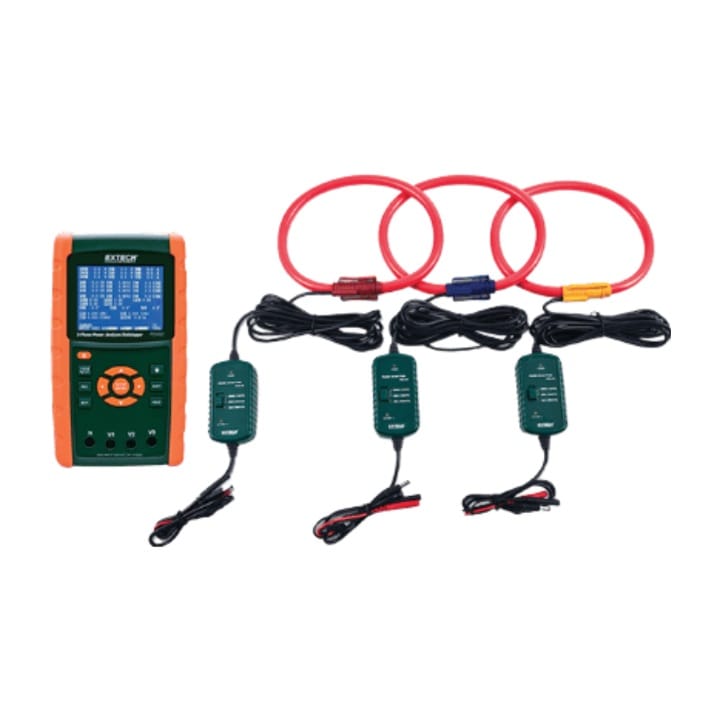
Extech PQ3450-30
3000A 3-Phase Datalogging Power Analyzer Kit
The same PQ3450 analyser supplied with PQ34-30 flexible current probes rated to 3000 A. The distinction that matters is mechanical as much as electrical: a flexible coil unclips, wraps around the conductor and clips shut again, so it fits over busbars, bundles of parallel cables and conductors positioned too close to panel walls for a rigid jaw to reach. On main incomers and transformer tails this is frequently the only practical way to take a measurement at all.
Everything else — the 35-parameter system analysis, 30,000-set SD card logging in Excel format, CT and VT ratio scaling, clock and calendar — is identical to the 1200 A kit. Choose this version when current exceeds 1200 A or when access, not range, is the constraint.
- AC voltage600.0 V
- AC current3000 A (PQ34-30 flexible probes)
- Probe advantageWraps busbars and cable bundles
- ParametersUp to 35, full system analysis
- Memory30,000 sets to removable SD card
- Safety ratingCAT III 600 V

Extech PQ3350-3
3-Phase Power & Harmonics Analyzer
Where the PQ3450 family is built around logging energy over time, the PQ3350-3 is built around waveform quality. Its defining capability is the simultaneous display of harmonic spectrum and waveform on a single screen, so distortion and its effect on the wave are visible at the same instant rather than by switching between views — the difference between seeing that the fifth harmonic is elevated and seeing what that elevation is doing to the current waveform feeding a transformer.
The instrument handles single and 3-phase/3-wire or 3-phase/4-wire systems, displays up to 35 parameters on one backlit screen, and stores up to 52,428 single-phase or 17,476 three-phase readings. It is the natural successor for anyone who was previously specifying the discontinued PQ3350-1 for harmonic work. Current probes are selected separately.
- Systems1-phase, 3-phase/3-wire, 3-phase/4-wire
- DisplayHarmonics + waveform simultaneously
- ParametersUp to 35 on one screen
- Readings stored52,428 single-phase / 17,476 3-phase
- Current probesSelected separately
- Supplied withVoltage leads, 8 x AA, AC adaptor, USB, software, case
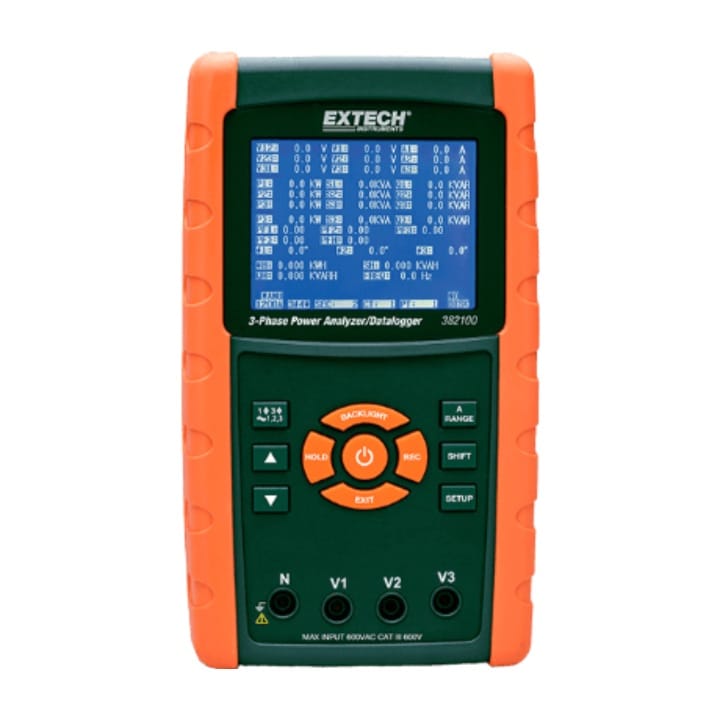
Extech 382100
1200A 3-Phase Power Analyzer / Datalogger
A complete 1200 A three-phase analyser supplied with three current clamps, four voltage leads with alligator clips, SD memory card, universal AC adaptor and case. It records up to 30,000 measurement sets in Excel format and reports the same 35-parameter system analysis as the PQ3450 family: phase-to-phase and phase-to-ground voltage, phase current, per-phase and system kW, kVA, kVAR and power factor, accumulated kWh, kVAh and kVARh, and phase angle.
Its distinguishing feature is the large sun-readable dot-matrix backlit LCD. On outdoor substations, rooftop plant rooms and yard-mounted panels in South African summer light, a display that stays legible in direct sun is a meaningful practical advantage over one that does not.
- AC voltage600 V
- AC current1200 A (three clamps included)
- DisplaySun-readable dot-matrix backlit LCD
- ParametersUp to 35, full system analysis
- Memory30,000 sets to SD card, Excel format
- Safety ratingCAT III 600 V
Power clamp meters

Extech PQ2071
1-/3-Phase 1000A True RMS AC Power Clamp Meter
A handheld meter that works as a true RMS clamp meter, a power meter, a multimeter and a non-contact AC voltage detector, which makes it the practical single tool to carry on a service call. It measures AC current, voltage and frequency alongside true power (kW), apparent power (kVA), reactive power (kVAR) and accumulated active energy (kWh), plus power factor and phase angle, on single-phase and balanced three-phase loads.
True RMS matters here rather than being a specification detail. On the non-linear loads that now dominate most installations — VSD-driven motors, LED lighting, switch-mode supplies — an averaging meter under-reads current, sometimes badly. The 55 mm jaw opening accommodates most sub-main cables, the 9999-count dual backlit display carries a bargraph for spotting fluctuation, and up to 99 data sets can be stored manually or downloaded over USB.
- AC current1000 A true RMS
- Jaw opening55 mm (2.16 in)
- Power measuredkW, kVA, kVAR, kWh, PF, phase angle
- Display9999-count dual backlit LCD with bargraph
- Memory99 data sets, USB datalogging
- ExtrasNon-contact voltage detector with LED alert
- Supplied withTest leads, alligator clips, USB cable, software, soft case

Extech 380976-K
Single Phase / Three Phase 1000A AC Power Clamp Meter Kit
This kit combines three instruments an electrician would otherwise carry separately. As a power meter it reports single and three-phase true power (kW), apparent power (kVA), reactive power (kVAR), horsepower, power factor and phase angle with a lead/lag indicator. As an insulation tester it measures resistance to 100 megohm. As a thermometer it takes Type K readings to 1000°F, switchable between Celsius and Fahrenheit.
Two specialised ranges make it particularly useful in HVAC and building services work: AC+DC microamp current with 10 nA resolution, which is the measurement needed to verify flame rod and flame rectification circuits on gas appliances, and capacitance to 7000 µF with 0.001 µF resolution for checking motor run and start capacitors. Auto-detecting AC/DC voltage with simultaneous frequency display, diode and continuity tests round it out. The 40 mm jaw is smaller than the PQ2071's, so check your conductor diameter before choosing between the two.
- AC current1000 A
- Jaw opening40 mm (1.6 in)
- Power measuredkW, kVA, kVAR, HP, PF, phase angle (lead/lag)
- Insulation resistanceTo 100 MΩ
- CapacitanceTo 7000 µF, 0.001 µF resolution
- Microamp rangeAC+DC µA, 10 nA resolution (flame rod)
- TemperatureType K to 1000°F, °C/°F switchable
- Supplied withTest lead kit, Type K probe, carrying case, 9 V battery
AC voltage & current dataloggers

Extech DL150
True RMS AC Voltage / Current Datalogger
A compact logger for the question that comes before a full power study: what is this circuit actually doing over time? It records up to 100,000 true RMS readings of AC voltage to 600 V or AC current to 200 A, at a user-programmable sample rate from one second to 24 hours. The LCD shows time and date, the live reading, min and max, and whether user-set high and low alarm thresholds have been crossed.
Three recording modes cover different investigations. Normal mode logs at a fixed interval for load profiling. Peak mode captures short-duration extremes that a fixed interval would step over. Capture mode waits on a user-specified trigger level and only records when it is exceeded, which is how you catch an intermittent overcurrent without filling the memory with hours of normal operation. Readings download to a PC over USB.
- AC voltage600 V true RMS
- AC current200 A true RMS
- Memory100,000 readings
- Sample rate1 second to 24 hours
- Recording modesNormal, peak, capture (triggered)
- AlarmsUser-settable high/low with display alert
- Supplied withCurrent clamp, test leads, alligator clips, software, USB cable

Extech DL160
Dual Input True RMS AC Voltage / Current Datalogger
The two-channel version of the DL150, and the more useful of the pair when you need to correlate rather than simply record. It logs two channels simultaneously — two voltages, two currents, or one voltage and one current — to a total of 256,000 readings, with the same programmable sample rate of one second to 24 hours.
Logging voltage and current on the same circuit at the same time is what makes cause and effect visible. A voltage sag recorded alone tells you the supply dipped; a voltage sag recorded alongside a current surge on the same timestamp tells you the load caused it. That distinction settles a large proportion of arguments about whether a problem originates on the supply side or inside the installation.
- Channels2, logged simultaneously
- AC voltage600 V true RMS
- AC current200 A true RMS
- Memory256,000 readings total
- Sample rate1 second to 24 hours
- Typical useCorrelating voltage sags with load current
Current clamp probes & accessories
The PQ3450 and PQ3350-3 are supplied without current probes so the range can be matched to the installation. Probe choice sets the analyser's maximum current and, just as importantly, its resolution at the low end — a 3000 A probe on a 60 A circuit will read, but poorly. Select the range closest above your expected maximum.
← Scroll to see full table →
| Accessory | Rating | Type | Typical application |
|---|---|---|---|
| PQ34-2 | 200 A | Rigid clamp, 19 mm jaw — set of three | Small commercial boards, sub-circuits, individual machines where resolution matters more than range |
| PQ34-12 | 1200 A | Rigid clamp probes — set of three | Distribution boards, motor feeders, sub-mains — the general-purpose choice |
| PQ34-30 | 3000 A | Flexible current probes — set of three | Busbars, parallel cable bundles, main incomers and any conductor a rigid jaw cannot close over |
| PQ1000 | — | Voltage test leads | Replacement or spare voltage leads for the PQ-series analysers |
Probes are ordered together with the analyser in most cases. Email sales@ecotao.co.za with your conductor size and expected maximum current and we can confirm the right combination.
Power analysis under South African conditions
South Africa's supply environment creates measurement requirements that generic international product literature does not address. Four situations account for most of the power analyser work done here.
Maximum demand tariffs are billed in kVA, not kW
Municipal and Eskom large-power tariffs charge separately for energy consumed and for maximum demand, and that demand charge is levied in kVA. The distinction is where money is lost. A site drawing 400 kW at a power factor of 0.75 presents 533 kVA to the meter; the same 400 kW at a corrected power factor of 0.95 presents 421 kVA. The work done is identical, the energy charge is identical, and the demand charge differs by more than a hundred kVA every month.
Establishing whether that gap exists requires logging kW, kVA and power factor together across a representative period — a full week at minimum, so weekday and weekend patterns are both captured — and reading the sustained peak over the tariff's integration window rather than the instantaneous maximum. The PQ3450 family and 382100 log directly to SD card in Excel format, so the analysis can be done in a spreadsheet rather than through proprietary software. This is also the dataset you need if you intend to query a demand charge with your supplier, since an argument backed by timestamped measurements carries weight that an estimate does not.
Load shedding, generator changeover and inverter transfer
Scheduled supply interruption has made transfer events routine, and transfer is where equipment damage tends to originate rather than during the outage itself. Voltage dips as the generator picks up load, frequency wanders while the governor settles, and phase unbalance can be markedly worse on generator supply than on utility supply because the source impedance is higher. Sensitive equipment that survives the outage sometimes does not survive the return.
An analyser logging across a full shedding cycle captures the transfer in both directions with timestamps, which turns a suspicion into evidence. With 30,000 measurement sets and a one-minute sample interval, the PQ3450 family covers roughly three weeks unattended — enough for several shedding stages plus the surrounding normal operation needed as a baseline for comparison. The transient capture capability of the PQ3350-3, which records dip, swell and outage events against a programmable threshold, is the better fit where the events themselves rather than the overall pattern are the subject of investigation.
Harmonics from solar inverters and variable speed drives
Rooftop PV, battery inverters and VSD-driven pumps and fans have proliferated across South African commercial, agricultural and industrial sites. All are non-linear loads: they draw current in pulses rather than smoothly, injecting harmonic currents back into the installation. The consequences are physical. Transformers and cables heat beyond what their RMS current rating would suggest. Neutral conductors carry triplen harmonics that can exceed phase current, which is a genuine hazard in older installations where the neutral was sized smaller than the phases. Capacitor banks installed for power factor correction can be driven towards resonance with the supply impedance.
NRS 048-2 sets compatibility levels for voltage harmonic distortion, unbalance and voltage dips on South African networks, so measuring total harmonic distortion is frequently a compliance exercise as well as an equipment-protection one. The PQ3350-3 analyses THD and displays the harmonic spectrum alongside the waveform, which is the measurement to take before adding capacitor banks or a large drive to an existing installation rather than after the resulting failure.
Phase unbalance on rural and agricultural supplies
Long rural feeders with a mix of single-phase and three-phase loads develop voltage and current unbalance as a matter of course. The effect on three-phase motors is disproportionate: a small percentage of voltage unbalance produces a much larger percentage of current unbalance, and the resulting negative-sequence current heats the rotor without contributing useful torque. Irrigation pump motors failing repeatedly on a farm supply are a common presentation of this, and it is regularly misdiagnosed as a motor quality problem.
Measuring it requires simultaneous three-phase readings — voltage and current unbalance ratios and unbalance factors, plus the calculated neutral current, which the three-phase analysers report directly. A clamp meter used on one phase at a time cannot detect unbalance at all, since the phases are not measured at the same moment.
Supply context: South Africa's low-voltage distribution is 400 V phase-to-phase, 230 V phase-to-neutral, at 50 Hz. Every three-phase Extech analyser on this page covers 600 V AC at CAT III with a 45–65 Hz frequency range, so all are appropriate for LV distribution board and feeder work. Work on the supply side of the main overcurrent device belongs to CAT IV and requires an instrument rated for it.
Frequently asked questions
What is a power analyzer and how is it different from a clamp meter?
A clamp meter measures one quantity at a time at the instant you look at it — amps, or volts, or sometimes kilowatts. A power analyzer samples voltage and current on every phase at the same time and derives the relationships between them: real power in kW, apparent power in kVA, reactive power in kVAR, power factor, phase angle, energy in kWh and harmonic distortion.
Because it captures voltage and current together, it can tell you not only how much energy a load draws but how cleanly it draws it. A three-phase analyzer such as the Extech PQ3450 also logs those values continuously to an SD card, so you can characterise a load over days rather than reading it once.
Which Extech power analyzer should I choose for a 400V three-phase supply in South Africa?
All of the three-phase Extech analysers — the PQ3450 family, the PQ3350-3 and the 382100 — are rated for 600 V AC at CAT III, which comfortably covers a 400 V phase-to-phase, 230 V phase-to-neutral South African supply at 50 Hz. The choice comes down to current and purpose.
For a distribution board or motor feeder up to 1200 A, the PQ3450-12 or 382100 are the practical picks. For an incomer, transformer tail or busbar above 1200 A, choose the PQ3450-30 with flexible probes. If your problem is harmonic distortion from variable speed drives or inverters rather than energy consumption, the PQ3350-3 is the harmonics-focused instrument.
What is the difference between the PQ3450, PQ3450-12 and PQ3450-30?
They are the same analyser. The difference is the current probes bundled with it. The PQ3450 is the analyser on its own, with voltage leads, SD card, AC adaptor and case, and no current probes — you select those separately. The PQ3450-12 ships with PQ34-12 rigid 1200 A clamp probes. The PQ3450-30 ships with PQ34-30 flexible 3000 A probes that wrap around conductors a rigid jaw cannot close over.
Buying the analyser alone makes sense only if you already own compatible probes, or want a probe set the kits do not include — such as the 200 A PQ34-2.
Has the Extech PQ3350-1 been discontinued?
Yes. Extech has discontinued the PQ3350-1, the version of the harmonics analyser that shipped with 1200 A flexible current clamp probes. Extech names the PQ3450-12 as the replacement.
If harmonic analysis specifically is what you need rather than datalogging, the PQ3350-3 remains available and is the closer functional equivalent — it is the same harmonics analyser with current probes selected separately. Ecotao can advise on which of the two suits your application.
Do I need to buy current clamp probes separately?
It depends on the model. The PQ3450-12, PQ3450-30 and 382100 all include current probes. The PQ3450 and PQ3350-3 do not — probes are selected separately so you can match the range to your installation.
Extech offers the PQ34-2 200 A clamp probes with a 19 mm jaw, the PQ34-12 1200 A clamp probes, and the PQ34-30 3000 A flexible probes. Oversizing costs resolution on small loads, so choose the probe range closest to your expected maximum current rather than the largest available.
How do I measure maximum demand for a municipal or Eskom tariff?
Log kVA continuously over a representative period — typically a full week, so that weekday and weekend patterns are both captured — and read the highest sustained value over the tariff's integration window rather than the instantaneous peak. A three-phase Extech analyser logging to SD card at a sample interval of one to five minutes gives a dataset you can open directly in Excel and analyse.
Because South African maximum-demand tariffs bill on kVA rather than kW, a poor power factor inflates the charge even when actual energy use is unchanged — which is why the analyser's power factor reading matters as much as the demand figure itself.
What is Total Harmonic Distortion and why does it matter?
Total Harmonic Distortion, or THD, expresses how much of a waveform sits at multiples of the 50 Hz fundamental rather than at the fundamental itself, as a percentage. Non-linear loads such as variable speed drives, LED drivers, UPS units and solar inverters draw current in pulses rather than smoothly, injecting harmonic currents back into the installation.
The consequences are practical: transformers and cables run hotter than their current rating suggests, neutral conductors carry triplen harmonics that can exceed phase current, and capacitor banks can be driven towards resonance. NRS 048-2 sets compatibility levels for voltage distortion on South African networks, so measuring THD is often a compliance question as well as an equipment-protection one.
Can these analyzers log through a full load-shedding and generator changeover cycle?
Yes, and this is one of the more common reasons South African users buy them. The PQ3450 family and 382100 log 30,000 measurement sets to a removable SD card with sample intervals from two seconds to two hours, which at a one-minute interval covers roughly three weeks of continuous recording.
That is long enough to capture several shedding stages, the transfer to generator or inverter, and the return to utility supply. Logging across the changeover shows voltage dips, frequency behaviour and unbalance during transfer — which is where sensitive equipment damage usually originates.
What CAT rating do I need for distribution board work?
CAT III 600 V is the appropriate minimum for work on fixed installation equipment — distribution boards, busbars, feeders and motor circuits — on a 400 V three-phase supply. The category describes how much transient energy the instrument can survive at that point in the installation, not just the steady-state voltage.
The Extech three-phase analysers carry a CAT III 600 V rating. Work at the service entrance or on the supply side of the main overcurrent device belongs to CAT IV and requires an instrument rated accordingly.
Does Ecotao deliver Extech power analyzers outside South Africa?
Yes. Ecotao supplies Extech test and measurement instruments from its Cape Town base throughout South Africa and to neighbouring countries including Namibia, Botswana, Zimbabwe, Mozambique, Lesotho and Eswatini.
Email sales@ecotao.co.za or call +27 21 911 5835 with your delivery destination and the models you are considering.
Not sure which analyser fits your installation?
Tell us the supply voltage, the maximum current you expect, the conductor type and what you are trying to establish — a demand study, a harmonics investigation, a load profile — and we will confirm the right model and probe combination before you order.
Head Office +27 21 911 5835 ·
Zak 086 142 8716 ·
Zaid 082 390 3989
sales@ecotao.co.za · 39 Olienhout Avenue, Plattekloof 3, Cape Town