
Calibrators – Current & Voltage
Process signal calibrators that source and measure 4–20mA current loops and 0–10V analogue signals, supplied across South Africa by Ecotao from Cape Town. Used to prove, adjust and troubleshoot transmitters, PLC analogue cards, indicators, recorders and variable speed drives without waiting for a real process condition.
In short
A current and voltage calibrator is a portable precision source and meter. It generates an exact, known electrical signal — typically anywhere from 0 to 24mA or 0 to 10V — and feeds it into a process instrument so you can see whether that instrument reads what it should. It also works in reverse, measuring the output of a transmitter you have driven with a known pressure, level or temperature. That single capability is what turns a suspected instrument fault from guesswork into a five-minute measurement, and it is what makes a calibrator the first tool an instrumentation technician reaches for on a loop check.
Why 4–20mA became the industrial standard
Almost every process instrument in a South African water treatment works, mine, food plant or refinery communicates using a 4–20 milliamp current loop, and understanding why explains what a calibrator actually has to do. Current was chosen over voltage because a current signal does not degrade over distance — the same milliamps that leave a transmitter at the far end of a plant arrive unchanged at the control room, whereas a voltage signal drops steadily across cable resistance. The 4mA live zero is equally deliberate: because a healthy loop never falls below 4mA, a reading of 0mA unambiguously means a broken wire or a dead transmitter rather than a genuine zero measurement. That distinction between "nothing is happening" and "nothing is connected" is safety-critical on a chlorine dosing line or a tailings level alarm.
Voltage signalling still has its place. Building management systems, HVAC controllers, damper actuators and many PLC analogue input cards work in 0–10V or 0–5V because the cable runs are short and the cost per channel is lower. Millivolt-level signals matter too: a thermocouple produces only tens of millivolts across its entire span, so any calibrator that claims to handle temperature work must resolve millivolts accurately. A calibrator that covers current, voltage and millivolts therefore covers the large majority of analogue instrumentation on a typical site, which is why the combined current-and-voltage models are the ones most technicians end up buying.
How to choose the right process calibrator
Working through these four questions in order will land you on the correct model without over-specifying. Each step narrows the field further.
-
Do you need current only, or current and voltage?
If your instrumentation is entirely 4–20mA — common on older water and wastewater plants and on straightforward pump and valve control — a current-only calibrator such as the Extech PRC10 does everything you need at the lowest cost. The moment you add building management controllers, VSD analogue references, or any 0–10V device, you need voltage as well: the Extech 412355A or PRC15. Technicians who service mixed sites almost always regret buying current-only.
-
Do you also work with thermocouples or RTDs?
Temperature instrumentation speaks a different language: thermocouples output millivolts on a non-linear curve specific to their type, and RTDs are resistance devices. A general current and voltage calibrator cannot simulate a Type K thermocouple at 800°C because it does not hold the linearisation tables. If temperature loops are part of your work, step up to the Extech PRC20 for dedicated thermocouple work, the Extech PRC30 for thermocouples plus current and voltage, or the SG-004A if you also need PT100 RTD, frequency and resistance.
-
Will you be powering transmitters on the bench?
A two-wire transmitter takes its power from the same pair of wires that carries its signal. Test one on a bench without a 24V supply and it simply does nothing. Built-in loop power solves this — the calibrator energises the transmitter and reads its output at the same time, so you can apply a known pressure and confirm the 4mA and 20mA endpoints in the workshop rather than on a live plant. The PRC30 supplies 24V loop power and the SG-004A offers selectable 12V or 24V, which matters for lower-voltage transmitters.
-
Do you need to record what happened, or just read it?
Intermittent faults are the hardest to catch, because by the time you connect a meter the signal has returned to normal. Logging capability lets you leave the instrument connected and review the trace afterwards. With the SD-series dataloggers now discontinued, the SG-004A covers this on Ecotao’s current range: it stores up to 100,000 records and plots a live trend graph on its colour screen, so a drifting or momentarily dropping signal shows up visually rather than having to be caught in the act.
Calibrator comparison — what each model actually does
← Scroll to see full table →
| Model | Current (mA) | Voltage | Thermocouple | RTD / Ω / Hz | Loop power | Best suited to |
|---|---|---|---|---|---|---|
| SG-004A | 0–24mA source & read, simultaneous | −10 to 100mV, 0–24V | 8 types (K J E T R S B N) | PT100, 0–390Ω, 0–9999Hz | 12V or 24V selectable | The all-rounder — one instrument for almost any analogue loop, with logging |
| Extech 412355A | 0–24mA source & measure | 0–10V and mV ranges | — | — | — | Everyday current and voltage loop checks, handheld or benchtop |
| Extech PRC10 | Source & measure | — | — | — | — | Sites running 4–20mA only; rugged field use in a hard case |
| Extech PRC15 | Source & measure | mV and V | — | — | — | The PRC10 in mixed-signal environments |
| Extech PRC20 | — | mV output | 8 types (J K T E C R S N) | — | — | Dedicated temperature calibration, furnaces, ovens, HVAC |
| Extech PRC30 | Source & measure | mV and V | 8 types | — | 24V | Top-of-range Extech unit for technicians covering process and temperature |
Calibrators supplied by Ecotao

SG-004A Multifunction Signal Calibrator
Source and read every common process signal from one pocket unit
This is the calibrator to buy if you want one instrument that handles essentially any analogue signal you will meet on a plant. It reads and sources simultaneously, so you can inject a test signal into a controller and watch its response on the same screen without swapping leads or reaching for a second meter. The 2.4” colour TFT plots a real-time trend graph, which is what makes it the practical successor to the discontinued SD900 and SD910 dataloggers — an intermittent dropout that a handheld meter would never catch shows up plainly on the trace. Programmable 25% stepping and ramp output means a five-point linearity check runs itself while you record the readings, and at 112 x 82 x 28mm and 167g it fits a shirt pocket rather than a toolbox.
- mA: 0.000–24.000mA, active and passive transmitter modes
- Voltage: −10.00 to 100.00mV DC and 0.000–24.000V DC
- Loop power: 24V DC ±10% max 24mA, settable to 12V
- Temperature: 8 thermocouple types (K J E T R S B N), PT100 −200.0 to 650.0°C
- Also: 0–9999Hz frequency/PWM, 0.0–390.0Ω resistance
- Memory: 100,000 records with real-time trend graph
- Power: 3.7V 3000mAh rechargeable, up to 10 hours, USB-C charging
- Supplied with: 4 leads with clips, USB-C cable, charger, manual

Extech 412355A
Current and Voltage Calibrator/Meter
Extech’s long-running workhorse for process loop calibration, and the model Extech itself nominates as the replacement for the discontinued 412300A. The oyster-case design with a flip-up display is the detail technicians appreciate most: stood on a bench the screen angles toward you, and closed in one hand it survives being carried around a plant. The display is unusually flexible for an instrument in this class, showing readings as milliamps, as a percentage of the 0–24mA span, or as millivolts in the voltage ranges — so when a specification is written in percent of span you read percent of span directly instead of doing arithmetic on a ladder. Five stored calibration values let you jump straight to your regular 4, 8, 12, 16 and 20mA check points.
- Current: adjustable 0–24mA source and measure
- Voltage: adjustable 0–10V calibration source
- Display: large 3-1/2 digit LCD, readings in mA, % of span or mV
- Control: touch keypad with five stored calibration values
- Form factor: oyster case with flip-up display, handheld or benchtop
- Supplied with: 9V battery, calibration cable with spade lugs, carrying case, neck strap, AC adaptor
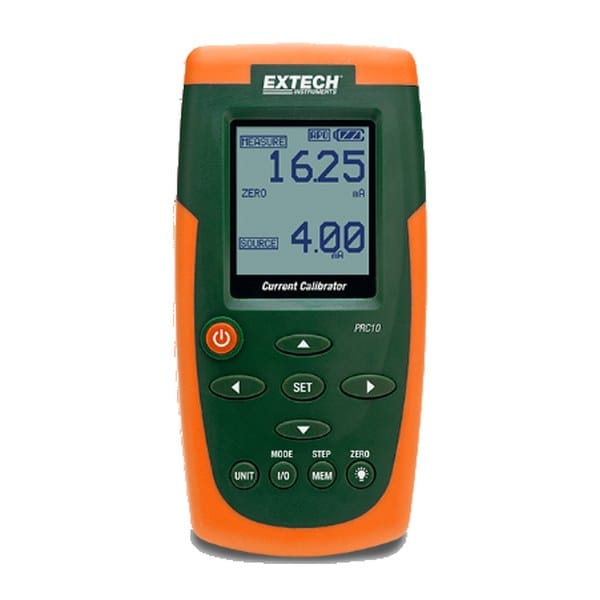
Extech PRC10
Current Calibrator/Meter
The PRC10 is built for technicians who spend their days inside 4–20mA loops and want a single-purpose instrument that does that job properly. Extech positions it for plant maintenance and electrical technicians testing transmitters, transducers, indicators, sensors, instrumentation, robotic systems and thermocouple-based industrial components — in other words, the full range of devices that live on a current loop. Because it does one thing, the interface stays simple under pressure: there are no mode menus to hunt through when a line is down and a supervisor is standing behind you. It ships complete in a hard carrying case with a universal AC adaptor carrying four plug patterns, so it works straight out of the box on South African sockets and travels internationally without an adaptor hunt.
- Function: mA source and measure for 4–20mA process loops
- Applications: transmitters, transducers, indicators, sensors, PLC analogue inputs
- Power: six AA batteries plus 100V–240V universal AC adaptor with four plugs
- Supplied with: test leads, alligator clips, hard carrying case
- Choose instead: the PRC15 if you also need voltage ranges
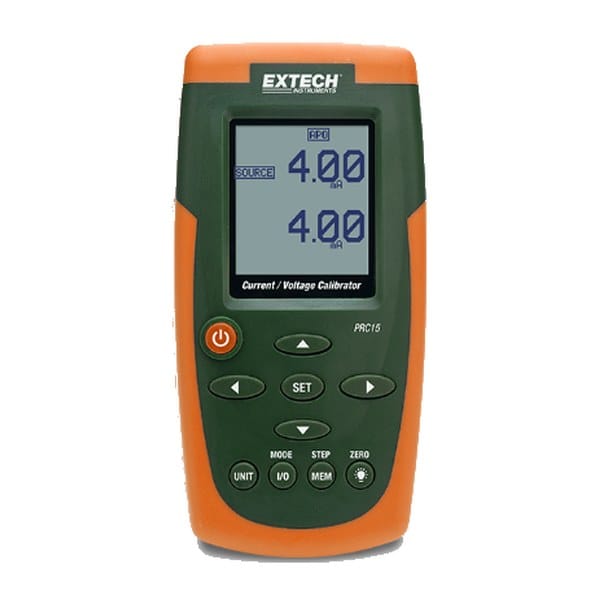
Extech PRC15
Current and Voltage Calibrator/Meter
The PRC15 is the PRC10 with voltage sourcing and measurement added, and for most maintenance departments that difference decides the purchase. A site is rarely purely 4–20mA: somewhere there is a variable speed drive taking a 0–10V reference, a building management controller, a damper actuator, or a PLC card wired for voltage rather than current. With a current-only calibrator each of those becomes a job you cannot finish. The PRC15 keeps the same rugged hard-case build and the same straightforward operation as the PRC10, so nothing is traded away for the extra capability. It calibrates the same population of transmitters, transducers, indicators, sensors, instrumentation and robotic system components, and adds the millivolt and volt ranges that make mixed-signal work possible.
- Function: mA plus mV and V source and measure
- Applications: 4–20mA loops, 0–10V analogue references, VSD and BMS signals
- Power: six AA batteries plus 100V–240V universal AC adaptor with four plugs
- Supplied with: test leads, alligator clips, hard carrying case
- Step up to: the PRC30 if you also need thermocouples and 24V loop power
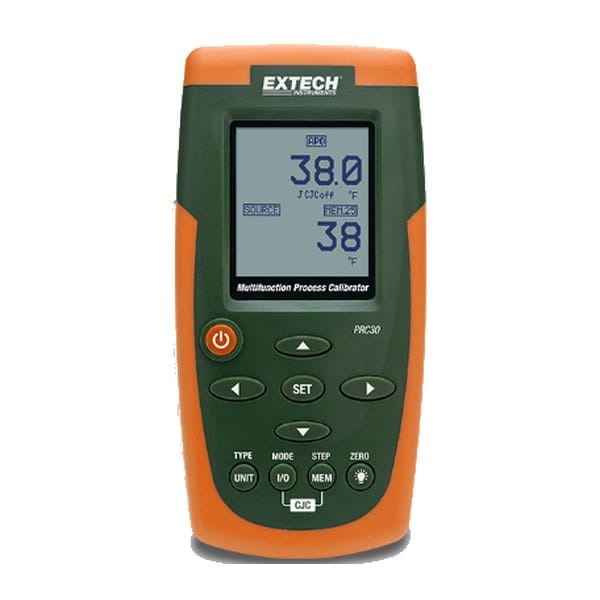
Extech PRC30
Multifunction Process Calibrator
The PRC30 is the top of the Extech calibrator range and the model to specify when one technician has to cover an entire plant. It combines everything the PRC15 does with the thermocouple capability of the PRC20, then adds the feature that changes how you work: 24 volt loop power. That built-in supply lets you take a two-wire transmitter off the plant, energise it on the bench, apply a known input and read its 4–20mA output directly — no borrowed power supply, no need to keep a section of the process live while you work. Temperature output can be displayed in Fahrenheit, Celsius or raw millivolts, which matters when you are cross-checking a controller’s reading against the actual thermocouple EMF. Five user-adjustable presets store the check points you use most.
- Current: precision mA sourcing and measurement
- Voltage: mV and V sourcing and measurement
- Temperature: eight thermocouple types, output in °F, °C or mV
- Loop power: 24V DC for powering two-wire transmitters on the bench
- Presets: five user-adjustable calibration presets
- Supplied with: test leads, alligator clips, thermocouple and universal calibration cables, universal AC adaptor with 4 plugs, AA batteries, hard case, manual
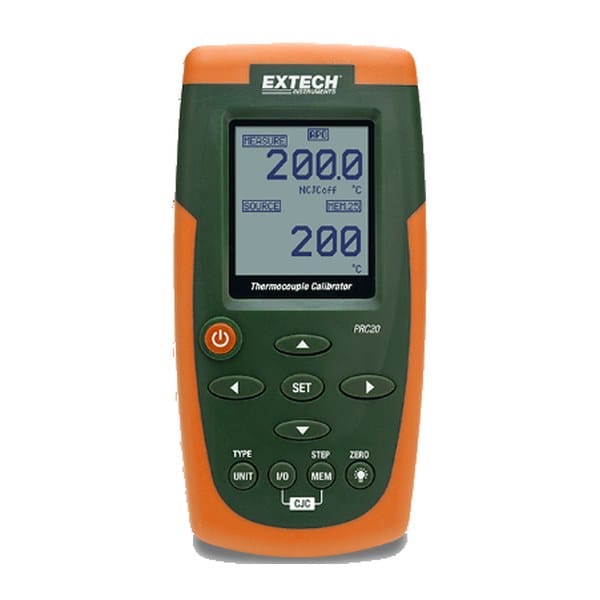
Extech PRC20
Thermocouple Calibrator
Temperature loops need a calibrator that understands thermocouple curves, and the PRC20 is the dedicated instrument for that work. It sources and measures eight thermocouple types — J, K, T, E, C, R, S and N — and displays output in Celsius, Fahrenheit or millivolts, so you can work in whatever units the controller in front of you is configured for. The Type K range runs from −50 to 1370°C, which spans everything from a cold room alarm to a furnace, and the 10MΩ input impedance means the instrument barely loads the circuit it is measuring. Extech aims it at lab and field calibration, engineering research and design, manufacturing and test engineering, temperature control process troubleshooting, and HVAC. Listed here because temperature work usually sits alongside current and voltage work — if you need both in one unit, the PRC30 combines them.
- Thermocouple types: J, K, T, E, C, R, S and N
- Type K range: −50 to 1370°C (−58 to 2498°F)
- Output units: Celsius, Fahrenheit or millivolts
- Input impedance: 10MΩ, sampling 4 times per second
- Presets: five user-adjustable calibration presets
- Supplied with: thermocouple and standard calibration cables with subminiature connectors, universal AC adaptor with 4 plugs, six AA batteries, hard case, manual
Discontinued models and their replacements
Four models previously listed on this page are no longer manufactured
Extech has discontinued the 412300A, SD900 and SD910. They are documented below rather than removed, because the model numbers still appear on old drawings, asset registers and maintenance schedules across South Africa — and if you have arrived here searching for one, the useful answer is what to buy instead. Manuals and datasheets for discontinued units are still available — contact us and we will send them through.
← Scroll to see full table →
| Discontinued model | What it did | Recommended replacement |
|---|---|---|
| Extech 412300A Current Calibrator/Meter |
Sourced and measured 0–24mA in the same oyster case as the 412355A, but without voltage ranges. | Extech 412355A — Extech’s own nominated replacement. Same form factor and current capability, with 0–10V added. |
| Extech SD900 3-Channel DC Current Datalogger |
Logged three DC current channels from 0 to 20mA at 0.01mA resolution to an SD card, roughly 2.7 million readings on a 4GB card. | SG-004A — adds sourcing, loop power and 100,000-record logging with a live trend graph, but on a single channel. Contact us if you need three channels logged simultaneously. |
| Extech SD910 3-Channel DC Voltage Datalogger |
Logged three DC voltage channels on 300.0mV and 3000mV ranges to an SD card, roughly 2.7 million readings on a 4GB card. | SG-004A — covers −10 to 100mV and 0–24V with logging and trending, plus current, thermocouple and RTD functions the SD910 never had. |
4–20mA calibration reference points
These are the five check points used in a standard linearity test. Sourcing each in turn and recording what the receiving instrument displays produces the as-found record that most quality systems require. The millivolt column is what you would read across a 250Ω loop resistor, which is how many older systems convert current to a voltage the controller can read.
← Scroll to see full table →
| % of span | Current (4–20mA) | Across 250Ω resistor | Equivalent on 0–10V | Example: 0–600 kPa transmitter |
|---|---|---|---|---|
| 0% | 4.00 mA | 1.000 V | 0.00 V | 0 kPa |
| 25% | 8.00 mA | 2.000 V | 2.50 V | 150 kPa |
| 50% | 12.00 mA | 3.000 V | 5.00 V | 300 kPa |
| 75% | 16.00 mA | 4.000 V | 7.50 V | 450 kPa |
| 100% | 20.00 mA | 5.000 V | 10.00 V | 600 kPa |
To convert any percentage to current, multiply the fraction of span by 16 and add 4. A reading of 14.4mA therefore represents (14.4 − 4) ÷ 16 = 65% of span, or 390 kPa on the example transmitter above. Working the other way, a transmitter that should read 4.00mA at zero but actually reads 4.32mA has a zero shift of 2% of span, which on a 600 kPa range is a 12 kPa error at every point on the scale until it is trimmed out.
Where these calibrators are used in South Africa
Water and wastewater treatment
Municipal works run on 4–20mA: level transmitters on reservoirs and clarifiers, flow meters on inlet and outlet mains, chlorine residual analysers, and pressure transmitters on pump stations. A calibrator lets an operator confirm that a level reading driving an automatic pump start is genuinely correct rather than drifting, which is the difference between a controlled process and a dry-run pump. During commissioning, sourcing a signal into the SCADA system verifies the whole chain from field wiring to control room screen before the plant ever sees water.
Mining and mineral processing
Belt weightometers, slurry density gauges, thickener bed level instruments and tailings dam monitoring all report over current loops, often across long cable runs in electrically noisy environments. Because current signals resist that noise, a fault is far more likely to be an instrument drifting than a cable problem — and a calibrator is what proves which. Loop power on the PRC30 or SG-004A is particularly valuable underground and on remote installations where bringing a 24V supply to the fault is impractical.
Food, beverage and pharmaceutical production
Temperature and pressure records in these industries are audited evidence, not just operational data. That makes documented calibration of every instrument in a critical control point mandatory rather than optional. Thermocouple capability on the PRC20, PRC30 or SG-004A allows a technician to simulate a pasteuriser holding temperature exactly, confirm that the recorder logs it correctly, and produce an as-found and as-left record for the quality file — without interrupting production to reach the actual temperature.
HVAC, building management and commissioning
Commercial building systems mix signal types more than any other sector: 0–10V to damper and valve actuators, 4–20mA from duct pressure and CO₂ sensors, and thermocouples or RTDs on air handling units. Commissioning agents need to drive each actuator through its full travel and confirm the BMS reports back correctly, which means sourcing signals rather than waiting for the building to reach a condition. A current-and-voltage unit is the minimum useful specification here; the SG-004A covers the whole mix in one instrument.
Calibration, traceability and support in South Africa
Traceability is what gives a calibration meaning. A calibrator is only a reference if its own accuracy can be traced back to a national standard. For South African facilities that means a certificate from a SANAS-accredited laboratory, traceable through the National Metrology Institute of South Africa (NMISA). If your site operates under ISO 9001, ISO/IEC 17025, a SANS-based quality system, or municipal or mining compliance requirements, an auditor will ask to see that certificate for the instrument used to calibrate everything else. Buying an uncertified calibrator and using it for compliance work is one of the more common and more expensive findings in a first audit.
Set recalibration intervals on evidence, not habit. Annual recalibration is the common default and a reasonable starting point, but the interval should reflect how the instrument is actually used. A calibrator that lives in a climate-controlled workshop and is used weekly will hold its accuracy far longer than one carried daily onto a dusty plant. Review each certificate when it comes back: if the as-found readings have stayed well inside tolerance across two or three cycles, there is a defensible case for extending the interval. If a unit has drifted or been dropped, shorten it.
Grid instability is a real consideration here. Load shedding and the switching transients around it are hard on two-wire transmitters and on the loop supplies that power them. After an extended outage it is worth spot-checking the instruments on critical loops rather than assuming they came back correctly — a transmitter that has shifted its zero will keep reporting confidently and wrongly. This is also a practical argument for battery-powered calibrators with long runtime: the SG-004A gives up to 10 hours from its internal rechargeable battery and charges over USB-C from a power bank, so a fault-finding session does not depend on mains power being available.
Supply and support. Ecotao supplies calibrators throughout South Africa from our Cape Town base at 39 Olienhout Avenue, Plattekloof. The SG-004A is available directly through our online store. The Extech models on this page are supplied to order — contact us for current pricing, availability and lead times, and we will confirm which model fits your instrumentation before you commit.
Frequently asked questions
What is a current and voltage calibrator used for?
It is a portable precision instrument that generates a known, accurate electrical signal — typically 0 to 24mA or 0 to 10V — and simultaneously measures signals of the same type. Technicians use it to verify that process instruments such as pressure transmitters, level sensors, flow meters, PLC analogue input cards, chart recorders and variable speed drives respond correctly across their full span. By injecting a known 4mA, 12mA and 20mA signal and comparing what the receiving device displays, you can prove whether an instrument is reading correctly, calculate its error, and adjust its zero and span without waiting for the actual process condition to occur.
What is the difference between a current calibrator and a current and voltage calibrator?
A current calibrator such as the Extech PRC10 works only with milliamp signals, which covers the 4–20mA loops that dominate industrial process control. A current and voltage calibrator such as the Extech 412355A or PRC15 adds millivolt and volt sourcing and measurement, so it also handles the 0–10V and 0–5V analogue signals used by building management systems, HVAC controllers, variable speed drives and many PLC analogue cards. If your site uses only 4–20mA loops, a current-only unit is sufficient and cheaper. If you work across mixed instrumentation, or you also need to check millivolt-level thermocouple signals, choose the current and voltage version.
Which Extech calibrator replaces the discontinued 412300A?
Extech has discontinued the 412300A Current Calibrator/Meter and names the 412355A Current and Voltage Calibrator/Meter as its direct replacement. The 412355A keeps the same oyster-case form factor, flip-up display and 0 to 24mA source and measure capability, and adds voltage ranges so the same instrument now covers 0–10V analogue signals as well as current loops. Ecotao supplies the 412355A in South Africa.
What replaces the discontinued Extech SD900 and SD910 dataloggers?
The SD900 3-Channel DC Current Datalogger and SD910 3-Channel DC Voltage Datalogger are both discontinued, and Extech has not named a like-for-like SD-series successor. For most users the practical replacement is the SG-004A Multifunction Signal Calibrator, which measures and sources mA and voltage and stores up to 100,000 records with a real-time trend graph on its colour display. The trade-off is that it logs one channel rather than three, but it adds signal sourcing, loop power, thermocouple, RTD, frequency and resistance functions the SD-series never had. If you specifically need three simultaneous logged channels, email sales@ecotao.co.za and we will quote a current multi-channel alternative.
What is loop power on a process calibrator and do I need it?
Loop power is a built-in 24V DC supply that lets the calibrator energise a two-wire transmitter on the bench, away from the control system that would normally power it. Without loop power you can only test a transmitter while it is still wired into a live loop, which means shutting down or bypassing part of the plant. With it you disconnect the transmitter, connect it to the calibrator, and read its 4–20mA output directly while applying a known pressure or temperature. The Extech PRC30 provides 24V loop power and the SG-004A offers selectable 12V or 24V, which is useful for transmitters designed for lower supply voltages.
Can a calibrator source and measure a signal at the same time?
Some can. Simultaneous source and read means the instrument outputs a signal on one set of terminals while independently measuring on another, which lets you inject a test input into a controller and watch its output response on the same screen. This halves the time needed to check a controller or signal isolator because you do not have to swap leads or use two instruments. The SG-004A reads and sources simultaneously. The Extech 412355A, PRC10 and PRC15 switch between source and measure modes rather than running both at once.
What is the difference between sourcing and simulating a 4–20mA signal?
In source mode the calibrator supplies both the current and the power that drives it, so you connect it to a passive input such as a PLC card, indicator or recorder that expects a signal from a powered transmitter. In simulate mode — also called passive or transmitter mode — the calibrator behaves like a two-wire transmitter: an external supply in the loop, usually the control system, provides the 24V and the calibrator simply regulates how much current flows. Choosing the wrong mode is the most common cause of a dead reading during a loop check. If the loop already has its own power supply, use simulate. If nothing else in the loop is powered, use source.
Which calibrator should I choose for thermocouple work?
For dedicated temperature work the Extech PRC20 sources and measures eight thermocouple types (J, K, T, E, C, R, S and N) with output in Celsius, Fahrenheit or millivolts, covering −50 to 1370°C on Type K. If you need thermocouple capability alongside current and voltage in one instrument, the Extech PRC30 combines all three plus 24V loop power, and the SG-004A adds PT100 RTD, frequency and resistance on top of eight thermocouple types.
How accurate does a process calibrator need to be?
The widely used rule of thumb is a 4:1 test accuracy ratio — the calibrator should be at least four times more accurate than the instrument being checked. If a pressure transmitter is specified at 0.25% of span, the calibrator sourcing its signal should be better than 0.0625%. Most handheld process calibrators achieve roughly 0.05% of reading on their mA ranges, which comfortably covers general plant instrumentation but may not suffice for a custody transfer meter or a laboratory reference standard. Check the accuracy specification of the instrument you are calibrating first, then choose a calibrator that beats it by a factor of four.
Do process calibrators need SANAS-traceable calibration certificates in South Africa?
A calibrator only proves anything if its own accuracy is traceable to a national standard. South African facilities operating under ISO 9001, ISO/IEC 17025, SANS quality systems, or municipal and mining compliance regimes are generally required to show that reference instruments carry a valid certificate from a SANAS-accredited laboratory, traceable through NMISA. Most auditors expect annual recalibration, though the interval should be based on how heavily the instrument is used and how stable it has proven over previous cycles. Contact Ecotao on +27 21 911 5835 to discuss certification and recalibration arrangements for any calibrator supplied.
Not sure which calibrator fits your instrumentation?
Tell us what you are calibrating — the signal types, whether you need to power transmitters on the bench, and whether temperature loops are involved — and we will confirm the right model before you commit. Ecotao supplies and supports process calibrators throughout South Africa from Cape Town.