
Extech Instruments in South Africa
Extech Instruments makes handheld meters and testers for electrical work, temperature, humidity, airflow, sound, light, water quality and more. Ecotao supplies the Extech range from Cape Town to customers across South Africa and neighbouring countries.
Extech was founded in 1971 in Massachusetts, USA, and the name stands for Excellence in Technology. FLIR Systems acquired Extech in 2007, and FLIR became part of Teledyne Technologies in 2021, so Extech is now a Teledyne FLIR brand. Below you will find all 24 Extech categories we cover, each with a short explanation of what the instruments do and who uses them.
The Extech range: 24 instrument categories
Categories are grouped by what they measure. Choose a group to jump to it, or open any category for models, specifications, comparison tables and buying advice.
- Electrical, power and electronics
- Temperature, humidity and moisture
- Air, sound, light and gas
- Water, laboratory and food
- Mechanical, inspection and timing
Electrical, power and electronics
For electricians, technicians and maintenance teams working on installations, distribution boards, solar systems and electronics.
VAΩWHz

Multimeters
Measure AC and DC voltage, current, resistance, continuity and more with one handheld meter. The Extech range runs from pocket-sized mini meters for general use to heavy-duty True RMS industrial meters for plant and panel work.
Pictured: Extech EX530A heavy-duty True RMS multimeter
See Extech multimeters
Clamp-on meters
Measure current without breaking the circuit by closing the jaw around a single conductor. AC-only clamps suit general electrical work; AC/DC clamps are needed for solar PV strings, battery banks and DC drives.
Pictured: Extech 380926 True RMS AC/DC clamp meter
See Extech clamp-on meters
Electrical testers
Quick, safe checks before and during electrical work: voltage testers, non-contact voltage detectors, circuit breaker finders and AC circuit analysers for sockets and earth-leakage protected circuits.
Pictured: Extech VT30 multifunction voltage tester
See Extech electrical testers
Cable testers
Trace, identify and verify wiring. Tone generators and amplifier probes pick out one cable in a bundle, continuity testers confirm a run end to end, and cable locators trace hidden wiring in walls, floors and ceilings.
Pictured: Extech 40180 tone generator and amplifier probe kit
See Extech cable testers
Power analyzers
Measure and log voltage, current, real power, power factor and harmonics on single-phase and three-phase systems. Used for energy audits, load studies before adding equipment, and tracking down power-quality problems.
Pictured: Extech PQ3450 three-phase power analyzer
See Extech power analyzers
Power supplies
Bench DC power supplies give a stable, adjustable voltage and current for electronics repair, product testing and teaching labs. Linear models offer low noise; switching models deliver more power in a smaller case.
Pictured: Extech 382200 single-output DC power supply
See Extech power supplies
Oscilloscopes
An oscilloscope shows how a voltage changes over time, revealing ripple, noise, spikes and distorted signals that a multimeter cannot display. Handheld Extech scopes are built for field service on drives, controls and electronics.
Pictured: Extech MS420 20MHz handheld oscilloscope
See Extech oscilloscopes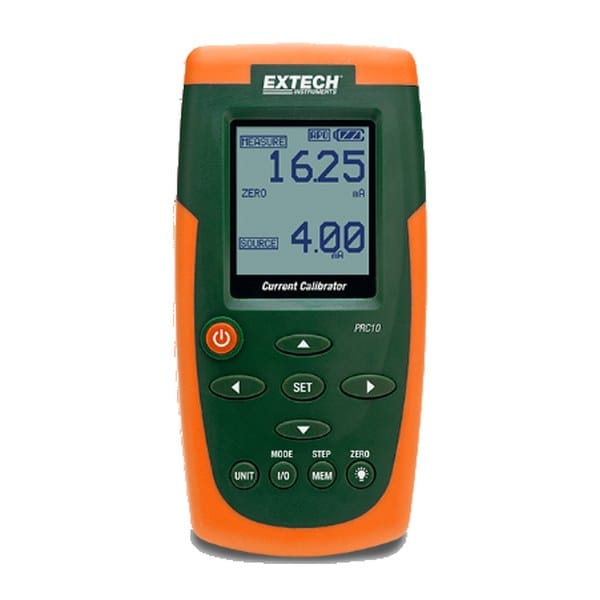
Calibrators
Process calibrators source and measure the 4–20 mA and voltage signals used by transmitters, PLC inputs and control loops, so technicians can simulate a sensor and check a loop end to end without the process running.
Pictured: Extech PRC10 4–20 mA current calibrator
See Extech calibratorsTemperature, humidity and moisture
For HVAC service, food safety, cold chain, building and damp surveys, and electrical inspection.
°C%RH%MC

Thermometers
Infrared thermometers read surface temperature from a distance; probe, thermocouple and datalogging thermometers read air, liquid and core temperatures. Used for HVAC service, food safety checks, electrical inspection and process monitoring.
Pictured: Extech IR267 mini IR thermometer
See Extech thermometers
Thermal imaging cameras
A thermal imager turns surface temperature into a picture, so hot connections, heat loss, damp and failing bearings stand out at a glance. This category covers thermal imaging cameras and the Extech VIR50 video IR thermometer.
Pictured: Extech VIR50 dual-laser video IR thermometer
See thermal imaging cameras
Humidity meters
Hygro-thermometers measure relative humidity, air temperature and dew point. They are used to commission HVAC systems, monitor storerooms, archives and greenhouses, and check drying conditions during damp and flooring work.
Pictured: Extech 445815 hygro-thermometer
See Extech humidity meters
Moisture meters
Measure moisture content in timber, drywall, plaster and concrete. Pin meters read at the depth of the pins; pinless meters scan the surface without marking it. Used by builders, flooring installers, damp specialists and timber merchants.
Pictured: Extech MO210 pocket moisture meter
See Extech moisture metersAir, sound, light and gas
For ventilation and HVAC work, occupational health, workplace lighting and gas safety.
m/sPadBluxppm

Airflow meters
Vane and hot-wire anemometers measure air velocity, volume flow and air temperature. Used to balance HVAC grilles and ducts, test extraction systems and fume cupboards, and check ventilation in factories and farm buildings.
Pictured: Extech AN100 vane thermo-anemometer
See Extech airflow meters
Pressure meters
Differential pressure manometers and pitot-tube anemometers measure duct static pressure, filter pressure drop, room pressurisation and duct air velocity. Everyday tools for HVAC technicians, cleanroom checks and filter monitoring.
Pictured: Extech HD755 differential pressure manometer
See Extech pressure meters
Sound meters
Sound level meters measure noise in decibels with A and C frequency weighting. Use them to screen workplace noise and check machinery and ventilation noise, with acoustic calibrators and an octave band analyser for detailed work.
Pictured: Extech 407730 digital sound level meter
See Extech sound meters
Light meters
Light meters measure illuminance in lux or foot-candles to check that offices, warehouses, classrooms and work areas are adequately lit. UV meters in the range measure UVA and UVC for curing and disinfection work.
Pictured: Extech 401025 lux and foot-candle light meter
See Extech light meters
Gas analyzers and testers
Detect combustible gas leaks and measure carbon monoxide (CO) and carbon dioxide (CO₂). Used by gas installers, HVAC technicians and facilities teams for leak searches, CO checks near appliances and indoor air quality monitoring.
Pictured: Extech EZ40 combustible gas detector
See Extech gas analyzers and testersWater, laboratory and food
For aquaculture, water treatment, pools and irrigation, laboratories, winemaking and food production.
pHµS/cmmg/L°Bx

Water quality meters
ExStik pocket meters and portable kits for pH, conductivity, TDS, salinity, dissolved oxygen, ORP, chlorine and fluoride. Used on fish farms, in water treatment and pool maintenance, for irrigation water and environmental sampling.
Pictured: Extech EX900 ExStik chlorine and pH kit
See Extech water quality meters
Lab instruments
Handheld and ExStik pH, conductivity and multi-parameter meters for laboratory, quality-control and teaching work. Models with replaceable electrode modules let you change the sensor rather than the whole meter.
Pictured: Extech PH220-C waterproof palm pH meter
See Extech lab instruments
Refractometers
Refractometers measure dissolved solids from a single drop of liquid, such as sugar content in °Brix or salinity. Winemakers and fruit growers use them to time harvests, and they are standard in juice and food production and marine aquaculture.
Pictured: Extech RF15 portable Brix refractometer
See Extech refractometersMechanical, inspection and timing
For maintenance workshops, production lines, engineering inspections and timed tests.
RPMNs

Tachometers and stroboscopes
Measure the rotational speed of motors, fans, pulleys and shafts. Laser and photo tachometers read at a distance using reflective tape, contact tachometers read directly from the shaft, and stroboscopes make moving parts appear still for inspection.
Pictured: Extech 461920 mini laser photo tachometer
See Extech tachometers and stroboscopes
Borescopes
Video borescopes and videoscopes put a camera on a flexible, semi-rigid or articulating probe, so you can see inside engines, pipes, ducts, wall cavities and machinery without taking them apart.
Pictured: Extech BR250 video borescope
See Extech borescopes
Specialty meters
Instruments for specialised jobs: EMF and RF field strength meters for electromagnetic surveys, digital force gauges for push and pull testing, and battery capacity testers for checking battery condition.
Pictured: Extech 480826 triple-axis EMF tester
See Extech specialty meters
Stopwatches, timers and clocks
Stopwatches, countdown timers and clocks for laboratory timing, production and quality tests, sport and training. The range includes the HW30 HeatWatch, which also shows heat index, humidity and temperature.
Pictured: Extech 365510 water-resistant stopwatch
See Extech stopwatches, timers and clocks
Extech DO610 ExStik II DO, pH and conductivity kit
An affordable multi-parameter kit for water quality monitoring. One kit covers the readings most fish farms, hatcheries, ponds and environmental monitoring programmes check every day.
- Dissolved oxygen
- pH
- Conductivity
- TDS
- Salinity
- Temperature
How to choose the right Extech instrument
Work through these five decisions in order. By the end you will know which category you need and which features to compare between models.
Name the quantity you need to measure
Be specific: surface or air temperature, AC or DC current, relative humidity or material moisture, dissolved oxygen or pH. The quantity decides the category, and many jobs need two readings, which is where combination meters save money.
Set the range, resolution and accuracy
Match the instrument to your worst case, not your typical reading. A kiln or furnace needs a high-temperature IR thermometer; laboratory pH work needs 0.01 pH resolution, while pond checks are fine at 0.1 pH.
Check safety rating and working conditions
For electrical work, choose a meter rated for the CAT category and voltage you will work on (see the FAQ below). For water, field and wash-down areas, look for waterproof ExStik-style meters and a rugged housing.
Decide between spot readings and logging
Spot readings answer “what is it now?”. Dataloggers with SD cards, PC software or Bluetooth apps answer “what happened overnight?”, which matters for energy audits, cold-chain monitoring and noise surveys.
Plan for calibration and consumables
pH and DO electrodes wear and need buffer or calibration solutions; sound level meters should be checked with an acoustic calibrator. Budget for these from the start, especially for quality-control and compliance work.
Common choices compared
These are the “what is the difference between” questions we are asked most often, side by side.
← Scroll to see full table →
| Decision | Option A | Option B | Choose A when | Choose B when |
|---|---|---|---|---|
| Multimeter or clamp meter | Multimeter | Clamp meter | You need precise voltage, resistance or low-current readings, or you work on electronics. | You need load current on live cables without disconnecting anything, especially in distribution boards. |
| Infrared thermometer or thermal imaging camera | IR thermometer | Thermal imager | You already know where to point it and need a quick spot temperature. | You need to find the hot or cold spot, scan a whole panel or wall, or produce an image for a report. |
| Vane or hot-wire anemometer | Vane anemometer | Hot-wire anemometer | You are measuring at grilles, large ducts or outdoors, at moderate to high air speeds. | You are measuring low air speeds, in small ducts, or at fume cupboard and extraction openings. |
| Pin or pinless moisture meter | Pin meter | Pinless meter | You need a reading at a known depth, or species-specific readings in timber. | You want fast, non-marking surveys of floors, walls and finished surfaces. |
| Contact or laser tachometer | Contact tachometer | Laser or photo tachometer | You can safely reach the shaft end, or need surface speed from a wheel attachment. | The part is guarded, hard to reach or unsafe to touch; stick reflective tape on it and read from a distance. |
| Class 1 or Class 2 sound level meter | Class 1 (Type 1) | Class 2 (Type 2) | You need precision measurements for formal environmental or acoustic assessments. | You are screening workplace noise, checking machinery or doing general surveys. |
Which Extech instrument do I need?
Find your job in the left column. The middle column links to the right category, and the right column lists the specification to compare first.
← Scroll to see full table →
| What you need to do | Instrument category | Check this first |
|---|---|---|
| Check whether a socket or circuit is live | Electrical testers | CAT rating and voltage range |
| Measure load current on a cable without disconnecting it | Clamp-on meters | True RMS; AC/DC for solar and battery systems |
| Measure voltage, resistance and continuity | Multimeters | CAT rating, True RMS, auto-ranging |
| Log three-phase power for an energy audit | Power analyzers | Harmonics, logging period, current clamps supplied |
| Find a hot breaker, loose connection or failing bearing | Thermal imaging cameras | Detector resolution and temperature range |
| Spot-check food, HVAC or surface temperatures | Thermometers | Distance-to-spot ratio, probe type |
| Balance HVAC grilles and ducts | Airflow meters | Vane or hot-wire, CFM/CMM with area entry |
| Screen workplace noise levels | Sound meters | Class 2, A-weighting, matching calibrator |
| Check lighting levels in an office or warehouse | Light meters | Lux range and resolution |
| Find damp in walls or check timber before finishing | Moisture meters | Pin or pinless, material scales |
| Monitor dissolved oxygen and pH in fish ponds | Water quality meters | DO and pH, waterproof housing |
| Check the sugar content of grapes or fruit | Refractometers | °Brix range and automatic temperature compensation |
| Measure motor, fan or pulley speed | Tachometers and stroboscopes | Contact or non-contact, RPM range |
| Look inside an engine, pipe or wall cavity | Borescopes | Probe diameter, length and articulation |
| Test a 4–20 mA transmitter loop | Calibrators | Source and measure modes, loop power |
Extech instruments for South African work
How the Extech range is used locally, from electrical compliance to aquaculture. Ecotao supplies these instruments from Cape Town across South Africa, Namibia, Botswana, Zimbabwe, Mozambique, Lesotho and Eswatini.
Electrical installations and CoC work
Electricians working to SANS 10142-1 use multimeters, clamp meters and voltage testers daily for fault-finding. For formal Certificate of Compliance testing, confirm that the instrument covers the tests required, such as insulation resistance, earth continuity, loop impedance and earth-leakage tripping.
Rooftop solar and battery backup
Solar PV, inverter and battery installations put DC current and distorted AC waveforms on everyday circuits. An AC/DC True RMS clamp meter reads PV string and battery current correctly, and an IR thermometer or thermal imager finds overheating DC connectors.
Workplace noise
South Africa’s Noise-Induced Hearing Loss Regulations under the Occupational Health and Safety Act set a noise-rating limit of 85 dB(A). Formal noise surveys are done by an approved inspection authority; a Class 2 sound level meter lets you screen areas and check noise controls between surveys.
Aquaculture, water treatment and irrigation
Fish farms, hatcheries and water treatment works rely on dissolved oxygen, pH, conductivity and chlorine readings. Waterproof ExStik meters suit wet, outdoor work on dams, ponds and tanks, and the DO610 kit covers six parameters in one case.
Winelands, orchards and food production
Across the Western Cape winelands and fruit-growing regions, Brix refractometers help time harvests and check juice and product consistency. Food producers pair them with probe thermometers for cooking, cooling and cold-chain checks.
Damp buildings and flooring
Winter rainfall and coastal humidity make damp a common problem in Cape homes and buildings. Moisture meters and hygro-thermometers show whether walls, screeds and timber are dry enough to paint, seal or lay flooring.
Extech Instruments: frequently asked questions
What is Extech Instruments?
Extech Instruments is a US brand of handheld test, measurement and inspection instruments, founded in 1971 in Waltham, Massachusetts. The name stands for Excellence in Technology. FLIR Systems acquired Extech in 2007, and FLIR became part of Teledyne Technologies in 2021, so Extech is now a Teledyne FLIR brand. The range covers electrical testing, temperature and humidity, airflow, sound, light, water quality, laboratory and mechanical measurement.
Where can I buy Extech instruments in South Africa?
Ecotao supplies Extech instruments from Cape Town, with delivery throughout South Africa and to Namibia, Botswana, Zimbabwe, Mozambique, Lesotho and Eswatini. Email sales@ecotao.co.za or aqua@ecotao.co.za, or call +27 21 911 5835, with the model number or a description of what you need to measure, and we will reply with pricing and availability.
Is Extech the same company as FLIR?
Extech is a brand owned by Teledyne FLIR. FLIR Systems bought Extech in 2007, but Extech kept its own name, model numbering and product range, which focuses on handheld meters and testers. FLIR-branded products are best known for thermal imaging.
What is the difference between a multimeter and a clamp meter?
A multimeter measures voltage, resistance and continuity through test leads, and measures current by being connected in series with the circuit, which means breaking it. A clamp meter measures current by closing its jaw around a single conductor, so the circuit stays live and intact. Most clamp meters also measure voltage and resistance with leads. Electricians often carry both: a multimeter for low-current and precision work, and a clamp meter for load current on cables and distribution boards.
What is the difference between an infrared thermometer and a thermal imaging camera?
An infrared thermometer gives one temperature reading for one spot, and the size of that spot depends on the distance-to-spot ratio. A thermal imaging camera measures thousands of points at once and shows them as an image, so hot spots, heat loss and moisture patterns are visible without scanning point by point. Use an IR thermometer for quick spot checks and a thermal imager when you need to find a fault or document it for a report.
What does True RMS mean, and do I need it?
A True RMS meter calculates the real effective value of an AC waveform. Average-responding meters are only accurate on clean sine waves and can read significantly low on circuits with variable-speed drives, LED lighting, inverters, UPS systems and switch-mode power supplies. If you work on modern commercial, industrial or solar installations, choose a True RMS multimeter or clamp meter.
What CAT safety rating do I need on a multimeter or clamp meter?
The IEC 61010 measurement category shows where on an installation a meter can be used safely. CAT II covers plug-in appliances and socket outlets, CAT III covers distribution boards, fixed wiring and three-phase equipment inside a building, and CAT IV covers the origin of the supply, such as the electricity meter and incoming service cable. Choose a meter rated for the highest category and voltage you will work on.
Which Extech meter is best for aquaculture and water quality testing?
For fish farms, hatcheries and ponds, dissolved oxygen, pH and temperature are the core readings, and conductivity and salinity matter in marine and brackish systems. The Extech DO610 ExStik II kit measures dissolved oxygen, pH, conductivity, TDS, salinity and temperature, which makes it a practical all-round choice. Single-parameter ExStik meters suit routine checks of one reading.
How do I choose the right Extech instrument?
Start with the quantity you need to measure and the range and accuracy the job requires. Then check the safety rating for electrical work, whether you need datalogging or a PC or app connection, and whether the meter must be waterproof or rugged. If you are unsure, send Ecotao a short description of the application and we can suggest suitable models.
Do you deliver Extech instruments outside South Africa?
Yes. As well as delivering throughout South Africa, Ecotao supplies customers in Namibia, Botswana, Zimbabwe, Mozambique, Lesotho and Eswatini. Contact us with your location for delivery options.
Need pricing or help choosing an Extech meter?
Send us the model number, or tell us what you need to measure and where, and we will reply with suitable options, pricing and availability.
- Head office: +27 21 911 5835
- Zak: 086 142 8716
- Zaid: 082 390 3989
- sales@ecotao.co.za
- aqua@ecotao.co.za