
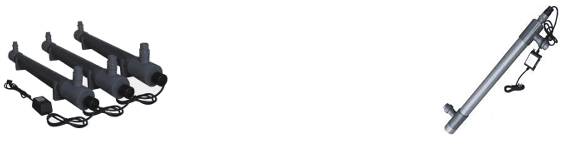
The UV sterilizers are uniquely designed to permit the water to pass all around the germicidal lamp, taking advantage of the 360° light source. When microorganisms are exposed to this light, the UV energy causes a change in the chemical bonds of the DNA molecules. This alteration results in their inability to multiply and therefore their elimination. The UV sterilizer is one of the cleanest, most non-pollution, non-chemical, without any color and odor and leaves no reside, it is the most natural way to kill virus and bacteria. This technique is often applied for fresh or marine water aquariums, garden ponds, breeder tanks and commercial applications. The UV sterilizer can be in many styles: submersible, float, flow-through, or open channel. The housing material of the flow-through UV sterilizer can be stainless steel or UPVC, the flow rate ranges from 0.2m?/h to 200 m/h. The open channel UV disinfection system has no closed disinfection reactor, it is put directly into an open water ditch to disinfect water flow through it, the treatment capacity of an open channel UV disinfection system can be 1000m/h, or as high as 10000m/h.
UV (ultraviolet) for water treatment

We supply a range of high quality, economical Ultraviolet (UV) sterilization units for water and other technology applications. UVLED (UV LED) is becoming an increasingly important technology. The UV curing industry is growing in the fields of UV-LED curing UV ink, UV adhesive UV paint, UV varnish and other UV sensitive materials. Our main focus has been UV treatment of water, but these other ultraviolet curing technologies are becoming increasingly important.
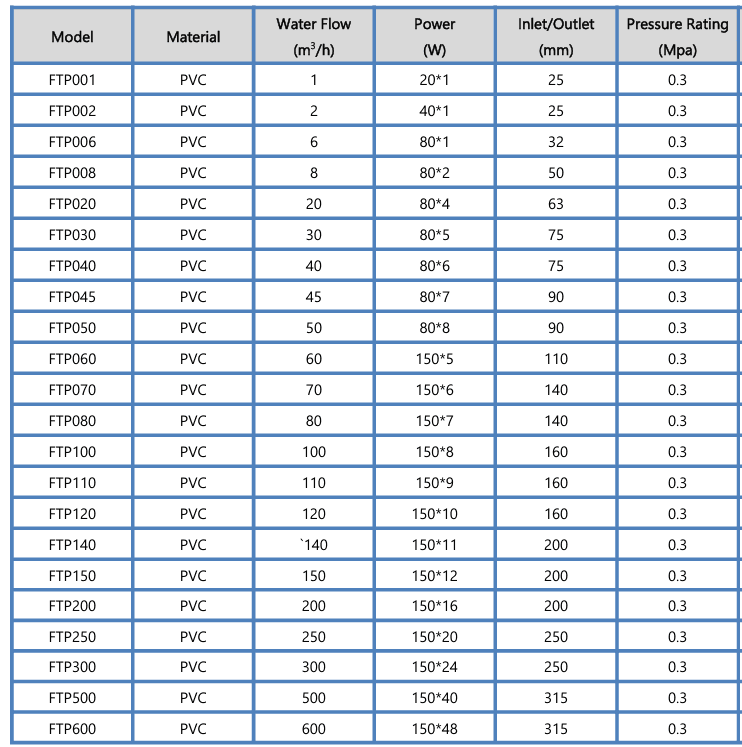
Typical ultraviolet sterilizer specifications
Note that we offer a variety of options, such as stainless steel housed units, so the below is a guideline as to what is available.


Larger type installation
The below UV setup was installed at a shrimp hatchery in Saudi Arabia.

Sizing of a UV for general use

Ultraviolet sterilizer Sizing, bacteria, algae, parasite guideline
A UV sterilizer can have different target organisms. For a koi pond is will be to lower all life – algae, bacteria, fungi and viruses – passing through the ultraviolet sterilizer. The percentage kill in this case will be low, perhaps below 50%, but constant recycling of water through the UV sterilizer has an impact.
Other systems, like a hatchery for fish or shrimp will filter the water to a high level (1 micron filters) and then send the clean water through the ultraviolet sterilizer for a much higher level of sterilization.

UV (ultraviolet) curing
Ultraviolet light can dry, bond and paint objects and materials by curing. Ecotao supplies the equiment for these UV curing applications.

UV curing oven ultraviolet
We supply a range of UV curing equipment. A wide variety of equipment includes UV light curing. These range from handheld UV LED paint dryers to large automatic, programmable UV LED dispensing and curing machines.
LED UV curing replaces UV mercury lamps as a technology. UVLED curing equipment now replaces mercury lamps. This removes both the mercury hazard and the ozone generated by mercury lamps. UVLED is cheaper, is easier to maintain, runs with lower temperatures, has a long life and does not take time to warm up or cool down.
The applications and equipment is quite diverse such as general and medical germicidal applications and UV spot, linear and area applications.


The UV-LED curing system adopts the LED lighting method. LED with different wavelengths of 365nm, 385nm, 395nm and 405nm wavelength can be used to cure different materials, such as UV glue, UV ink, UV varnish, UV paint.

365nm 385nm 395nm 405nm is available for UV LED Spot Curing systems for resin glue adhesive curing.
UV light has a wavelength of 100 to 400 nm. The shorter the wavelength, the higher the energy and the more destructive power. Ultraviolet light is categorized as A, B, and C depending on the wavelength length.
UV-A: Long wavelength UV 320-400nm
UV-B: Medium wavelength ultraviolet ray 280-320nm
UV-C: Short wavelength UV 100-280nm