
The Complete Extech Instrument Range
Moisture meters are one category within a much wider Extech line-up of electrical testers, thermal imagers, air quality analysers, sound level meters and laboratory instruments — all supplied from our Cape Town base.
Extech Moisture Meters
A moisture meter is a handheld instrument that quantifies how much water is held inside a solid material — timber, plaster, screed, masonry or soil — without having to cut a sample out and weigh it.
It does this in one of two ways. Pin (resistance) meters drive two electrodes into the material and measure the electrical resistance between them; water is conductive and dry material is not, so resistance falls sharply as moisture rises. Pinless (dielectric) meters press a sensor flat against the surface and measure how a low-power electromagnetic field is distorted by the water in the material beneath it, reading to a fixed depth without leaving a mark.
Ecotao supplies the Extech moisture meter range to building inspectors, restoration contractors, flooring installers, sawmills, agricultural operations and civil engineering laboratories throughout South Africa, Namibia, Botswana, Zimbabwe, Mozambique, Lesotho and Eswatini.
Range at a glance
- Pin-type — MO50A, MO210, MO230
- Pinless — MO57A, MO257, MO280
- Combination pin & pinless — MO55A, MO260, MO265
- Soil moisture — MO750
- Moisture psychrometer with infrared — MO290
- Restoration kits — MO280-KW, MO290-RK
- Probes, pins and extenders — see accessories
How to choose a moisture meter
The decision comes down to three questions, in this order.
1. Can you mark the surface?
If the material is a finished floor, a veneered panel, face brick or a client's furniture, pin holes are unacceptable and you need a pinless instrument. If you are working on a stripped-back restoration site, structural framing or raw stock timber, pins are fine and will give you a more defensible number.
2. Do you need an absolute number or a comparison?
Pins give a true percentage moisture content when calibrated for the material — the number you need for a kiln-drying specification, a flooring installation sign-off or an insurance report. Pinless gives a relative 0–100 value that only means something when compared against a known dry reference area on the same material.
3. How deep is the moisture?
Surface damp and a saturated substrate need different sensing depths. A 19–22 mm field suits sheet materials and thin timber; a 40 mm field reaches through a screed topping; 100 mm reaches into thick sections and subfloors. Deeper is not always better — an over-deep field on thin board will read whatever is behind it.
The efficient professional workflow
Most experienced inspectors do not choose between pin and pinless — they use both, in sequence. Scan first with pinless to sweep a wall or floor quickly and map where the moisture is concentrated, since a pinless sensor can cover several square metres a minute without damaging anything. Then confirm with pins at the two or three locations that read highest, to convert a relative indication into a defensible percentage figure at a known depth. This is exactly why the combination instruments — the MO55A, MO260 and MO265 — are the most-purchased category in the range: they collapse a two-tool workflow into one.
Pin versus pinless versus combination
← Scroll to see full table →
| Consideration | Pin (resistance) | Pinless (dielectric) | Combination |
|---|---|---|---|
| What it measures | Electrical resistance between two electrodes | Dielectric response of a sensing field beneath the sensor | Both, switchable |
| Reading type | True %MC (or %WME on non-wood) | Relative 0–100 comparative scale | %MC on pins, relative on pinless |
| Surface damage | Two small pin holes | None | None in pinless mode |
| Depth | Pin length only (typically 8–10 mm) | 19–100 mm depending on model | Both |
| Speed over an area | Slow — one point at a time | Fast — continuous sweeping | Fast to scan, slow to confirm |
| False readings from | Surface salts, conductive treatments, chemical preservatives | Metal fixings, foil-backed insulation, dense substrate behind thin board | Either, depending on mode |
| Best for | Sign-off figures, timber grading, insurance reports | Surveying, finished surfaces, locating a leak | General inspection and restoration |
The Extech moisture meter range
Pin-type moisture meters
Resistance meters that give a true percentage moisture content reading at pin depth. These are the instruments to reach for when the number itself has to stand up — a drying certificate, a timber consignment acceptance, or a report that may be read by a loss adjuster.
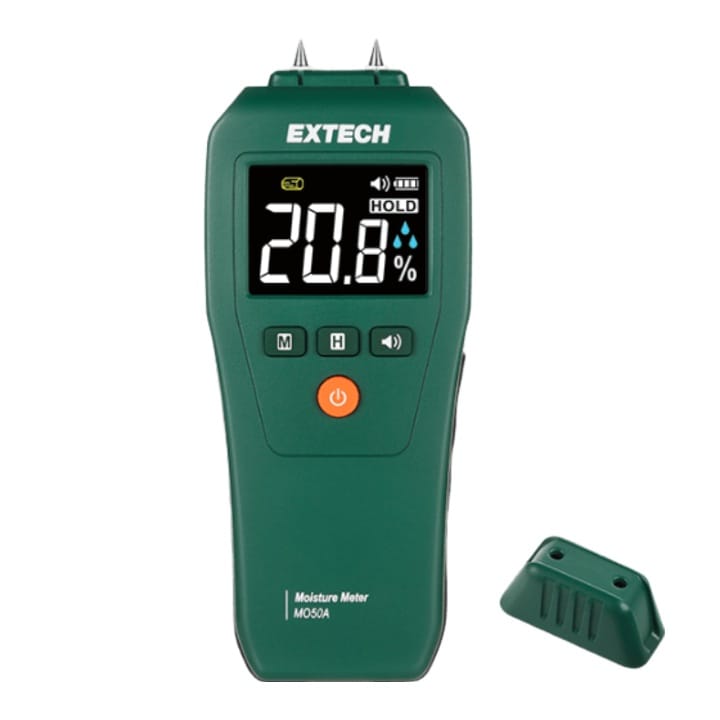
Extech MO50A
Compact Pin Moisture MeterThe entry point to the current MO5xA generation. A pocket-sized pin meter that reads wood, drywall, concrete and mortar, rebuilt around a high-contrast colour LCD with backlight — a meaningful upgrade when you are reading inside a dark roof void or under a suspended floor rather than in showroom light.
- High-contrast colour LCD with backlight
- Audible alert that beeps faster as moisture rises
- Data Hold freezes the reading for documentation
- Ships with installed and spare pins, protective cap and batteries

Extech MO210
Pocket Moisture Meter with 2-in-1 LCD and BargraphA self-contained pocket meter with a belt clip, built around two separate calibrated scales rather than one compromise scale. Switch to the building-materials setting for a 0.2–2.4% range across sheetrock, plaster, concrete and mortar; switch to timber for 6–44%. The analogue bargraph beneath the digital readout makes a rising or falling trend visible as you move the pins, which a numeric display alone does not.
- Dual measurement scale — separate building material and timber ranges
- Digital LCD plus analogue bargraph for trend visibility
- Replaceable threaded electrode pins
- Belt clip; supplied with protective cap, spare pins and three CR-2032 cells
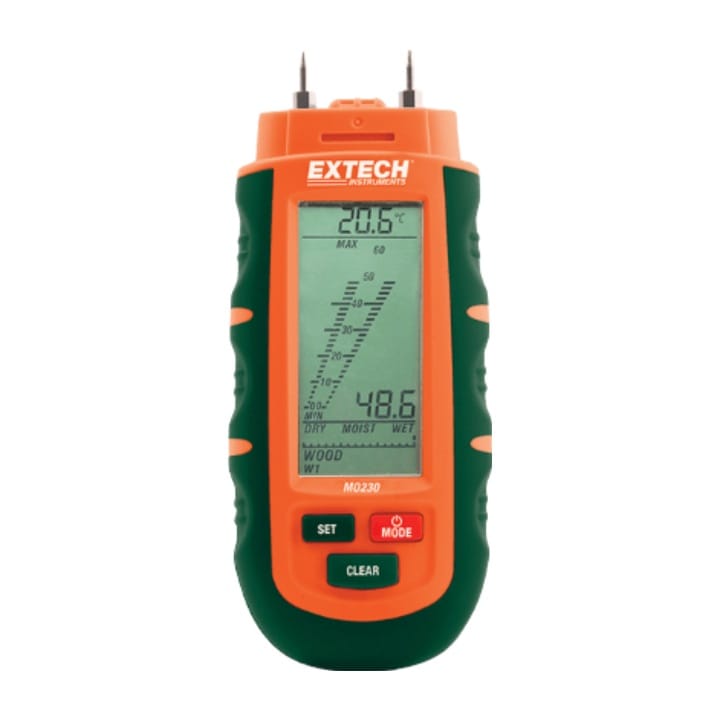
Extech MO230
Pocket Moisture Meter with Humidity & TemperatureA pin meter that also reads the air around it. Because material moisture readings are temperature-dependent, the MO230 measures ambient temperature and compensates the material reading automatically — and it lets you enter a temperature offset when the material you are testing is not at ambient, such as a wall that has been in direct Highveld afternoon sun.
- Moisture in wall board, sheet rock, cardboard, paper, mortar and plaster
- Also measures relative humidity and ambient temperature
- Automatic material temperature compensation, with manual offset
- User-configurable dry/wet threshold scale
Pinless moisture meters
Non-invasive dielectric instruments that read through the surface without touching the material's integrity. These are what you use to survey an area quickly, and the only option when the surface cannot be marked.
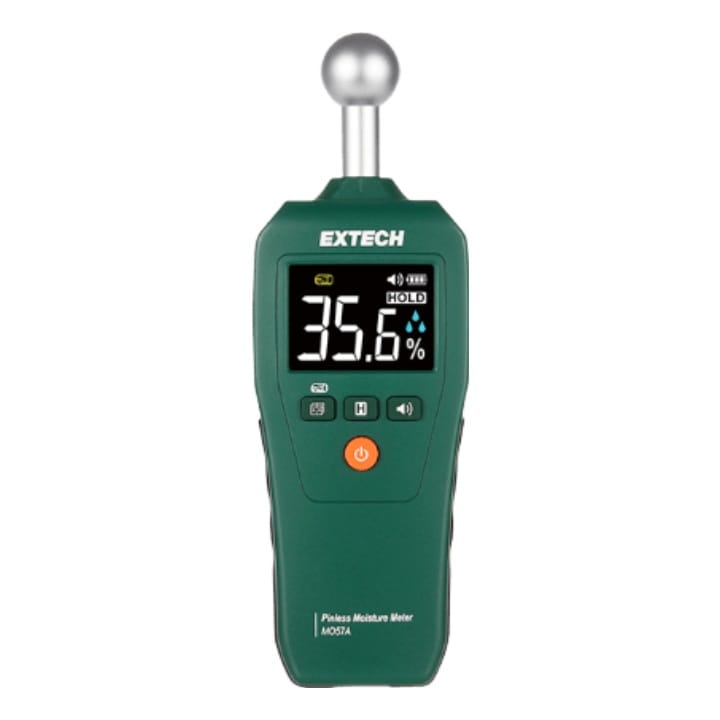
Extech MO57A
Pinless Moisture Meter, 100 mm depthThe deepest-reading pinless instrument in the range at 100 mm, and the one to specify when the moisture is not near the surface — beneath a screed, inside a thick structural member, or under a subfloor. The rounded ball probe is the detail that matters in practice: it glides across uneven, textured or delicate surfaces without catching, so you can sweep a ceiling or skirting line in a continuous motion.
- Pinless sensing depth to 100 mm — deepest in the range
- Ball probe glides smoothly over hard, delicate and uneven surfaces
- High-contrast colour LCD with backlight and intuitive icons
- Data Hold captures readings for later review

Extech MO257
Pinless Moisture Meter with Dual DepthThe most configurable pinless meter in the range. Sensing depth is selectable between 20 mm and 40 mm, which lets you deliberately distinguish surface damp from a wetter substrate by taking two readings at the same spot — a shallow reading that is dry and a deep reading that is wet tells you the problem is underneath, not condensation. Two independently adjustable alarm thresholds flash RISK or WET with an audible beep, so a technician can sweep a wall watching the surface rather than the screen.
- Relative pinless reading 0.0–100.0 at 0.1 resolution
- Selectable sensing depth: 20 mm or 40 mm
- High-frequency sensing technology
- Two adjustable alarms with audible beeper and flashing RISK / WET indicators
- Multifunction backlit triple LCD; automatic calibration in dry air at power-on
- Automatic Data Hold, low battery indication, auto power off
- Supplied with three AA batteries and pouch case
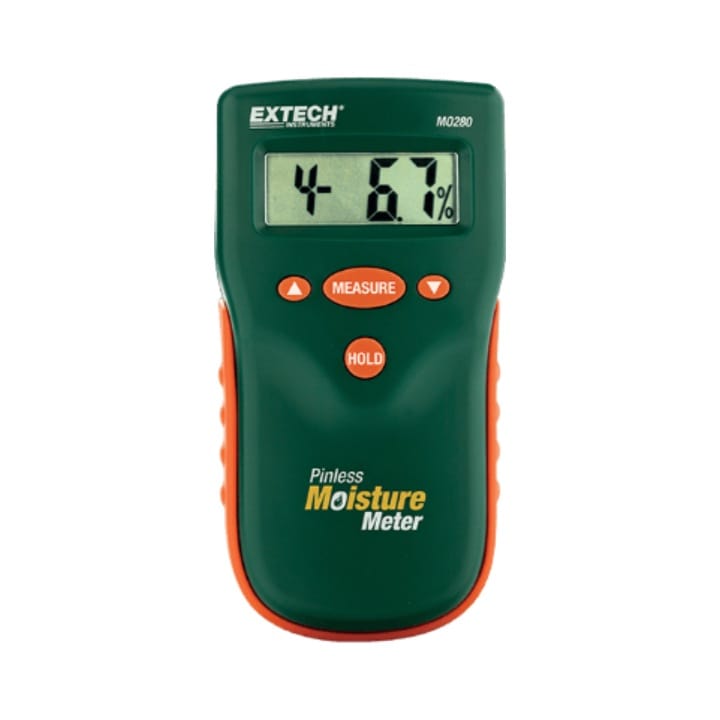
Extech MO280
Pinless Moisture Meter, 22 mm depthA straightforward electro-magnetic pinless meter reading to 22 mm with virtually no surface damage. The 22 mm field is well matched to sheet materials, floorboards and plasterwork — deep enough to see past the surface skin, shallow enough that it will not read the masonry or steel stud behind a board and report it as a wet ceiling. This is also the meter at the heart of the MO280-KW restoration kit.
- Electro-magnetic sensing to 22 mm below the surface
- Non-invasive — no marks on finished timber or decorative surfaces
- Quickly indicates moisture content across wood and building materials
Combination pin & pinless moisture meters
One instrument covering both measurement principles. This is the most practical single purchase for anyone doing general building inspection or restoration work, because it supports the scan-then-confirm workflow without carrying two meters.
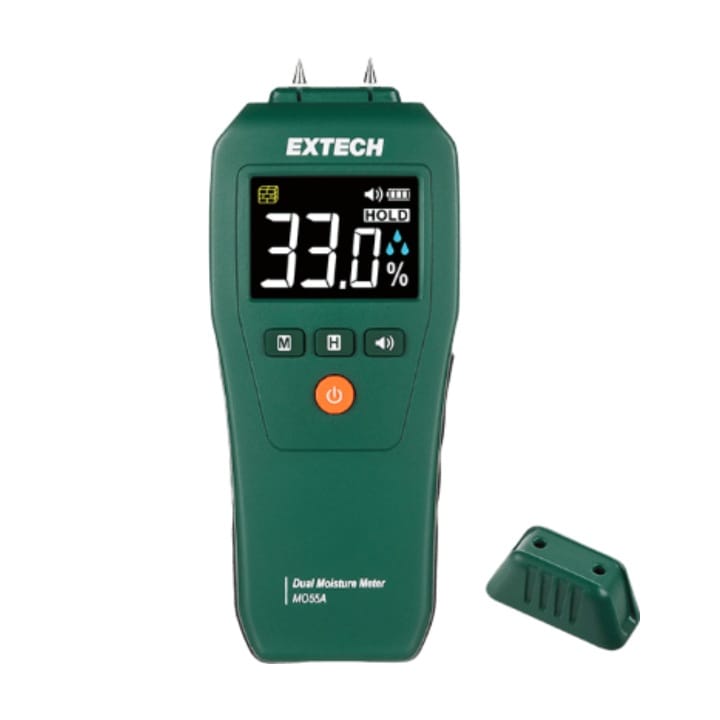
Extech MO55A
Combination Pin/Pinless Moisture MeterBoth measurement modes in one compact body, at the accessible end of the combination category. Pinless scanning reaches 25 mm for non-destructive sweeps; switch to pins to convert a suspect area into a firm reading. Particularly useful in restoration, where the moisture is often hidden under flooring or tile and the whole point is to find it while minimising the damage you cause looking.
- Switchable pin and pinless measurement in one instrument
- Pinless scanning to 25 mm depth
- High-contrast colour LCD with backlight and clear visual indicators
- Audible alert that speeds up as moisture increases
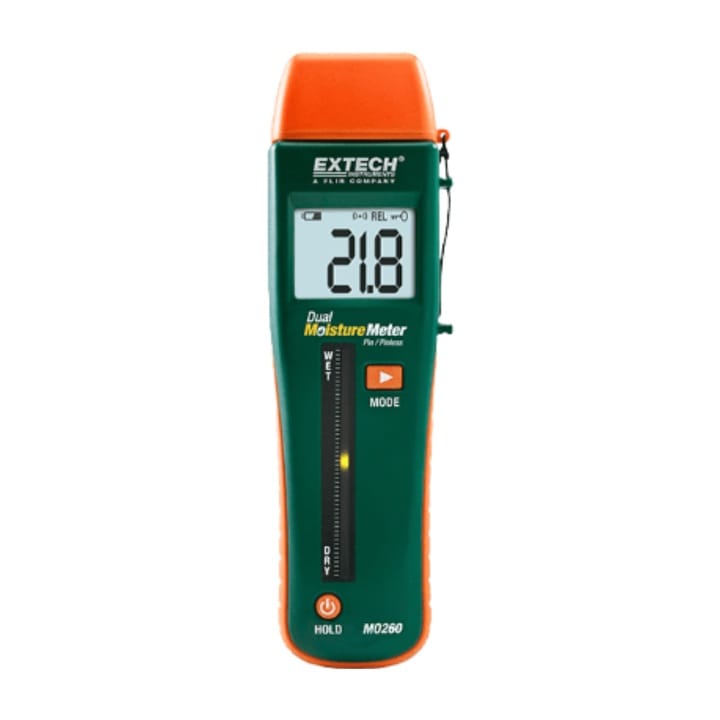
Extech MO260
Combination Pin/Pinless Moisture MeterAdds a tri-colour LED bargraph alongside the backlit digital readout, giving an at-a-glance green / amber / red verdict without having to interpret a number — useful when you are handing the meter to a client or a site foreman to look at. A built-in calibration check confirms the instrument is reading correctly before you start a job.
- Pin (%) and pinless (relative) measurement modes
- Backlit digital LCD with tri-colour LED bargraph
- Electro-magnetic pinless sensing to approximately 19 mm
- Built-in calibration check
- Replaceable electrode pins and protective cap
- Supplied with 9V battery, replacement pins and pouch case

Extech MO265
Combination Pin/Pinless Moisture Meter with Remote ProbeThe professional specification in this category. The differentiator is the remote pin probe on a lead: it separates the pins from the meter body, so you can push them into the back of a cupboard, behind a skirting, under a joist or into an awkward corner while still reading the display comfortably. Readings are given as %WME on pins and on a relative scale pinless, with backlighting and a tri-colour LED bargraph. Supplied in a hard case rather than a pouch.
- Pinless (relative) or contact pin (%WME) measurement
- Remote pin probe included for hard-to-reach areas
- Pinless measurement depth to 22 mm; electro-magnetic sensing
- Backlit digital LCD with tri-colour LED bargraph
- Built-in calibration check; replaceable electrode pins
- Supplied with 9V battery, remote pin probe, spare pins, protective cap and hard carrying case
Soil moisture
A different instrument class entirely. Building moisture meters have short pins calibrated for the resistance range of timber and masonry, and will neither read soil usefully nor survive being buried in it.
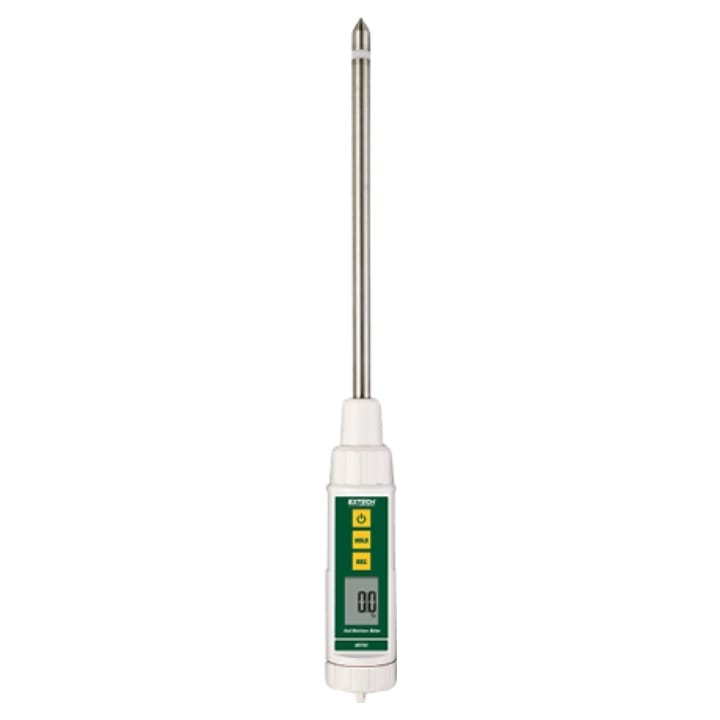
Extech MO750
Soil Moisture Meter with 200 mm ProbeAn integrated 200 mm heavy-duty probe reads soil moisture from 0 to 50% in one-handed operation — you push it in, read it, pull it out and move on, which matters when you are sampling a grid across a field rather than taking one reading. The 200 mm length puts the sensing element down in the active root zone rather than in the dry surface crust, which is where a short probe misleads you badly on a hot Karoo or Highveld afternoon. Water-resistant housing, min/max recall and Data Hold. The probe (MO750-P) is replaceable, so a bent or worn probe does not retire the meter.
- Soil moisture measurement 0–50%
- Integrated 200 mm (8 in) heavy-duty probe
- Easy one-handed operation for rapid grid sampling
- Min/Max recall and Data Hold
- Durable water-resistant housing; large LCD
- Supplied with replaceable probe, four AAA batteries, probe sensor cap and manual
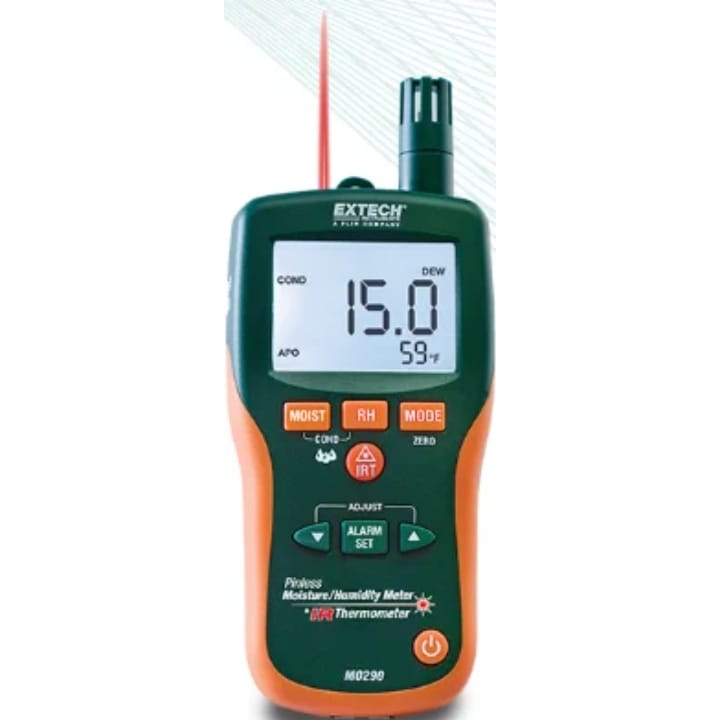
Extech MO290
Pinless Moisture Psychrometer + Infrared ThermometerThe most capable single instrument in the range, and the one that answers the question a plain moisture meter cannot: is this material wet because of a leak, or because the air around it is wet? It reads material moisture pinlessly, ambient humidity and air temperature from a built-in probe, and non-contact surface temperature via a patented infrared circuit with an 8:1 distance-to-spot ratio. Because it can display material moisture and dew point simultaneously, you can tell immediately whether a cold surface is below dew point and condensing — a completely different remedy from a plumbing leak. A remote pin probe (MO290-P, 0.9 m lead) is included for contact readings in hazardous or hard-to-reach positions.
- Pinless moisture sensing with no surface damage
- Built-in humidity and air temperature probe
- Non-contact infrared thermometer, 8:1 distance-to-spot ratio
- Derived values including dew point, vapour pressure and grains per pound
- Dual display with automatic backlight; programmable high/low moisture and humidity alarms
- Selectable wood types and measurement ranges
- Remote pin probe (MO290-P) included, 0.9 m cable
Restoration and contractor kits
Water damage restoration is not a single measurement — it is a documented drying programme. These kits pair a moisture instrument with the humidity measurement needed to prove the drying environment was controlled, which is what an insurer asks for.

Extech MO280-KW
Water Damage Restoration KitBuilt specifically for water damage restoration contractors, and sensibly specified: a pinless meter to survey without damaging a client's finishes, a pin meter to confirm the finding as a number, and a precision hygro-thermometer to record the ambient conditions the drying equipment is producing. Together those three instruments produce the evidence trail an insurance claim needs — job site conditions, drying progress over time, and a defensible sign-off.
- MO280 Pinless Moisture Meter — non-invasive survey to 22 mm
- MO210 Pocket Moisture Meter — pin confirmation readings
- RH490 Precision Hygro-Thermometer — ambient conditions
- Monitors job site conditions, drying progress and insurance reporting
- Supplied in a storage case
Extech MO290-RK
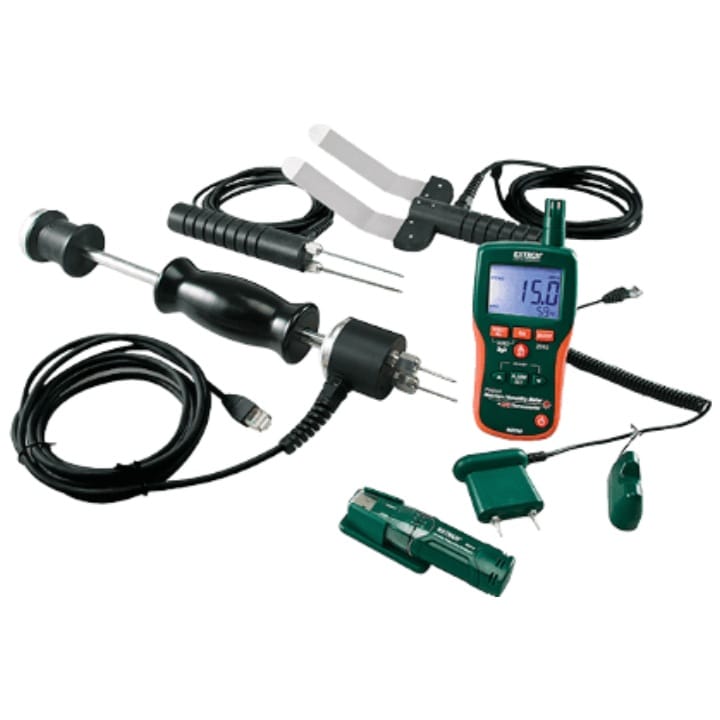
Water Restoration Contractor KitThe upper-tier restoration package, and the one to choose when you need an unattended record rather than a series of site visits. It pairs the MO290 moisture psychrometer with an RHT10 USB humidity and temperature datalogger that can be left running on site for the duration of the drying programme. Instead of arguing that conditions were maintained, you download a continuous logged curve and attach it to the report.
- MO290 Pinless Moisture Psychrometer with infrared thermometer
- RHT10 USB humidity and temperature datalogger
- Unattended logging across the full drying programme
- Downloadable record for insurance and client reporting
Extech moisture meter comparison
← Scroll to see full table →
| Model | Measurement type | Pinless depth | Notable feature | Typical user |
|---|---|---|---|---|
| MO50A | Pin | — | Colour LCD, Data Hold, compact | Maintenance teams, spot checks |
| MO210 | Pin | — | Dual scale + analogue bargraph, belt clip | Inspectors, everyday carry |
| MO230 | Pin + RH/temp | — | Temperature compensation with manual offset | Drying supervision |
| MO57A | Pinless | 100 mm | Deepest field; ball probe for uneven surfaces | Subfloors, thick timber sections |
| MO257 | Pinless | 20 or 40 mm | Selectable depth; RISK / WET alarms | Surface vs. substrate diagnosis |
| MO280 | Pinless | 22 mm | Simple, robust electro-magnetic sensing | Sheet materials, flooring |
| MO55A | Combination | 25 mm | Colour LCD; both modes in a compact body | First combination meter |
| MO260 | Combination | ~19 mm | Tri-colour LED bargraph; calibration check | Client-facing inspection |
| MO265 | Combination | 22 mm | Remote pin probe on lead; hard case | Professional inspection |
| MO750 | Soil probe | — | 200 mm probe, 0–50%, water resistant | Agriculture, turf, civil |
| MO290 | Pinless + psychrometer + IR | Pinless | 8-in-1; dew point; 8:1 IR optics | Diagnosis and formal reporting |
| MO280-KW | Kit (3 instruments) | 22 mm | MO280 + MO210 + RH490 in case | Restoration contractors |
| MO290-RK | Kit (instrument + logger) | Pinless | MO290 + RHT10 USB datalogger | Long or disputed drying programmes |
Understanding %MC, %WME and relative scales
A moisture meter reading is only useful if you know which of three quite different things it is telling you. Confusing them is the single most common cause of a misread report.
%MC — true moisture content
The mass of water in the material expressed as a percentage of its oven-dry mass. This is the real, physical quantity, and it is what a specification means when it calls for timber at 12%. A pin meter reports valid %MC only when it is set to the correct material — a meter calibrated for pine will misreport a dense hardwood, sometimes by several percentage points.
%WME — wood moisture equivalent
What a wood-calibrated pin meter reports when its pins are in something that is not wood — plaster, screed, brick. It is not that material's actual moisture content and should never be quoted as such. What it is, is consistent: a %WME of 22 in one part of a wall and 11 in another reliably tells you the first area holds roughly twice the moisture. That comparison is usually what the investigation actually needs.
Relative scale (0–100)
What pinless meters report. It has no physical units and no absolute meaning whatsoever. A reading of 60 is not 60% water. It becomes meaningful the moment you take a reference reading on a matching area of the same material that you know to be dry: if the reference reads 15 and the suspect area reads 60, you have found something. Without the reference, you have found nothing.
The reference reading habit
Whatever meter you use, take a control reading on known-dry material of the same type, in the same building, before you take the reading that matters. It costs thirty seconds and it converts an ambiguous number into evidence. It also catches an instrument fault immediately — if your known-dry reference reads wet, the problem is the meter, not the wall.
Moisture measurement in South African conditions
South Africa spans several genuinely distinct moisture climates, and a target figure that is correct in Johannesburg will be wrong in Durban. Because timber and masonry equilibrate with the air around them, the moisture content material settles at — its equilibrium moisture content, or EMC — is a property of the location and the season, not of the material alone.
← Scroll to see full table →
| Region | Moisture character | Practical implication for measurement |
|---|---|---|
| Cape Town & Western Cape | Winter rainfall; humid and wet May–August, dry and windy summer | Readings swing seasonally on the same wall. A reading taken in July is not comparable with one taken in January — always re-establish a dry reference on the day. |
| Durban & KZN coast | Subtropical, persistently high humidity year-round | Materials sit at a naturally higher EMC. Timber acclimatised inland will take up moisture and expand after installation on the coast if it is not conditioned locally first. |
| Gauteng & the Highveld | Dry winters, summer afternoon thunderstorms, high altitude | Very low winter EMC dries materials aggressively. Timber installed at coastal moisture content will shrink and gap over its first Highveld winter. |
| Karoo & interior | Arid, very large diurnal temperature swing | Surface readings mislead badly — a dry crust can cover damp material. Use a deeper pinless field or drive pins past the surface layer. |
| Lowveld & Mpumalanga | Hot, humid summers; mild dry winters | Condensation risk is high in air-conditioned interiors. Distinguish condensation from ingress using a dew point capable instrument. |
Working guidance for timber in South Africa
As a practical starting point rather than a specification: interior joinery and flooring on the Highveld is generally conditioned to roughly 8–11% MC; the humid KZN coastal belt usually settles higher at around 11–14%; and Cape Town falls between the two, shifting with the winter rainfall pattern. Structural timber in a roof void behaves differently again, since the void is ventilated and tracks outdoor conditions rather than indoor ones.
The rule that holds everywhere: measure the timber and measure the space it is going into. Let the material acclimatise on site until repeated readings stop changing over several days, and only then fix it down. Installing timber that is 4% wetter than its eventual equilibrium is the usual cause of cupped floors and split skirtings, and no adhesive or fixing schedule compensates for it.
Condensation or a leak? A South African diagnostic
Damp on an interior wall has two entirely different causes with entirely different remedies, and the wrong diagnosis wastes a lot of money. Ingress — a failed roof, a cracked wall, rising damp, a burst pipe — produces moisture that is highest at the source and reduces with distance from it, and it persists regardless of indoor conditions. Condensation produces moisture on the coldest surfaces, appears and disappears with the weather and with occupancy, and is common in poorly ventilated Cape Town bedrooms in winter and in over-cooled Durban offices in summer.
The distinguishing measurement is dew point. If the surface temperature of the wall is at or below the dew point of the air in the room, that surface will condense water out of the air and no amount of waterproofing will stop it — the answer is ventilation, heating or insulation. This is precisely what the MO290 is built to determine in a single reading: it gives you material moisture, room humidity, air temperature and non-contact surface temperature together, so the comparison takes seconds rather than requiring three instruments and a psychrometric chart.
Applications across South African industry
Building inspection and pre-purchase surveys
A moisture meter converts "there seems to be a damp patch" into a mapped, quantified finding that a report can defend. Pinless scanning locates the extent of an affected area without leaving a single mark on a home the seller still occupies, and pin readings at the worst points give figures the buyer's attorney can act on. The MO265 is the common choice here because the remote probe reaches behind fitted cupboards and under skirtings where damp collects and hides.
Water damage restoration
Restoration is a documented process, not a single visit. Contractors need an initial moisture map, a series of readings proving the material is drying, and a final reading proving it is dry — plus a record of the ambient conditions the dehumidifiers were producing throughout. The MO280-KW covers this for typical jobs; the MO290-RK adds continuous unattended logging for claims where the drying period itself is disputed.
Flooring installation
Wood flooring failures are overwhelmingly moisture failures, and almost always avoidable. Both the flooring and the substrate must be measured before installation: a concrete screed that has not fully cured will drive moisture into a floor laid over it for months. Pinless meters are essential for checking finished or pre-sealed boards that cannot be pin-tested, and the deeper field of the MO57A reaches into a screed rather than reading only its dry surface skin.
Sawmilling and timber processing
Kiln operators need consistent, repeatable readings across a stack to decide when a charge is finished, and a batch pulled at the wrong moisture content is either wasted energy or a warranty claim. Pin meters give the true %MC figure a drying schedule is written in, and pins driven to depth reveal the moisture gradient between a dry shell and a wetter core — a gradient that a surface reading alone completely hides.
Agriculture and irrigation
The MO750's 200 mm probe reads in the active root zone rather than the surface crust, which is the difference between scheduling irrigation on real data and scheduling it on the look of the topsoil. Grid sampling across a block reveals whether an irrigation system is applying water evenly, and repeated readings at the same points over a season show how quickly a soil actually drains.
Civil engineering and materials testing
Compaction moisture content governs whether a fill layer will reach its specified density, and a layer placed too wet or too dry fails the test no matter how many passes the roller makes. A field soil moisture reading gives an immediate indication of whether a layer is near optimum before the nuclear gauge or laboratory result confirms it, saving a rework cycle.
Probes, pins and accessories
Pins are consumable and probes are the part that gets bent, dropped or corroded. Replacements are available for the models below, so a damaged probe does not mean replacing the instrument.
← Scroll to see full table →
| Accessory | Description | Fits |
|---|---|---|
| MO290-P | Remote moisture pin probe with two 10 mm pins assembled on the probe head | MO290, MO295, MO297, MO300 |
| MO290-BP | Baseboard probe for reading behind skirtings and at wall/floor junctions | MO290, MO295, MO297, MO300 |
| MO290-EP | Extension moisture probe with dual sharp pins on a flexible cable | For use with MO290-EXT extenders |
| MO290-EXT | Probe extender; two combined give roughly 580 mm of extra reach for ceilings and high walls | MO290 series |
| MO750-P | Replacement 200 mm heavy-duty soil moisture probe | MO750 |
| Replacement pins | Threaded electrode pins — consumable, bend and blunt with use in dense material | MO210, MO260, MO265 and other pin models |
Frequently asked questions
What is the difference between a pin and a pinless moisture meter?
A pin moisture meter drives two electrodes into the material and measures the electrical resistance between them, which falls as moisture rises. It gives a true percentage moisture content reading at a known depth, but leaves two small holes. A pinless meter presses a flat or ball sensor against the surface and reads the dielectric response of everything in a sensing field beneath it, typically 20 to 100 mm deep. It leaves no marks and covers ground quickly, but returns a relative comparative value rather than an absolute percentage, and it can be misled by metal, foil-backed insulation or dense fixings within the field. Most professionals scan with pinless to find the wet area, then confirm with pins.
Which Extech moisture meter should I buy for building inspection in South Africa?
For general building inspection where you need to survey quickly and then confirm a finding, a combination pin and pinless instrument is the most efficient single purchase. The MO55A covers this at entry level with pinless scanning to 25 mm, and the MO265 covers it at professional level with a remote pin probe on a lead and a hard case. If you inspect finished surfaces you cannot mark, such as sealed hardwood floors or face brick, choose a pinless-only meter like the MO257 or MO57A. If you only need occasional spot checks on plaster and drywall, the pocket-sized MO210 or MO50A is sufficient.
What moisture content should timber be at before installation in South Africa?
Timber equilibrates to the humidity of the space it sits in, so the target depends on region and on whether the space is air conditioned. As a working guide for South African conditions, interior joinery and flooring in the Highveld interior is generally conditioned to roughly 8–11% moisture content, while the humid coastal belt around Durban and the KwaZulu-Natal north coast usually sits higher, around 11–14%. Cape Town falls between the two and shifts seasonally with the winter rainfall pattern. The practical rule is to measure the timber and the space it is going into, allow the material to acclimatise on site until readings stabilise over several days, and only then fix it down.
What is the difference between %MC, %WME and a relative moisture scale?
%MC is true moisture content — the mass of water expressed as a percentage of the oven-dry mass of the material — and it is only valid when the meter is calibrated for that specific material. %WME, or wood moisture equivalent, is the reading a meter calibrated for wood produces when its pins are placed in a non-wood material such as plaster or screed. It is not that material's actual moisture content, but it is a consistent and comparable number that tells you whether the material is wetter or drier than surrounding areas. A relative scale, typically 0 to 100, is what pinless meters report. It has no physical units at all and is only meaningful as a comparison between a suspect area and a known dry reference area on the same material.
How deep can a pinless moisture meter read?
Sensing depth varies considerably across the range and is one of the main reasons to choose one model over another. Within the Extech range the MO260 reads to about 19 mm, the MO265 and MO280 to about 22 mm, the MO55A to 25 mm, the MO257 to a selectable 20 mm or 40 mm, and the MO57A to 100 mm. Deeper is not automatically better. A deep sensing field is what you want for finding moisture under a screed or behind a thick timber section, but on a thin sheet material it will read through the sheet and pick up whatever sits behind it, including damp masonry or metal framing, which will read as a false positive.
Can a moisture meter be used to check soil moisture for irrigation?
Only a meter designed for soil should be used for that purpose. A building moisture meter has short pins calibrated for the resistance range of timber and masonry, and it will not read soil usefully or survive burial. The MO750 is the soil instrument in this range: it has an integrated 200 mm heavy-duty probe, reads 0–50% soil moisture, and has water-resistant housing intended for repeated field insertion. It suits irrigation scheduling, nursery and turf management, and checking compaction water content on civil sites.
Do moisture meters need calibration?
Resistance-type pin meters are inherently stable because they measure a physical electrical property, so they do not drift in the way a chemical sensor does. What they do need is a periodic functional check, and several models including the MO260 and MO265 have a built-in calibration check for exactly this. Pinless meters self-calibrate in dry air at power-on, which is why the MO257 should be switched on while held away from any surface. If a meter is used for reports that carry commercial or insurance weight, keep a known dry reference sample of the material you commonly test and check the meter against it at the start of each job.
Why does my moisture meter read differently on the same wall in summer and winter?
Building materials are hygroscopic, meaning they continuously exchange moisture with the surrounding air until they reach equilibrium with it. In the Western Cape winter rainfall region, ambient humidity rises sharply from May to August and wall readings rise with it even where there is no leak. On the Highveld the opposite happens: dry winters pull moisture out of materials and readings fall. This is why a single reading in isolation proves very little. Take a reference reading on a matching area you know to be dry, compare the suspect area against it, and where the distinction matters use an instrument such as the MO290 that logs ambient humidity and dew point alongside the material reading.
Not sure which moisture meter fits your application?
Tell us what you are measuring, whether you can mark the surface, and how deep the moisture is likely to be — and we will point you at the right instrument rather than the most expensive one. Supplied across South Africa, Namibia, Botswana, Zimbabwe, Mozambique, Lesotho and Eswatini.