
Extech Pressure Meters & Digital Manometers
A digital manometer measures the difference in pressure between two points, or between one point and the surrounding atmosphere, using a silicon sensing element in place of the liquid column that gave the instrument its name. Extech's pressure range spans 0.5 psi to 101.5 psi (34 mbar to 7000 mbar) in eight current models, from high-resolution low-range meters for cleanroom and duct work through to SD-card dataloggers for unattended compressed-air and hydraulic monitoring.
Ecotao Enterprises supplies the Extech pressure range from our Cape Town base to customers throughout South Africa, Namibia, Botswana, Zimbabwe, Mozambique, Lesotho and Eswatini. This page sets out what each model actually measures, how the ranges differ in practice, and how to size an instrument so you are not spending most of your accuracy budget on span you will never use.
The one thing that decides which model you need
Every meter here quotes accuracy as a percentage of full scale, not a percentage of reading. On a 29 psi instrument at ±1% full scale, the uncertainty is roughly 0.29 psi whether the display shows 28 psi or 0.5 psi. On a 0.5 psi instrument at ±0.3% full scale it is roughly 0.0015 psi. Pick the smallest range that still comfortably covers your expected maximum, and you gain two orders of magnitude in usable precision at no extra cost.
Extech pressure meter range at a glance
All eight models are two-port instruments, so each can work as a differential meter using both ports or as a gauge meter with one port open to atmosphere. The split that matters is between handheld meters with a live PC interface and SD-card dataloggers that can be left running unattended.
← Scroll to see full table →
| Model | Full-scale range | Equivalent | Basic accuracy | Units | Data output | Best suited to |
|---|---|---|---|---|---|---|
| HD755 | 0.5 psi | 34 mbar / 13.85 inH₂O | ±0.3% FS | 11 | USB + software | Cleanroom, filter differential, low duct static |
| HD700 | 2 psi | 137 mbar / 55.40 inH₂O | ±0.3% FS | 11 | USB + software | General HVAC duct and fan static pressure |
| HD750 | 5 psi | 344 mbar / 138.3 inH₂O | ±0.3% FS | 11 | USB + software | Blowers, aeration headers, gas train pressure |
| 407910 | 29 psi | 2 bar / 2.04 kg/cm² | ±1% FS | 8 | RS-232 + software | Pneumatics, compressed air, rugged site work |
| HD350 | 0.7252 psi | 50 mbar + air velocity | ±1% FS (velocity) | 5 | USB + software | Pitot traverses, air velocity and volumetric flow |
| SDL710 | 2.9 psi | 200 mbar / 80.2 inH₂O | ±2% FS | Multi | SD card (Excel) | Unattended low-pressure logging over days |
| SDL720 | 29 psi | 2000 mbar / 1.974 atm | ±2% FS | Multi | SD card (Excel) | Compressed air ring and process gas logging |
| SDL730 | 101.5 psi | 7000 mbar / 6.905 atm | ±2% FS | Multi | SD card (Excel) | Hydraulic circuits, high-pressure air, pump testing |
Discontinued: Extech SDL700 and PT-series transducers
The SDL700 is now a legacy product
The Extech SDL700 3-Channel Pressure Meter/Datalogger and its plug-in PT30, PT150 and PT300 universal pressure transducers have been moved to legacy status by Extech and are no longer in current production. This page previously listed the SDL700; it has been replaced by the current range below.
What to buy instead. The SDL710 / SDL720 / SDL730 family covers the same measurement territory with an important simplification: the sensing elements are built into the meter as dual differential inputs, so there are no separate transducers to specify, match to a range, or replace when one goes missing. The SDL720 at 29 psi is the closest direct equivalent to an SDL700 fitted with the 30 psi PT30 transducer, and the SDL730 at 101.5 psi extends well beyond what the old PT300 covered in a single reading. All three log to SD card in Excel-ready format exactly as the SDL700 did.
If you are running an existing measurement routine built around SDL700 data files, contact us before ordering — the column layout of the SD card output differs slightly between the two generations.
How to choose the right pressure meter range
Sizing a manometer is a three-step decision. Work through it in this order, because the first step eliminates most of the catalogue and the third one is the only place where budget should enter.
Step 1 — Establish your expected maximum, then add about 25%
Take the highest pressure you realistically need to read, not the highest the system could theoretically reach. A typical commercial HVAC filter bank runs 50–250 Pa clean and is changed somewhere around 500–750 Pa, which is 0.007 to 0.11 psi — a job for the HD755 at 0.5 psi. A shop compressed-air ring at 6 bar is 87 psi, which needs the SDL730 at 101.5 psi. A side-channel blower discharging at 250 mbar is 3.6 psi, which lands on the HD750 at 5 psi. Adding roughly 25% headroom protects the sensor against transients without pushing you into a range that costs you resolution.
Step 2 — Decide whether you need a record or just a reading
If a technician stands at the instrument, reads a number, writes it on a commissioning sheet and moves on, a handheld HD-series meter is the right tool: it powers up instantly, resolves finely, and the USB interface is there when a live trace is occasionally useful. If the question is "what is this system doing at 03:00 on a Sunday", no amount of resolution helps and you need an SDL-series logger writing to an SD card. Filter loading trends, compressor duty cycling, intermittent pressure drops and night-setback verification all fall into the second category, and all of them are effectively invisible to spot readings.
Step 3 — Check whether pressure is actually what you want
A surprising share of pressure-meter enquiries are really airflow enquiries. If the deliverable is m³/h, CFM or m/s rather than pascal, the HD350 does the conversion internally from a pitot tube differential and saves a manual calculation on every reading. Buying a pure manometer and a separate pitot tube works, but you will be applying the velocity-pressure equation by hand at every traverse point, which is where duct traverse errors usually creep in.
Quick reference: which model for which pressure
← Scroll to see full table →
| Your expected maximum | Spot readings | Logged over time |
|---|---|---|
| Under 30 mbar (0.44 psi / 300 Pa) | HD755 | SDL710 |
| 30–130 mbar (0.44–1.9 psi) | HD700 | SDL710 |
| 130–340 mbar (1.9–5 psi) | HD750 | SDL720 |
| 340 mbar – 2 bar (5–29 psi) | 407910 | SDL720 |
| 2–7 bar (29–101.5 psi) | — | SDL730 |
| Air velocity / volumetric flow | HD350 | — |
The Extech pressure meter range
Eight current models, listed from lowest range to highest. Handheld meters first, then the SD-card datalogger family.

Extech HD755
Differential Pressure Manometer — 0.5 psi
The finest-resolution instrument in the range. At 0.001 psi resolution across a 0.5 psi span, the HD755 reads the small differentials that make up most building-services work — the pressure drop across a filter bank, the cascade between a cleanroom and its anteroom, the static in a low-velocity supply duct. Those readings sit in the bottom 2% of a 29 psi meter's scale and are effectively unmeasurable on one. The zero function corrects for sensor offset before each set of readings, and the built-in USB port streams a live trace when you need to watch a value settle rather than catch it once.
- Range0 to 0.5 psi / 13.85 inH₂O
- Resolution0.001 psi
- Accuracy±0.3% full scale
- Units11 selectable
- InterfaceUSB (software + cable)
Right choice when: your readings are in pascal rather than bar — cleanroom pressurisation, filter differential, fume cupboard face pressure, low duct static.

Extech HD350
Pitot Tube Anemometer + Differential Manometer
A differential manometer that finishes the calculation for you. Feed it velocity pressure from the supplied pitot tube and it displays air velocity and volumetric flow alongside the raw pressure and temperature, on one screen, in the units your specification is written in. That matters most on a duct traverse, where a technician takes readings at a dozen points across a cross-section: doing the velocity-pressure conversion by hand at every point is where traverse errors normally come from. The pitot tube and its two 85 cm hoses reach into ducts and plenums that a vane anemometer cannot enter, and the 99-reading store means a full traverse can be captured before anything is written down.
- Pressure range±0.7252 psi (50 mbar)
- Air velocity200 to 15733 ft/min
- 3.5 to 288.0 km/h
- Accuracy±1% full scale
- Units5 pressure units
- Memory99 readings per mode
- InterfaceUSB (software + cable)
Right choice when: the deliverable is m³/h, CFM or m/s rather than pascal — duct traverses, extraction system commissioning, fan performance verification.

Extech HD700
Differential Pressure Manometer — 2 psi
The general-purpose middle of the HD family, and the model most HVAC contractors end up carrying. Two psi is 55.40 inches of water column, which comfortably covers fan discharge static, ducted system total pressure and a heavily loaded filter bank without the resolution penalty of jumping to a 5 psi or 29 psi range. Accuracy holds at ±0.3% full scale across the span, and the relative time stamp on Max/Min recording tells you not just what the extremes were but when they occurred — useful when a system is cycling and you are trying to correlate a pressure spike with a damper movement. Supplied with an AC adaptor as well as a 9V battery, so it can sit powered on a bench for extended tests.
- Range0 to 2 psi / 55.40 inH₂O
- Equivalent0.137 bar
- Accuracy±0.3% full scale
- Units11 selectable
- RecordingMax/Min + relative time stamp
- InterfaceUSB (software + cable)
Right choice when: you want one meter that handles most building-services pressure work — fan static, ducted total pressure, loaded filters, balancing dampers.
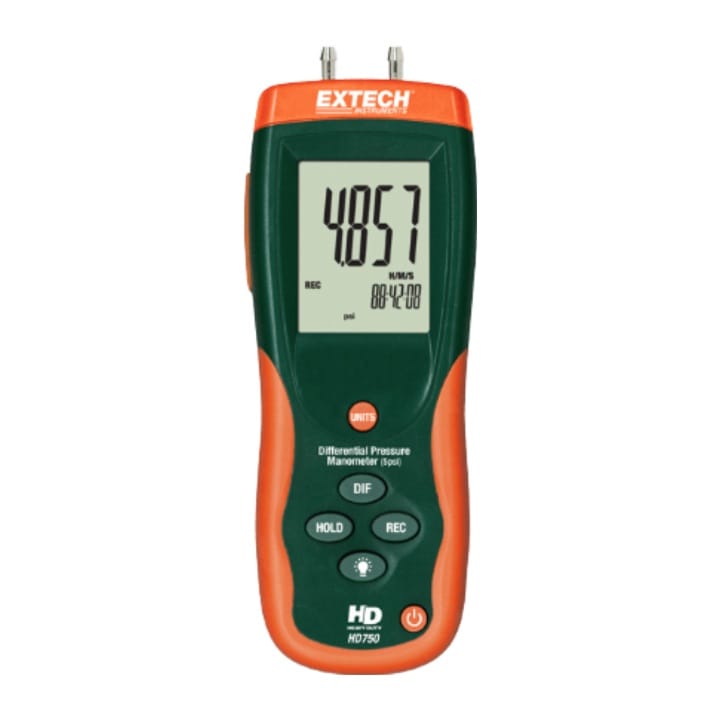
Extech HD750
Differential Pressure Manometer — 5 psi
Five psi — 344 mbar, or 138.3 inches of water column — is the natural range for equipment that sits between HVAC and true pneumatics. Side-channel and regenerative blowers, aeration diffuser headers in wastewater and aquaculture, gas train pressure ahead of a burner, and dust extraction plant with heavily loaded bag filters all live here. Below this range a 2 psi meter over-ranges; above it a 29 psi meter throws away most of its resolution. The HD750 shares the HD-family ±0.3% full-scale accuracy, 11 selectable units and USB interface, so a fleet of HD700, HD750 and HD755 meters behaves identically in the hand and produces interchangeable data files.
- Range0 to 5 psi / 138.3 inH₂O
- Equivalent0.344 bar
- Accuracy±0.3% full scale
- Units11 selectable
- RecordingMax/Min + relative time stamp
- InterfaceUSB (software + cable)
Right choice when: you are measuring blower discharge, aeration header pressure or gas train pressure — too high for a 2 psi meter, too low to waste on a 29 psi one.

Extech 407910
Heavy Duty Differential Pressure Manometer — 29 psi
The rugged member of the range, built for pneumatic and compressed-air work where the instrument gets carried around a plant rather than kept in a case. Twenty-nine psi is 2 bar, which covers shop air lines, pneumatic cylinder supply pressure, air-operated valve actuators and the discharge side of small compressors. The two quick-disconnect fittings matter more than the specification sheet suggests: on pneumatic circuits you are constantly moving between test points, and threaded connections slow that down considerably. A protective holster with an integral stand lets the meter be propped against plant while both hands are on a spanner, and the RS-232 interface with supplied software captures a trace when a fault is intermittent.
- Range±29 psi (2 bar)
- Resolution0.02 psi
- Accuracy±1% full scale
- Units8 selectable
- Fittings2 × quick-disconnect
- InterfaceRS-232 (software included)
Right choice when: the work is pneumatic and mobile — shop air, cylinder supply, actuator pressure, small compressor discharge, general plant maintenance.

Extech SDL710
Differential Pressure Manometer / Datalogger — 2.9 psi
The low-range member of the SDL logging family, covering 200 mbar with dual differential inputs and internal sensors. Its reason for existing is unattended measurement: a filter bank that loads gradually over three weeks, a cleanroom cascade that drifts only when a particular door is used, a night-setback sequence that nobody is on site to watch. The SD card writes directly in Excel-compatible format, so there is no proprietary export step — pull the card, open the file, plot the trend. Ninety-nine readings can also be stored manually for conventional spot checks, which means one instrument covers both survey work and long-term logging.
- Range2.9 psi (200 mbar / 200 hPa)
- Equivalent80.2 inH₂O / 0.197 atm
- Accuracy±2% full scale
- InputsDual differential, internal sensors
- LoggingSD card, Excel format
- Manual store99 readings
Right choice when: the answer requires a trend, not a number, and the pressures are low — filter loading studies, cleanroom cascade verification, ventilation performance over a full duty cycle.

Extech SDL720
Differential Pressure Manometer / Datalogger — 29 psi
The mid-range logger, and the natural upgrade path for anyone previously running an SDL700 with a 30 psi transducer. Twenty-nine psi (2000 mbar) covers compressed-air reticulation, process gas headers and the pressure side of most industrial blower installations. The design change worth understanding is that the sensing elements are now inside the meter as dual differential inputs, rather than plugged in as separate transducers — one fewer item to specify, calibrate, match to a range, or lose on site. Everything else behaves as before: SD card logging in Excel format, 99 manual stores, and a dual display that shows both channels at once.
- Range29 psi (2000 mbar / 2000 hPa)
- Equivalent802 inH₂O / 1.974 atm
- Accuracy±2% full scale
- InputsDual differential, internal sensors
- LoggingSD card, Excel format
- Manual store99 readings
Right choice when: you are logging compressed air or process gas, or replacing a discontinued SDL700 with a 30 psi PT30 transducer.

Extech SDL730
Differential Pressure Manometer / Datalogger — 101.5 psi
At 101.5 psi (7000 mbar) this is the highest range in the Extech pressure family and the only model that reaches into hydraulic territory. Typical work is compressed-air ring main surveys at 6–7 bar, pump discharge testing, hydraulic circuit monitoring and any application where a system is expected to hold pressure over time and the question is whether it actually does. Because it logs continuously to SD card, it answers leak-down and duty-cycle questions that a spot reading cannot: a compressed-air ring that reads 6.2 bar at 09:00 on a Tuesday tells you almost nothing about what happens during a shift change.
- Range101.5 psi (7000 mbar / 7000 hPa)
- Equivalent2810 inH₂O / 6.905 atm
- Accuracy±2% full scale
- InputsDual differential, internal sensors
- LoggingSD card, Excel format
- Manual store99 readings
Right choice when: pressures run to several bar and the question is about behaviour over time — compressed-air leak-down surveys, pump testing, hydraulic circuit monitoring.
Gauge, differential and absolute pressure explained
These three terms describe what the reading is measured against, and confusing them is the most common source of pressure measurement errors. Every Extech meter on this page reads gauge and differential; absolute pressure requires a barometer or a dedicated absolute transducer.
← Scroll to see full table →
| Type | Measured against | Reads zero when | Affected by altitude? | Typical use |
|---|---|---|---|---|
| Gauge | Local atmospheric pressure | Process is at ambient pressure | No — the reference moves with you | Tyre pressure, compressed air lines, tank pressure |
| Differential | A second point in the same system | Both points are at the same pressure | No — the ambient component cancels | Filter drop, duct static, pump head, cleanroom cascade |
| Absolute | A perfect vacuum | Perfect vacuum only | Yes — strongly | Barometric pressure, vacuum systems, gas density work |
Practical consequence. A two-port digital manometer used with both ports connected gives you a differential reading. Leave the negative port open to atmosphere and the same instrument gives you a gauge reading. That is why the whole Extech range is described as gauge and differential — it is one sensor used two ways, not two instruments.
Where these instruments earn their keep
HVAC commissioning and building services
Commissioning an air handling system means proving that design airflow is actually reaching each terminal, and pressure is how that gets established. Duct static readings identify where a system is losing pressure it should not be; filter differentials establish clean baseline values that later become change-out triggers; fan total pressure confirms the unit is operating on the part of its curve the designer intended. These readings are small — typically 25 to 750 Pa — which is exactly why range selection matters here more than in any other application. An HD755 or HD700 gives a technician a number they can defend on a commissioning sheet; a 29 psi meter gives them a number sitting inside its own error band.
Cleanroom and containment pressure cascade
Cleanrooms, pharmaceutical suites, laboratory containment areas and hospital isolation rooms rely on maintaining a specified pressure difference between adjacent spaces, so that air always moves in the intended direction. The differentials involved are very low, often 5 to 15 Pa, and they must be demonstrated rather than assumed during validation. The HD755's 0.001 psi resolution is what makes this measurable at all; the SDL710 extends it into continuous verification, which is what auditors increasingly want to see rather than a single witnessed reading.
Compressed air systems and pneumatics
Compressed air is generally the most expensive utility in a plant per unit of delivered work, and most systems lose a substantial share of it to leaks and to pressure drop across undersized reticulation. Establishing where that loss occurs means measuring pressure at several points along a ring and, critically, over time rather than once. The SDL730 logging at 101.5 psi captures overnight leak-down, which is the cleanest way to quantify total system leakage: with no production running, any pressure the system loses is a leak. For hands-on fault finding at individual machines, the 407910's quick-disconnect fittings make moving between test points fast enough to be practical.
Blowers, aeration and wastewater treatment
Aeration is typically the largest electrical load on a wastewater works, and blower discharge pressure is the number that tells you whether that energy is doing useful work. Rising header pressure at constant airflow usually means diffuser fouling; falling pressure can mean a membrane failure or a leaking header. Both are gradual, both are expensive, and both are invisible to occasional spot readings. The HD750 at 5 psi covers most diffused-aeration header pressures directly, and the SDL720 logs the same range continuously so the trend, rather than a single value, drives the maintenance decision.
Dust extraction and filtration plant
Bag houses, cartridge filters and cyclone systems are all managed by differential pressure. Too low a differential can mean a torn bag passing dust straight through; too high means restricted airflow and reduced capture velocity at the hood, which is where an extraction system stops protecting the operator. Continuous logging with an SDL710 across a cleaning cycle shows whether reverse-pulse cleaning is actually restoring the filter or merely delaying a change-out.
Pressure measurement in South African conditions
Altitude, and when it actually matters
South Africa spans a wide altitude range, and this affects pressure work in a way that is often either ignored or over-applied. The rule is straightforward: differential readings need no altitude correction, because both measurement points sit in the same ambient air and the atmospheric component cancels out. A 200 Pa filter differential reads 200 Pa in Cape Town and 200 Pa in Johannesburg. Absolute conversions and any density or mass-flow calculation derived from a pressure reading do need correction, and the difference is large.
← Scroll to see full table →
| Location | Approx. altitude | Approx. standard pressure | Air density vs sea level |
|---|---|---|---|
| Cape Town / Durban | 0–50 m | ~1013 mbar | 100% |
| Port Elizabeth / East London | ~60 m | ~1006 mbar | ~99% |
| Bloemfontein | ~1395 m | ~860 mbar | ~85% |
| Pretoria | ~1339 m | ~866 mbar | ~86% |
| Johannesburg | ~1753 m | ~840 mbar | ~83% |
| Polokwane | ~1310 m | ~869 mbar | ~86% |
The practical consequence is that a fan or blower performance curve published at sea level overstates delivered mass flow on the Highveld by roughly 17%. Equipment sized from a catalogue curve without altitude derating will underperform, and the symptom usually shows up as a pressure reading that does not match the design figure. Measuring inlet pressure rather than assuming it is the cheapest way to catch this before commissioning.
Units on South African sites
Three unit conventions coexist on most South African plants, which is the main reason a multi-unit instrument is worth having. Building services specifications are written in pascal and kilopascal under SANS conventions. Compressed air and pneumatics are almost always discussed in bar. Imported American equipment — a substantial share of process and HVAC plant — carries documentation in psi and inches of water column. An instrument that switches between all of these in the field removes an entire category of conversion error from the measurement chain, which is why the 11-unit HD-series meters tend to end up being the ones that stay in the toolbox.
Supply and support
Ecotao supplies the Extech pressure range from Cape Town to customers across South Africa, Namibia, Botswana, Zimbabwe, Mozambique, Lesotho and Eswatini. If you are unsure which range suits an application, send us the expected working pressure and what the reading is for — range selection is where most of the value in this decision sits, and it is a five-minute conversation.
Frequently asked questions
What is the difference between a pressure meter and a manometer?
In modern usage the two terms overlap almost completely. A manometer originally meant a liquid-column instrument, where pressure was read as the height difference of a fluid in a U-tube. A digital manometer replaces that fluid column with a silicon or piezoresistive sensing element but keeps the name and the same two-port arrangement, so it still reads the difference between two pressures.
"Pressure meter" is the broader term and can also cover single-port gauge and absolute instruments. Every Extech unit on this page is a two-port digital manometer, which means it works as a differential meter using both ports, or as a gauge meter with one port left open to atmosphere.
What is the difference between gauge, differential and absolute pressure?
Gauge pressure is measured relative to the surrounding atmosphere, so a gauge reading of zero means the process is at local ambient pressure. Differential pressure is the difference between two points in a system — before and after a filter, for example — and is independent of the ambient value. Absolute pressure is measured from a perfect vacuum and therefore includes the atmospheric component.
Extech pressure manometers read gauge and differential. Absolute pressure is the domain of a barometer or a dedicated absolute transducer. In South Africa the distinction matters because gauge and absolute readings differ by roughly 1013 mbar at the coast and roughly 840 mbar on the Highveld.
Which Extech manometer range should I choose for HVAC duct pressure?
Most commercial HVAC duct static and filter differential readings sit between 25 Pa and 750 Pa — roughly 0.1 to 3 inH₂O. That falls comfortably inside the HD755 at 0.5 psi full scale, which resolves to 0.001 psi and gives the best readable precision at those values. If your system runs higher static, or you want one meter for general building-services work, the HD700 at 2 psi is the usual choice.
Choosing a 29 psi instrument for a 250 Pa duct reading wastes almost all of the instrument's span, because accuracy on these meters is quoted as a percentage of full scale rather than of reading. If you also need air velocity and volumetric flow from the same instrument, the HD350 adds a pitot tube and converts differential pressure directly to m/s, km/h and CFM.
Why is accuracy quoted as percent of full scale instead of percent of reading?
Percent of full scale means the error band is a fixed absolute value set by the top of the range, not by the number currently on the display. On a 29 psi meter specified at ±1% full scale, the error band is about 0.29 psi at every point on the scale — including a reading of 1 psi, where it represents 29% of the value. On a 0.5 psi meter at ±0.3% full scale, that band is about 0.0015 psi.
This is the single most important reason to size a manometer to the smallest range that still covers your expected maximum, rather than buying the widest range available "to be safe". Extra range is not free; it is paid for in resolution at the readings you actually take.
Is the Extech SDL700 still available?
No. Extech has moved the SDL700 pressure meter and datalogger, together with its plug-in PT30, PT150 and PT300 universal pressure transducers, to legacy status, and it is no longer in current production.
The replacement is the SDL710 / SDL720 / SDL730 family, covering 2.9 psi, 29 psi and 101.5 psi respectively. The important practical change is that these meters use dual differential inputs with sensors built into the meter, so there are no separate transducers to buy, match or lose. The SDL720 at 29 psi is the closest equivalent to an SDL700 fitted with the 30 psi transducer. Contact Ecotao if you need help migrating an existing SDL700 measurement routine — the SD card column layout differs slightly between generations.
Can these Extech pressure meters log data to a computer?
Yes, in two different ways. The HD700, HD750, HD755, HD350 and 407910 have a built-in PC interface — USB on the HD models, RS-232 on the 407910 — and are supplied with Windows-compatible software, so readings can be streamed to a connected computer during a test.
The SDL710, SDL720 and SDL730 log to a removable SD card in Excel-ready format, which means they can be left running on a plant unattended for days and the card simply carried back to the office. Choose the SDL series when the measurement point is remote or unattended, or when you need a record spanning hours and days rather than minutes.
What pressure units do Extech manometers display?
The HD700, HD750 and HD755 offer 11 selectable units, the 407910 offers 8 and the HD350 offers 5. Between them the range covers psi, bar, mbar, hPa, kPa, mmHg, inHg, inH₂O, cmH₂O, ftH₂O, kg/cm² and atmospheres.
South African building-services specifications are normally written in pascal or kilopascal, compressed air and pneumatics work in bar, and imported American equipment documentation is usually in psi or inH₂O. An instrument that switches units in the field removes an entire class of on-site conversion error.
Do I need to correct pressure readings for altitude in Johannesburg or Pretoria?
For differential readings, no. A differential measurement compares two points that are both sitting in the same ambient air, so the atmospheric component cancels out — a filter differential of 200 Pa reads 200 Pa in Cape Town and on the Highveld alike.
For gauge readings converted to absolute, and for any mass flow or air density calculation derived from a pressure reading, altitude matters a great deal. Standard atmosphere is roughly 1013 mbar at sea level, roughly 840 mbar at Johannesburg's 1753 m and roughly 860 mbar at Bloemfontein's 1395 m. Fan and blower performance curves published at sea level therefore overstate mass flow on the Highveld by roughly 17%, which is why inlet pressure should be logged rather than assumed.
Can one meter cover both low duct pressures and compressed air?
Not well, and this is the most common sizing mistake. A meter that reaches 29 psi for compressed air work has an error band of roughly 0.29 psi — about 2000 Pa — which is larger than the entire range of most HVAC duct measurements. The reading will be displayed, but it will not be meaningful.
Where both jobs genuinely need to be covered, the usual answer is two instruments: a low-range HD755 or HD700 for building-services work, and a 407910 or SDL720 for pneumatics. Because the HD-series meters share the same interface and file format, running two of them adds no training overhead.
How often should a digital manometer be recalibrated?
Annual recalibration is the general industry convention for instruments used in commissioning, validation or any work where a reading is signed off. Instruments used only for indicative fault-finding are often run on a longer interval, and instruments used in regulated environments such as pharmaceutical cleanrooms may be on a shorter one, set by the quality system rather than by the instrument.
Between calibrations, use the zero function before each set of readings. Sensor offset drift is the most common source of small errors on these instruments, and zeroing with both ports open to atmosphere takes a few seconds and removes it.
Not sure which range you need?
Range selection is where most of the value in this decision sits. Tell us the expected working pressure and what the reading is for, and we will point you at the right model — or tell you if a different instrument entirely is the better answer.
Head Office +27 21 911 5835 · Zak 086 142 8716 · Zaid 082 390 3989 · sales@ecotao.co.za
Supplied across South Africa, Namibia, Botswana, Zimbabwe, Mozambique, Lesotho & Eswatini