
Ozone in Water Meter: Dissolved Ozone (O3) Meters & Test Kits
An ozone in water meter (dissolved ozone meter) measures how much ozone gas is dissolved in a water sample, reported in mg/L (equal to ppm in water). It tells you whether an ozone treatment system is delivering enough residual ozone to disinfect and oxidise, without overdosing.
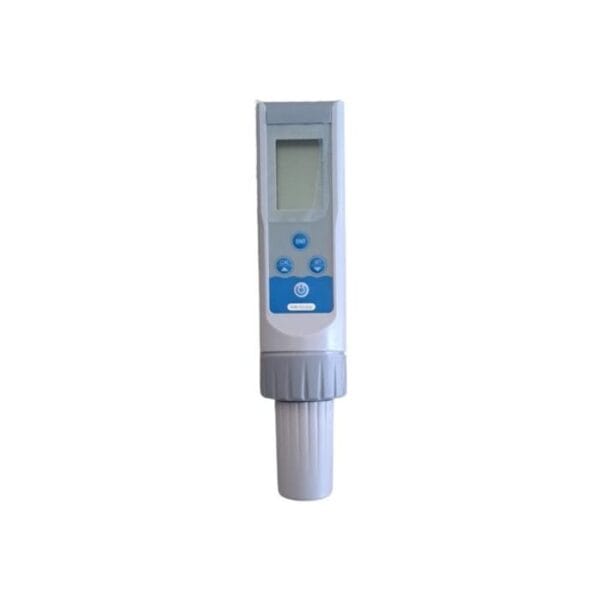
Ecotao supplies a pocket DOZ30 dissolved ozone meter that reads 0 to 10.00 mg/L in seconds with no reagents, and the Hanna HI38054 DPD ozone test kit used to calibrate and cross-check it. Both are supplied from our Cape Town base across South Africa and neighbouring countries.
- 0 – 10.00 mg/LDOZ30 measuring range
- 0.01 mg/LDOZ30 resolution
- No reagentsTri-electrode sensor
- DPD referenceHI38054 kit, ~100 tests
Ozone in water meters and test kits
The meter gives you speed; the DPD kit gives you a traceable reference. If you have no other way to confirm a known ozone level, order the HI38054 with the DOZ30 so you can calibrate on day one.
DOZ30 Ozone in Water Meter
A pocket-sized digital meter that reads dissolved ozone directly in the sample. Its tri-electrode electrochemical sensor gives a stable reading in seconds and is designed to track DPD results, so routine checks no longer mean opening reagent packets. Use it handheld at the tap or tank, or mount it in a PVC flow fitting as an inline monitor.
- Range0 – 10.00 mg/L
- Resolution0.01 mg/L
- Accuracy±2% F.S.
- Calibration2 points
- ProtectionIP67
- Power1 × AAA (not included)
In stock
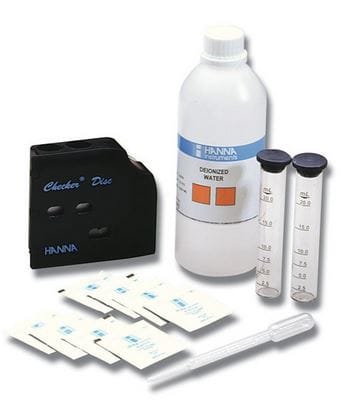
Hanna HI38054 Water Ozone Test Kit
A direct chemical measurement of ozone using the DPD colorimetric method. Add one reagent packet to the sample and match the pink colour on the Checker® disc, which offers more resolution points than colour cubes. Use it as your stand-alone ozone test, or as the reference for calibrating the DOZ30.
- Range0.0 – 2.3 mg/L
- Resolution0.1 mg/L
- MethodDPD
- TestsApprox. 100
- IncludesReagents, Checker disc, 2 glass vials, pipette, deionised water
Reagents are marked with lot number and expiry date for traceability. When they run out, order the HI38054-100 refill rather than a new kit.
Available on backorder · ask us for lead time
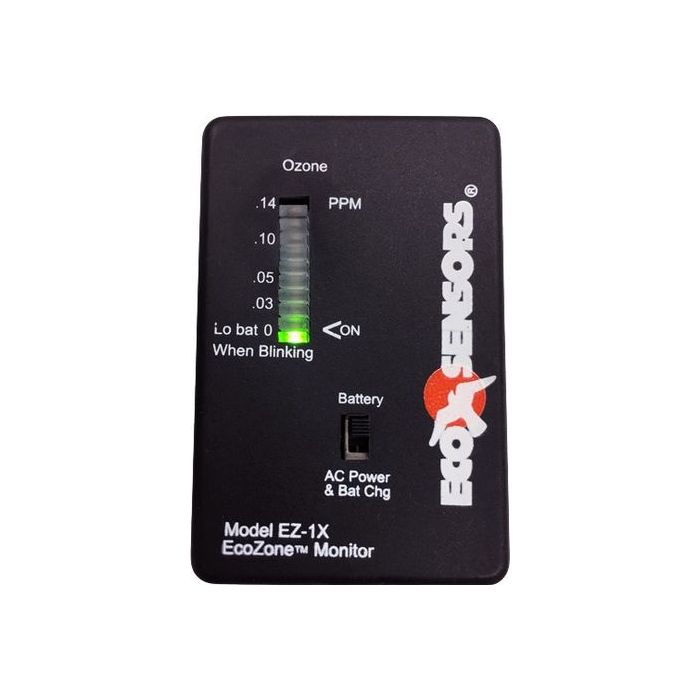
EZ-1X Ozone Monitor
Ozone that escapes from the water, generator or contact tank becomes an air-quality hazard for operators. The EZ-1X sits beside the equipment and shows a simple green / yellow / red bar graph, so non-technical staff know at a glance when to ventilate. It does not measure ozone in water; pair it with the DOZ30.
- Range0.02 – 0.14 ppm (air)
- Caution / dangerYellow 0.05 ppm / red 0.1 ppm
- BatteryNiMH, approx. 8 h
- Size / weight85 × 35 × 60 mm, 154 g
In stock
DOZ30 dissolved ozone meter: full specification
← Scroll to see full table →
| Parameter | DOZ30 specification |
|---|---|
| Measuring range | 0 to 10.00 mg/L dissolved ozone |
| Resolution | 0.01 mg/L |
| Accuracy | ±2% of full scale |
| Sample temperature range | 0 to 100.0 °C (32 to 212 °F) |
| Working (ambient) temperature | 0 to 60.0 °C (32 to 140 °F) |
| Calibration | 2 points |
| Display | 20 × 30 mm multi-line LCD |
| Reading lock | Auto / manual |
| Electrode | CS6930 tri-electrode |
| Auto backlight off | 1 minute |
| Auto power off | 5 minutes without a key press |
| Power | 1 × 1.5 V AAA battery (not included) |
| Dimensions (H × W × D) | 185 × 40 × 48 mm |
| Weight | 95 g |
| Protection | IP67 |
Download the DOZ30 user manual (PDF) for the full calibration and operating procedure.
How to measure ozone in water: three methods compared
Dissolved ozone is unstable. It breaks down back to oxygen within minutes, faster at higher pH and temperature, so a sample carried back to a lab will read low. Whichever method you use, measure at the point of use, straight after sampling.
← Scroll to see full table →
| Method | What it measures | Range / resolution | Consumables | Speed | Best for |
|---|---|---|---|---|---|
| Electrochemical meter (DOZ30) | Dissolved ozone, directly at the electrode | 0 – 10.00 mg/L / 0.01 mg/L | None (AAA battery) | Seconds | Frequent routine checks, inline monitoring, higher concentrations |
| DPD test kit (HI38054) | Ozone concentration, by colour reaction | 0.0 – 2.3 mg/L / 0.1 mg/L | 1 reagent packet per test | A few minutes | Calibrating meters, spot checks, a reference record |
| ORP correlation | Total oxidising capacity (mV), not ozone itself | Estimated from a table | None | Seconds | Rough trend indication in clean water with no chlorine or bromine |
How to choose an ozone in water meter
1. What concentration do you work at?
The HI38054 reads up to 2.3 mg/L. If your process runs higher, for example concentrated ozone rinse water, you need the DOZ30's 0 to 10.00 mg/L range for routine readings.
2. How often do you test?
Several checks a day make reagent costs and time add up. A reagent-free meter pays back quickly; a DPD kit suits occasional checks or audits.
3. Handheld or inline?
For continuous observation at one point, mount the DOZ30 in a PVC flow-through fitting (see inline installation). For checks at several taps or tanks, use it handheld.
4. Can you calibrate?
An electrochemical ozone meter must be calibrated against a known ozone concentration. If you don't already have a DPD photometer or kit, buy the HI38054 with the meter.
5. Is there chlorine or bromine in the water?
Other oxidisers make ORP-based estimates unreliable. In mixed-oxidant water, rely on the DOZ30 calibrated by DPD rather than an ORP table.
6. Who is working near the ozone?
If staff work close to an ozone generator or contact tank, add an EZ-1X ozone-in-air monitor for operator safety.
How to calibrate a dissolved ozone meter with a DPD test kit
The DOZ30 uses two-point calibration against a known ozone concentration. The DPD chemical method is the recommended reference because it measures ozone specifically. This is the general workflow; follow the DOZ30 user manual for button sequences and calibration points.
- Prepare a sample within the kit's range. Take ozonated water at a stable concentration below 2.3 mg/L so the HI38054 can read it.
- Test with the DPD kit immediately. Fill the vial, add the HI38054 reagent and read the value on the Checker disc.
- Measure the same sample with the DOZ30 straight away. Ozone decays, so a delay of even a few minutes between the two readings introduces error.
- Calibrate the meter to the DPD value using the DOZ30's calibration mode, as described in the manual.
- Verify periodically. Repeat a DPD cross-check on a regular schedule and after cleaning the electrode or changing the battery.
Installing the DOZ30 as an inline ozone meter
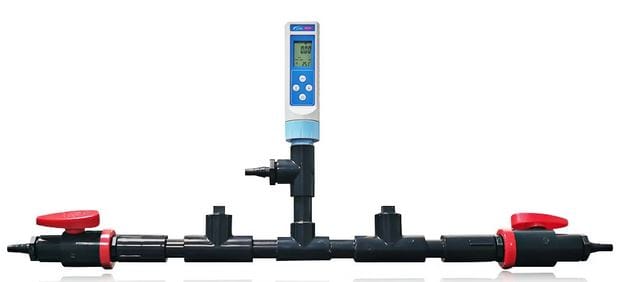
The meter's electrode end screws into a PVC tee on a bypass line. Ball valves on each side let you isolate the meter for calibration, cleaning or removal without shutting down the main flow. PVC fittings are not included and are sourced separately.
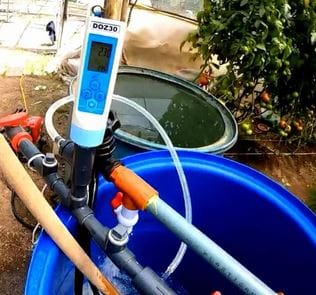
A typical installation on an ozonated holding tank. Place the meter after the ozone contact point, where you want to confirm the residual, and keep the flow past the electrode steady for a stable reading.
ORP to ozone conversion table (mV to mg/L)
In clean water with no chlorine or bromine, ORP can be loosely correlated with dissolved ozone. Use this published calibration table as an indicator only. For calibration, use the DPD method described above.
← Scroll to see full table →
| ORP (mV) | O3 (mg/L) | ORP (mV) | O3 (mg/L) | ORP (mV) | O3 (mg/L) | ORP (mV) | O3 (mg/L) |
|---|---|---|---|---|---|---|---|
| 100 | 0 | 875 | 1 | 1125 | 3.5 | 1375 | 6 |
| 200 | 0.04 | 900 | 1.25 | 1150 | 3.75 | 1400 | 6.25 |
| 300 | 0.08 | 925 | 1.5 | 1175 | 4 | 1425 | 6.5 |
| 400 | 0.13 | 950 | 1.75 | 1200 | 4.25 | 1450 | 6.75 |
| 500 | 0.16 | 975 | 2 | 1225 | 4.5 | 1475 | 7 |
| 600 | 0.2 | 1000 | 2.25 | 1250 | 4.75 | 1500 | 7.25 |
| 700 | 0.22 | 1025 | 2.5 | 1275 | 5 | 1525 | 7.5 |
| 750 | 0.25 | 1050 | 2.75 | 1300 | 5.25 | 1550 | 7.75 |
| 800 | 0.39 | 1075 | 3 | 1325 | 5.5 | 1575 | 8 |
| 860 | 0.5 | 1100 | 3.25 | 1350 | 5.75 | 1600 | 8.25 |
Calibration table of conversion of ozone concentration from ORP to ppm (mg/L). Valid only as a guide in clean water free of chlorine and bromine.
Where an ozone in water meter is used, and why
Ozone is a strong oxidant used as a germicide, deodoriser and mild bleaching agent. In each case the goal is the same: enough residual ozone to do the job, without wasting generator capacity or leaving excess ozone downstream.
Drinking water disinfection
Confirms the ozone residual after the contact tank so water is disinfected before distribution. Where the source water contains bromide, ozonation can form bromate, so check final water against SANS 241.
Wastewater treatment
Verifies ozone dose for disinfection, colour and odour removal, so operators can adjust the generator output against real readings instead of estimates.
Food processing rinse water
Checks the ozone level in produce and equipment wash water at the line, where concentration must be consistent shift to shift.
Manganese and iron removal
Ozone oxidises dissolved manganese so it precipitates and can be filtered out. Measuring the residual shows when enough ozone has been applied.
Cyanide oxidation in plating effluent
Ozone oxidises cyanide in plating wastewater. A dissolved ozone reading confirms ozone is present in excess during treatment.
Textile bleaching
As a mild bleaching agent, ozone dose affects result and fibre damage. Measuring dissolved ozone keeps the process repeatable.
Ozone in water meter: frequently asked questions
How do I measure ozone in water?
There are three common methods. An electrochemical dissolved ozone meter such as the DOZ30 gives an instant digital reading in mg/L without reagents. A DPD colorimetric test kit such as the Hanna HI38054 reacts a reagent with the sample and compares the colour against a Checker disc. ORP (oxidation reduction potential) can be correlated with ozone in clean water, but it is indirect and least precise. Because dissolved ozone decays quickly, always test at the point of use immediately after sampling.
What is the difference between a dissolved ozone meter and an ozone test kit?
A dissolved ozone meter (DOZ30) measures electronically in seconds, reads 0 to 10.00 mg/L at 0.01 mg/L resolution and needs no consumables, but it must be calibrated against a known ozone concentration. A DPD test kit (HI38054) is a direct chemical method that reads 0.0 to 2.3 mg/L at 0.1 mg/L resolution and uses one reagent packet per test. Many users buy both: the kit to calibrate and spot-check, the meter for fast routine readings.
How do I calibrate an ozone in water meter?
The DOZ30 uses two-point calibration against a known ozone concentration. The recommended reference is the DPD chemical method, for example the Hanna HI38054 test kit: take one sample, measure it with the DPD kit and immediately calibrate the meter to that value, following the DOZ30 user manual. Calibration against a published ORP-to-ozone table is possible in clean water without chlorine or bromine, but it is less precise.
Can I use ORP to measure ozone in water?
Only as an estimate. ORP measures the total oxidising capacity of the water, not ozone specifically, so chlorine, bromine and other oxidisers raise the reading, and pH and temperature change the ORP-to-ozone relationship. In clean water without chlorine or bromine a published ORP table gives a rough guide; for calibration or compliance work, use the DPD method.
What units are used for dissolved ozone, mg/L or ppm?
Dissolved ozone is reported in mg/L. In dilute water samples 1 mg/L is equivalent to 1 ppm, so the two are used interchangeably. Ozone in air is a different measurement, reported in ppm by volume, and needs an ozone gas monitor rather than a water meter.
Can the DOZ30 be installed inline on a pipe?
Yes. The DOZ30 can be mounted in a PVC tee and flow-through fitting so the treated water passes over the electrode. The PVC fittings are not included and are sourced separately. Ball valves either side let you isolate the meter for calibration and cleaning.
Do I need an ozone gas monitor if I am treating water with ozone?
It is strongly recommended. Ozone that leaves the water as off-gas, or leaks from a generator, contact tank or fitting, is a respiratory hazard. A monitor such as the EZ-1X shows green, yellow at 0.05 ppm and red at 0.1 ppm in the air around the equipment, so operators know when to ventilate or leave the area.
Where can I buy an ozone in water meter in South Africa?
Ecotao supplies the DOZ30 dissolved ozone meter and the Hanna HI38054 ozone test kit from its Cape Town base, with delivery throughout South Africa and to Namibia, Botswana, Zimbabwe, Mozambique, Lesotho and Eswatini. Order online at ecotao-store.co.za or call +27 21 911 5835.
Need help choosing an ozone meter?
Tell us your ozone concentration, water type and how often you test, and we'll recommend the right meter and calibration kit. Supplied from Cape Town to South Africa, Namibia, Botswana, Zimbabwe, Mozambique, Lesotho and Eswatini.
- Head Office+27 21 911 5835
- Zak086 142 8716
- Zaid082 390 3989
- Emailsales@ecotao.co.za
aqua@ecotao.co.za
Related ozone instruments: