
Portable Leeb Hardness Testers
A portable Leeb hardness tester measures the hardness of metals on site by firing a small impact body at the surface and comparing its rebound speed to its impact speed. The result is read in Leeb units (HL) and converted instantly to Rockwell, Brinell, Vickers and Shore. There is no need to cut a sample or move the part to a bench machine.
Ecotao supplies the Leeb110 to Leeb190 range and the colour-screen OLH300 from Cape Town, with delivery throughout South Africa and neighbouring countries.
What is Leeb hardness testing?
The Leeb method is a dynamic rebound hardness test developed in the 1970s by Dietmar Leeb. A spring launches an impact body with a hard spherical tip against the test surface. A permanent magnet inside the impact body passes through a coil and induces a voltage proportional to its speed. The instrument records the velocity just before impact and just after rebound, about 1 mm from the surface.
A harder metal deforms less and returns more energy, so the impact body rebounds faster and the HL value is higher. The suffix shows which impact device was used: HLD for the standard D device, HLC for C, HLG for G and so on.
Why a Leeb tester instead of a bench tester?
- Tests parts where they are installed: pipework, pressure vessels, rolls, shafts, castings and structural steel.
- Each reading takes a few seconds, so large parts can be mapped for hardness variation quickly.
- The indentation is tiny, so finished or in-service components are not scrapped.
- One instrument converts to HRC, HRB, HB, HV and HS for the common metal groups.
Leeb testing is standardised in ASTM A956, ISO 16859 and GB/T 17394. HRC, HB and HV values from a Leeb tester are conversions, so a bench test remains the referee method where a specification requires one.
Portable Leeb hardness tester models
All Leeb-series models below share the same measuring range: 170 to 960 HLD, 17.9 to 69.5 HRC, 13.5 to 101.7 HRB, 19 to 683 HB, 80 to 1042 HV and 30.6 to 102.6 HS (manufacturer specification). They differ in which impact devices they accept, how data is stored and printed, and how they are powered.

Leeb110 Portable Hardness Tester
Simple, pocket-sized hardness checks with the standard D impact device.
The Leeb110 is built for workshops, receiving inspection and maintenance teams who test ordinary steel, cast iron and non-ferrous parts and read the result off the screen. It uses the universal D device only, runs on two AAA batteries with around 150 hours of standby, and has a backlit LCD for dim plant rooms. Readings can be calibrated against HL, HRC and HB reference values, and it converts freely between HL, HRC, HRB, HB, HV and HS.
- Impact deviceD only
- Accuracy±0.5% at 800 HLD
- Memory1 250 groups
- PC link / printerNo / No
- Power2 × AAA
- Size / weight129 × 68 × 25 mm, 230 g
Leeb120 Portable Hardness Tester
The Leeb110 body with all seven impact devices and PC download.
The Leeb120 looks like the Leeb110 but accepts the D, DC, DL, D+15, G, C and E impact devices and recognises each one automatically, so you can move from a heavy casting to a narrow gear root without re-calibrating. Its PC connection lets QC staff transfer stored readings into inspection reports. It is the practical choice for contractors and inspection companies that test a wide mix of components.
- Impact devicesD, DC, DL, D+15, G, C, E
- Accuracy±0.5% at 800 HLD
- Memory1 250 groups
- PC link / printerYes / No
- Power2 × AAA
- Size / weight129 × 68 × 25 mm, 240 g
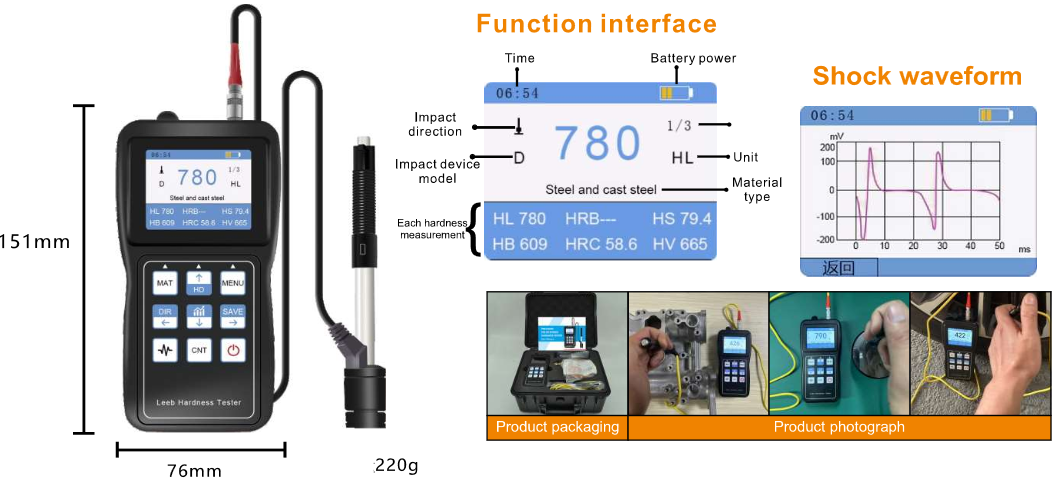
OLH300 Colour Screen Leeb Hardness Tester
Every hardness scale on one colour screen, plus the impact waveform.
The OLH300 is a split-type tester with a bright full-colour graphic LCD. It shows HL, HB, HRB, HRC, HV and HS together on the main screen, with a bargraph and the impact device waveform, so there is no need to switch scales or look up a conversion table. It averages 1 to 32 impacts, stores the impact direction and material with each reading, connects by USB to the supplied software and pairs with a Bluetooth printer for on-site records.
- Impact deviceD supplied (others: ask Ecotao)
- AccuracyDisplay error ±6 HLD
- Memory100 groups
- PC link / printerUSB / Bluetooth printer
- Min. workpiece (D)5 kg and 5 mm unsupported
- Size / weight151 × 76 mm, 220 g
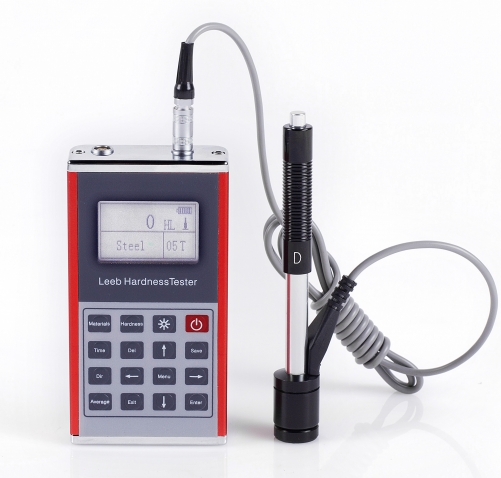
Leeb130 Portable Hardness Tester
Compact tester in a fully enclosed metal shell for harsh sites.
The Leeb130 keeps the compact format and AAA power of the Leeb120 but moves to a fully enclosed metal housing, which the manufacturer specifies for strong anti-interference performance. That suits heavy fabrication shops, mills and power stations where instruments are carried in tool bags. It accepts all seven impact devices and links to a PC.
- Impact devicesD, DC, DL, D+15, G, C, E
- Accuracy±0.5% at 760 HLD
- Memory1 250 groups
- PC link / printerYes / Ask Ecotao
- Power2 × AAA
- Size / weight130 × 70 × 25 mm, 300 g

Leeb140 Hardness Tester with Printer
Print a signed-off hardness record at the test point.
The Leeb140 adds a built-in high-speed thermal printer, so inspectors can print results immediately and attach them to job cards or weld maps. A 6 V rechargeable lithium battery with USB charging replaces disposable cells for heavy daily use. It accepts all seven impact devices and also transfers data to a PC.
- Impact devicesD, DC, DL, D+15, G, C, E
- Accuracy±0.5% at 760 HLD
- Memory1 250 groups
- PC link / printerYes / Built-in thermal
- Power6 V rechargeable Li, USB
- Size / weight230 × 86 × 46 mm, 400 g
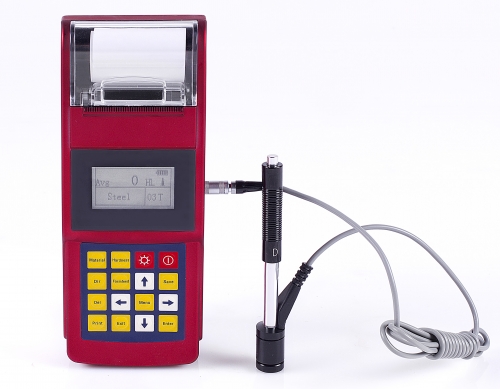
Leeb160 / Leeb170 Hardness Testers
Printer models for long shifts, with the Leeb170 specified for rollers.
The Leeb160 and Leeb170 carry a built-in thermal printer and a 6 V rechargeable lithium battery rated for 10 hours of continuous work. The manufacturer also specifies the Leeb170 for measuring rollers, which makes it relevant to steel mills, paper machines and conveyor maintenance. Contact Ecotao to confirm the configuration that suits your parts.
- Impact devicesD, DC, DL, D+15, G, C, E
- Accuracy±0.5% at 760 HLD
- Memory1 250 groups
- PC link / printerYes / Built-in thermal
- Power6 V rechargeable Li, 10 h continuous
- Size / weight230 × 86 × 46 mm, 450 g
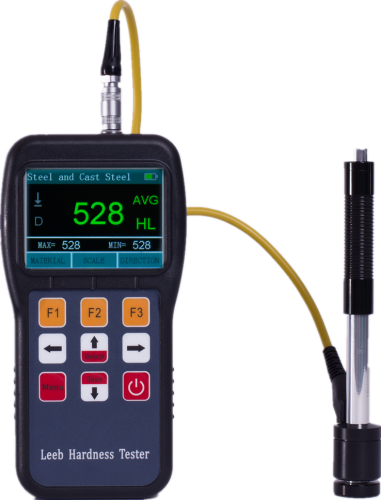
Leeb190 High Precision Hardness Tester
Tightest accuracy in the range, plus user-defined materials.
The Leeb190 is the precision model, built to the JB/T 9378-2001 Leeb tester standard. Its "Users' Material" function lets you set up curves for alloys outside the ten standard material groups, and it adds the HRA scale. USB software handles data exchange, statistical analysis and report printing on a PC. It is suited to heat-treatment shops, laboratories and QC departments working to tight hardness bands.
- Impact devicesD, DC, DL, D+15, G, C, E
- Accuracy±0.3% at 800 HLD
- Memory600 groups
- PC link / printerUSB / via PC software
- PowerRechargeable Li-ion
- Size / weight129 × 68 × 25 mm, 230 g
Leeb hardness tester comparison table
Side-by-side specifications to help you choose between the Leeb110, Leeb120, Leeb130, Leeb140, Leeb160/170, Leeb190 and OLH300.
← Scroll to see full table →
| Model | Display | Impact devices | Accuracy | Memory | PC link | Printer | Power | Weight |
|---|---|---|---|---|---|---|---|---|
| Leeb110 | Backlit LCD | D only | ±0.5% at 800 HLD | 1 250 groups | No | No | 2 × AAA | 230 g |
| Leeb120 | Backlit LCD | D, DC, DL, D+15, G, C, E | ±0.5% at 800 HLD | 1 250 groups | Yes | No | 2 × AAA | 240 g |
| Leeb130 | Backlit LCD, metal shell | D, DC, DL, D+15, G, C, E | ±0.5% at 760 HLD | 1 250 groups | Yes | Ask Ecotao | 2 × AAA | 300 g |
| Leeb140 | Backlit LCD | D, DC, DL, D+15, G, C, E | ±0.5% at 760 HLD | 1 250 groups | Yes | Built-in thermal | 6 V rechargeable Li | 400 g |
| Leeb160 / Leeb170 | Backlit LCD | D, DC, DL, D+15, G, C, E | ±0.5% at 760 HLD | 1 250 groups | Yes | Built-in thermal | 6 V rechargeable Li | 450 g |
| Leeb190 | Adjustable LCD | D, DC, DL, D+15, G, C, E | ±0.3% at 800 HLD | 600 groups | USB | Via PC software | Rechargeable Li-ion | 230 g |
| OLH300 | Full-colour graphic LCD | D supplied; others ask Ecotao | ±6 HLD display error | 100 groups | USB | Bluetooth printer pairing | Batteries (ask Ecotao) | 220 g |
Leeb-series figures are from the manufacturer's current specifications. OLH300 figures are from the Ecotao store listing and product catalogue. Hardness scales: all models convert to HRC, HRB, HB, HV and HS; the Leeb190 adds HRA, and the OLH300 also converts to tensile strength.
Leeb impact devices explained: D, DC, DL, D+15, C, G and E
The impact device is the probe that strikes the part. Choosing the right one matters more than choosing the instrument, because it sets the impact energy, the tip size and the smallest part you can test. The Leeb120 to Leeb190 recognise each device automatically when it is plugged in.
← Scroll to see full table →
| Device | Best for | Impact energy | Test tip | Min. mass, direct test | Max. sample hardness |
|---|---|---|---|---|---|
| D | Universal device for most steel, cast iron and non-ferrous testing | 11 Nmm | 3 mm tungsten carbide | over 5 kg | 940 HV |
| DC | Very short body for holes, cylinders and internal surfaces of assembled machines | 11 Nmm | 3 mm tungsten carbide | over 5 kg | 940 HV |
| DL | Extremely slim nose for narrow slots, gear roots and the base of grooves | 11 Nmm | 3 mm tungsten carbide | over 5 kg | 940 HV |
| D+15 | Slim, extended front section for grooves and recessed surfaces | 11 Nmm | 3 mm tungsten carbide | over 5 kg | 940 HV |
| C | Reduced energy for case-hardened layers, coatings, and thin, light or impact-sensitive parts | about 2.7 Nmm | 3 mm tungsten carbide | over 1.5 kg | 1000 HV |
| G | About nine times the energy of D for heavy, rough castings and forgings (Brinell range only) | 90 Nmm | 5 mm tungsten carbide | over 15 kg | 650 HB |
| E | Synthetic diamond tip for very hard materials such as tool steels above the D limit | 11 Nmm | 3 mm diamond | over 5 kg | 1200 HV |
Typical values for standard Leeb impact devices. Lighter parts can still be tested on a solid support or coupled to a heavy base plate; see getting accurate readings. Check the manual supplied with your device for its exact limits.
How to choose a portable hardness tester
Work through these questions in order. The first two usually decide the impact device; the rest decide the instrument.
How heavy and thick are the parts?
Compact parts over about 5 kg suit the standard D device. Light or thin parts need the C device or coupling to a base plate. Very large, rough castings and forgings suit the G device.
Can you reach the test point?
Open, flat surfaces work with D. Bores and internal faces need DC. Narrow grooves and gear roots need DL or D+15. If you need any of these, rule out the Leeb110.
How hard is the material?
Most steels and cast irons fall within the D range. Very hard tool steels and hard-faced surfaces call for the E diamond device. Surface-hardened layers call for C.
How must results be recorded?
Screen-only checks suit the Leeb110. PC download suits the Leeb120, Leeb130 and Leeb190. Printed records at the test point suit the Leeb140, Leeb160/170, or the OLH300 with a Bluetooth printer.
What accuracy does your specification need?
The Leeb190 has the tightest stated accuracy in the range (±0.3% at 800 HLD) and supports user-defined materials for unusual alloys.
How often is it used?
Daily, all-shift use favours rechargeable models (Leeb140, Leeb160/170, Leeb190). Occasional use suits the AAA-powered Leeb110 to Leeb130 with their long standby.
Where portable Leeb hardness testers are used
Pressure vessels and pipework
Confirms that installed vessels, boiler tubes and pipe spools have not hardened or softened after welding, repair or long service at temperature. Because the tester goes to the vessel, readings can be taken during shutdowns without cutting samples.
Turbines, generators and bearings
Checks shafts, bearing races and rotating parts during failure analysis and overhauls. DC and DL devices reach bores and confined areas on assembled machines.
Heat treatment and machining
Verifies that quench and temper, normalising or through-hardening reached the target before parts move to machining or dispatch. The C device checks case-hardened surfaces.
Castings, forgings and rolls
Maps hardness across large castings, forged parts and mill rolls that cannot fit on a bench tester. The G device handles rough, heavy parts in the Brinell range; the Leeb170 is specified for roller testing.
Incoming inspection and material sorting
Sorts mixed stock and confirms supplier material grades at goods receiving. A compact AAA-powered model such as the Leeb110 or Leeb120 is quick to carry to the receiving bay.
Moulds, dies and tooling
Checks mould and die hardness in the toolroom without damaging polished working faces. The E device extends the range for very hard tool steels.
Getting accurate Leeb hardness readings
Prepare the part
- Grind the test spot to a clean, bright, flat finish. Mill scale, paint, rust and coarse lathe marks all lower the reading.
- With the D device, compact parts over about 5 kg can be tested directly. Parts of about 2 to 5 kg should be clamped to a solid support. Lighter parts must be coupled to a heavy base plate with coupling paste.
- Use a shaped support ring on curved surfaces such as pipes and shafts so the device sits square.
- Select the correct material group on the instrument before converting to HRC, HB or HV.
Take the reading
- Verify the instrument on the supplied reference test block before each session.
- Set the impact direction if your model does not correct for it automatically.
- Take several impacts at least a few millimetres apart and use the average, never a single hit.
- Never strike the same spot twice, and keep impacts away from edges.
- Clean the impact device and check the ball tip regularly; a worn tip reads low.
Leeb hardness testing in South Africa
South African plant is often large, installed and far from a laboratory, which is where portable Leeb testers earn their keep. Typical local uses include checking mill liners, crusher parts and wear plate on mines, inspecting boiler tubes and turbine components during power station and sugar mill shutdowns, and testing pipework and pressure equipment at refineries and petrochemical plants.
Pressure equipment in South Africa falls under the Pressure Equipment Regulations of the Occupational Health and Safety Act, and hardness surveys are a common part of in-service inspection and repair records. A tester with PC download or a printer (Leeb120 upward, or the OLH300) makes it easier to keep traceable results for an inspection file.
For coastal sites in Cape Town, Durban and Gqeberha, surface corrosion builds quickly, so allow extra time to grind each test spot back to bright metal. The Leeb-series instruments are rated to operate from −20 °C to +60 °C.
Portable hardness tester FAQ
What is a Leeb hardness tester and how does it work?
A Leeb hardness tester is a portable, non-destructive rebound hardness tester for metals. A spring fires an impact body with a tungsten carbide ball tip at the test surface. A coil measures its velocity just before impact and just after rebound. The Leeb value is HL = 1000 × rebound velocity ÷ impact velocity. Harder metal returns more energy, so HL is higher. The instrument then converts HL to Rockwell (HRC, HRB), Brinell (HB), Vickers (HV) or Shore (HS) using stored material curves.
What is the difference between Leeb hardness testing and Rockwell, Brinell or Vickers testing?
Rockwell, Brinell and Vickers are static indentation tests. The part is brought to a bench machine and an indenter is pressed in under a set load. Leeb is a dynamic rebound test done with a hand-held instrument on the part where it sits, including installed pipework, castings and machine components. Leeb is faster and portable. Its HRC, HB and HV readings are conversions, so they are best used for field checks, sorting and trend monitoring. Where a specification demands a referee value, a bench test is still used.
Which Leeb impact device should I choose?
D is the universal device for most steel, cast iron and non-ferrous work. DC is very short for holes, cylinders and internal surfaces. DL has a slim nose for narrow grooves and confined spaces. D+15 has an extended front section for grooves and recessed surfaces. C uses lower impact energy for surface-hardened layers, coatings and thin-walled or light parts. G uses about nine times the energy of D for heavy, rough castings and forgings in the Brinell range. E has a synthetic diamond tip for very hard materials above the D device's limit. The Leeb110 uses D only. The Leeb120 to Leeb190 accept all seven.
How heavy and how thick must a part be for Leeb hardness testing?
With the D impact device, compact parts over about 5 kg can be tested directly. Parts of about 2 to 5 kg need to be held firmly on a solid support. Lighter parts must be coupled to a heavy base plate with coupling paste. The C device allows lighter parts and the G device needs heavier ones. The OLH300 listing gives a minimum unsupported workpiece of 5 kg and 5 mm thickness with the D device. The surface must be clean, flat and ground to a fine finish.
Are Leeb hardness conversions to HRC and HB accurate?
Conversions are reliable when the correct material group is selected on the instrument and the part meets the mass, thickness and surface requirements. They are derived from material-specific curves, so choosing steel when testing cast iron or brass gives the wrong converted value. Leeb testers can be calibrated against HL, HRC and HB reference values, and each reading should be an average of several impacts.
Which Leeb hardness tester should I buy?
Choose the Leeb110 for occasional general-purpose testing with the standard D device. Choose the Leeb120 if you need other impact devices or want to download data to a PC. Choose the Leeb140 or Leeb160/170 if you must print results on site. Choose the Leeb190 for the tightest stated accuracy, user-defined materials and the HRA scale. Choose the OLH300 if you want a colour screen that shows every hardness scale at once and Bluetooth printing.
Do Leeb hardness testers need calibration?
Yes. Every model on this page is supplied with a Leeb reference test block. Check the instrument on the block before each testing session. If the average reading falls outside the block's stated tolerance, clean the impact device, check the ball tip and re-calibrate on the block using the instrument's user calibration function.
Where can I buy a portable Leeb hardness tester in South Africa?
Ecotao supplies portable Leeb hardness testers from Cape Town, with delivery throughout South Africa, Namibia, Botswana, Zimbabwe, Mozambique, Lesotho and Eswatini. The OLH300 is listed on the Ecotao online store. Leeb110 to Leeb190 models are supplied on request. Contact sales@ecotao.co.za or +27 21 911 5835.
Need help choosing a hardness tester?
Tell us what you are testing, the part size and how you need to record results, and we will recommend the right instrument and impact devices. Supplied across South Africa and neighbouring countries from our Cape Town base.
- Head Office: +27 21 911 5835
- Zak: 086 142 8716
- Zaid: 082 390 3989
- sales@ecotao.co.za
- aqua@ecotao.co.za