
Refractometers — Optical & Digital, Brix, Salinity, Automotive Fluid & Custom Scales
Handheld optical and digital refractometers for Brix, salinity, alcohol, automotive fluids, dairy, clinical and fully customizable scale applications.
A refractometer measures the refractive index of a liquid — how much light bends as it passes through the sample — and converts that reading into a practical unit such as % Brix (sugar content), % salinity, specific gravity, or a substance-specific concentration scale. Because refractive index changes predictably and repeatably with the concentration of dissolved solids in a liquid, a refractometer gives an accurate, near-instant concentration reading from a single drop of sample, without the reagents or wait time of a lab titration.
Ecotao supplies both optical (analog, eye-read) and digital (electronic, LCD display) refractometers, covering applications from fruit juice and wine to AdBlue, car battery fluid, honey, urine and serum protein, plus a fully customizable digital range that can be programmed with up to ten measurement scales. The full range is listed on our Ecotao Store refractometers page.
Optical vs. digital refractometer: how to choose
← Scroll to see full table →
| Optical (handheld) | Digital | |
|---|---|---|
| How it's read | By eye, through an eyepiece, against a printed scale | Electronically, on an LCD screen |
| Light source | Needs bright natural or ambient light | Uses its own LED light source — works in any lighting |
| Accuracy | Good for field and routine use; some reader subjectivity | Higher resolution and precision; automatic temperature compensation |
| Best for | Fruit juice, honey, cutting fluids, quick field checks | Lab-grade precision, food QC, programmable custom scales |
| Typical setup | Simple, no batteries, robust for field use | Battery powered, one or two-button calibration |
Refractometer range

Optical / Handheld Refractometers
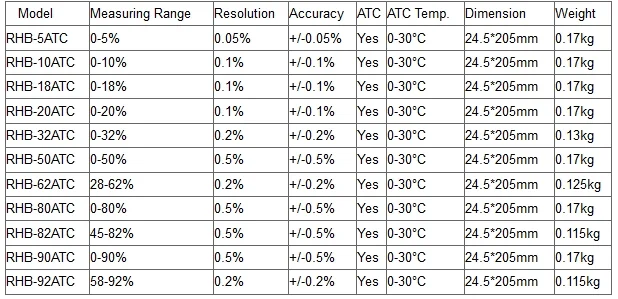
Analog eyepiece refractometers for Brix (0–10%, 0–20%, 0–32%, 45–82%), alcohol 0–80%, and salinity 0–10% / 0–28%. Ideal for fruit juice, honey, brine and quick field checks — no batteries required.
Automotive & Industrial Fluid Testing
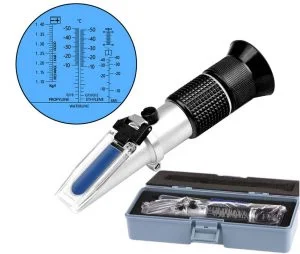
Combined refractometers for car battery fluid, AdBlue (vehicle urea) and ethylene/propylene glycol antifreeze — a single handheld unit reads all three scales for workshop and fleet maintenance use.

Customizable Digital Refractometer (MSDR-P2)
Digital refractometer available in 50 (LOW) and 90 (HIGH) refractive-index range models, programmable with your choice of scale from AD Blue and NaOH to wine must weight and honey moisture. See the full scale list below.

Hanna HI96801 — Digital Food Brix Refractometer
Rugged digital refractometer for 0–85% Brix food analysis, with a sealed stainless steel sample well, ICUMSA-standard temperature compensation, and a 1.5-second reading time. Ideal for juice, honey, jam and dairy QC.

MISCO Palm Abbe Precision Digital Refractometers
Laboratory-grade digital refractometers for dairy, glycol concentration/freeze-point, and human urine specific gravity — the most accurate field option for glycol testing, with results in Celsius.
Atago PAL Series — Precision Instrument Range
Atago is a leading global refractometer brand. Ecotao can supply PAL-series models covering nearly every application, from coffee and Brix to hypochlorous acid and ethylene glycol. Not yet listed on the online store — contact us for a specific PAL model quote.
What is an optical (handheld) refractometer?
An optical or handheld refractometer is an analog instrument that needs a bright, natural light source to measure a liquid's refractive index. A drop of the sample liquid is placed on the glass sensor prism, and the reading is taken by eye against a printed internal scale, viewed through an eyepiece. Optical refractometers are compact, need no batteries, and are ideal for laboratory, industrial and production-line spot checks — though they are less precise than digital models. Typical uses include calculating the Brix value of fruit juices, crops, soft drinks, sauces, soups, water-soluble cutting oils, washing liquids and industrial coolants. Each model is calibrated to a specific measurement: a salinity refractometer measures water salt content and cannot be used for fruit juice, for example, so matching the model to the application matters.
What is a digital refractometer?
A digital refractometer uses an electronic light sensor rather than the human eye, giving a higher resolution and generally more accurate reading than an optical model. A good digital refractometer includes automatic temperature compensation, correcting for the effect that sample temperature has on refractive index, and typically offers a wider scale range with far higher resolution and precision than an equivalent optical unit.
Applications: what refractometers are used for
Refractometers are used across an unusually wide span of industries because refractive index is such a fast, non-destructive way to check concentration. In fruit and beverage production, a Brix refractometer checks ripeness before harvest and sugar concentration during processing — including South African sugar-cane operations checking cane juice Brix before cutting. In viticulture, the same principle reads must weight on scales familiar to the wine industry, such as degrees Oechsle (°Oe) used in German-style wine grading or KMW (the Austrian sugar unit), letting a cellar track ripeness through harvest. In vehicle maintenance, a combined refractometer reads car battery acid specific gravity, AdBlue (vehicle urea) concentration and ethylene or propylene glycol antifreeze strength from the same handheld unit, avoiding the need for three separate hydrometers. In veterinary and clinical settings, a serum-protein and urine specific-gravity refractometer gives an instant reading from a single drop of blood serum or urine, used both in animal health checks and human clinical work. In food and dairy QC, digital Brix and glycol refractometers verify concentration in honey, jam, dairy products and processing-line coolants to a tighter tolerance than optical models allow.
Customizable digital refractometer — programmable scale reference
The MSDR-P2 customizable digital refractometer can be programmed for the scales below in addition to its standard RI and %Brix readings — up to ten scales total (two normally reserved for RI/Brix, so effectively eight more can be added, though this gets cluttered in practice). Programming beyond the first four scales carries a once-off setup cost and is best specified at initial purchase; the RI/Brix scales can be removed if not required, though most customers leave them active. As a general rule for selecting the correct base model: if the target refractive index is below 1.42432, use the LOW (50) range model; at 1.42432 or higher, use the HIGH (90) range model.
← Scroll to see full table →
| Scale | Measures | Test range | Accuracy | Resolution | Model |
|---|---|---|---|---|---|
| Brix | Brix range | 0.0–90.0% | ±0.2 | 0.1 | MSDR-P2-90 |
| R.I. | Refractive Index | 1.3330–1.5177 nD | ±0.0003nD | 0.0001nD | MSDR-P2-90 |
| Urea Density | Density of urea | 0.998–1.135 | ±0.002 | 0.001 | MSDR-P2-50 |
| Battery Fluid | Specific gravity of battery fluid | 0.990–1.500 | ±0.005 | 0.001 | MSDR-P2-50 |
| DMAC-1 | N-Dimethyl Acetamide | 0.0–100.0% | ±0.3 | 0.1 | MSDR-P2-90 |
| DMF | Dimethylformamide | 0.0–55.0% | ±0.2 | 0.1 | MSDR-P2-50 |
| NaClO | Sodium hypochlorite concentration | 0.0–18.0% | ±0.2 | 0.1 | MSDR-P2-50 |
| NaOH | Sodium hydroxide concentration | 0.0–55.0% | ±0.2 | 0.1 | MSDR-P2-90 |
| NMP | N-Methyl Pyrrolidone | 0.0–100.0% | ±0.3 | 0.1 | MSDR-P2-90 |
| NaCl % | Sodium chloride concentration (mass %) | 0.0–28.5% | ±0.2 | 0.1 | MSDR-P2-50 |
| NaCl ppt | Sodium chloride concentration | 0–285 | ±2 | 1 | MSDR-P2-50 |
| NaCl S.G D20/4 | Relative density of sodium chloride | 0.990–1.220 | ±0.002 | 0.001 | MSDR-P2-50 |
| AD Blue | Vehicle urea concentration | 0.0–51.0% | ±0.2 | 0.1 | MSDR-P2-50 |
| AD Blue JIS | Vehicle urea concentration (JIS) | 0.0–51.0% | ±0.2 | 0.1 | MSDR-P2-50 |
| Cleaner | Cleaning liquid ice point | -94.0–32.0°F | ±0.5 | 0.1 | MSDR-P2-50 |
| DOT3 | Mobil DOT3 brake oil boiling point | 125–260 | ±5 | 1 | MSDR-P2-90 |
| DOT4 | Mobil DOT4 brake oil boiling point | 125–276 | ±5 | 1 | MSDR-P2-90 |
| Ethylene Glycol V/V | Volume concentration | 0.0–100.0% | ±0.5 | 0.1 | MSDR-P2-90 |
| Ethylene Glycol % | Mass concentration | 0.0–65.0% | ±0.5 | 0.1 | MSDR-P2-50 |
| Ethylene Glycol °C | Boiling point | 99.9–112.8 | ±0.5 | 0.1 | MSDR-P2-50 |
| Ethylene Glycol F | Freezing point (ASHRAE) | -62.0–33.0°F | ±0.5 | 0.1 | MSDR-P2-50 |
| Propylene Glycol V/V | Volume concentration | 0.0–100.0% | ±0.5 | 0.1 | MSDR-P2-90 |
| Propylene Glycol % | Mass concentration | 0.0–73.0% | ±0.5 | 0.1 | MSDR-P2-50 |
| Propylene Glycol °C | Boiling point | 100.0–112.0 | ±0.5 | 0.1 | MSDR-P2-50 |
| Propylene Glycol F | Freezing point (ASHRAE) | -94.0–33.0°F | ±0.5 | 0.1 | MSDR-P2-50 |
| Honey Baume | Honey Baumé (°Bé) | 33.0–48.0°B | ±0.5 | 0.1 | MSDR-P2-90 |
| Honey Water | Water content of honey | 5.0–38.0% | ±0.2 | 0.1 | MSDR-P2-90 |
| Sea Chlorinity | Chloride content in seawater | 0.0–57% | ±0.2 | 1 | MSDR-P2-50 |
| Sea S.G D20/4 | Relative density of seawater | 0.990–1.070 | ±2 | 0.001 | MSDR-P2-50 |
| Sea Salinity | Salinity of seawater | 0–100% | ±0.002 | 1 | MSDR-P2-50 |
| CaCl₂ | Calcium chloride concentration | 0.0–41.0% | ±2 | 0.1 | MSDR-P2-90 |
| Glycerol | Glycerin concentration | 0.0–100.0% | ±0.2 | 0.1 | MSDR-P2-90 |
| H₂O₂ | Hydrogen peroxide concentration | 0.0–61.0% | ±0.4 | 0.1 | MSDR-P2-50 |
| Sodium Sulfate | Mass concentration | 0.0–22.0% | ±0.2 | 0.1 | MSDR-P2-50 |
| Sodium Sulfate (viscosity) | Viscosity | 0.971–2.481 | ±0.002 | 0.001 | MSDR-P2-50 |
| Beer Plato | °P, volume fraction of original wort | 0.0–30.5°P | ±0.2 | 0.1 | MSDR-P2-50 |
| Wort S.G D20/20 | Specific gravity of wort | 0.990–1.134 | ±0.002 | 0.001 | MSDR-P2-50 |
| Red Wine %VOL | Alcohol content | 0.0–23.0% | ±0.2 | 0.1 | MSDR-P2-50 |
| KMW | Austrian wine sugar unit | 0.0–25.0 | ±0.3 | 0.1 | MSDR-P2-50 |
| Oe (France) | Oechsle, France scale | -5–230°Oe | ±2 | 1 | MSDR-P2-50 |
| Wine Oe (German) | Oechsle sugar-of-grapes grading | 0–150°Oe | ±2 | 1 | MSDR-P2-50 |
| Dextran | Mass concentration | 0.0–10.6% | ±0.2 | 0.1 | MSDR-P2-50 |
| Fructose | Mass concentration | 0.0–68.9% | ±0.2 | 0.1 | MSDR-P2-90 |
| Glucose | Mass concentration | 0.0–59.9% | ±0.2 | 0.1 | MSDR-P2-90 |
| Lactose | Mass concentration | 0.0–16.5% | ±0.2 | 0.1 | MSDR-P2-50 |
| Maltose | Mass concentration | 0.0–15.6% | ±0.2 | 0.1 | MSDR-P2-50 |
| Serum Protein | Human/animal blood serum protein | 0.0–12.0 g/100ml | ±0.2 | 0.1 | MSDR-P2-50 |
| Human Urine | Specific gravity D20/4 | 0.990–1.050 | ±0.002 | 0.001 | MSDR-P2-50 |
| Alcohol (mass) | Ethanol concentration | 0–73% | ±1 | 1 | MSDR-P2-50 |
| Alcohol (volume) | Ethanol volume fraction | 0–80% | ±1 | 1 | MSDR-P2-50 |
| Ammonia | Mass concentration | 0.0–35.0% | ±0.6 | 1 | MSDR-P2-50 |
| IPA | Isopropanol mass concentration | 0–81% | ±1 | 1 | MSDR-P2-50 |
Scale table sourced from Ecotao's programmable refractometer specification sheet. Confirm the exact scale and model combination with our team before ordering — some scale/range pairings require the 50 (LOW) model and others the 90 (HIGH) model as noted above.
Full product list & direct store links
← Scroll to see full table →
| Product | Type | Availability |
|---|---|---|
| Brix refractometer 0–10% | Optical | Check stock |
| Brix refractometer 0–20% | Optical | Check stock |
| Brix refractometer 0–32% | Optical | Check stock |
| Brix refractometer 0–32% & Wort S.G. 1.000–1.120sg | Optical | Check stock |
| Brix refractometer 0–32% (bagged) | Optical | Check stock |
| Brix refractometer 45–82% | Optical | Check stock |
| Handheld 0–90% Brix refractometer | Optical | Check stock |
| Handheld 28–62% Brix refractometer | Optical | Check stock |
| Handheld 58–90% refractometer (Brix, Baumé, Water) | Optical | Check stock |
| Alcohol refractometer 0–80% | Optical | Check stock |
| Car battery fluid & antifreeze refractometer | Optical | Check stock |
| Car battery fluid & glycol antifreeze refractometer | Optical | Check stock |
| Car battery, AdBlue & glycol antifreeze refractometer | Optical | Check stock |
| Handheld 0–10% salinity refractometer | Optical | Check stock |
| Handheld 0–28% brine & salinity refractometer | Optical | Check stock |
| Cats & dogs urine / animal serum protein refractometer | Optical | Check stock |
| Refractometer for serum protein / urine / R.I. | Optical | Check stock |
| Crop Sap Press | Accessory | Check stock |
| Handheld digital 0–50% Brix refractometer, customizable | Digital | Check stock |
| Handheld digital 0–90% Brix refractometer, customizable | Digital | Check stock |
| Economic Digital Salt Refractometer (NaCl) | Digital | Check stock |
| Hanna HI96801 — Digital Refractometer for Food Brix | Digital | Check stock |
| Hanna — Digital Refractometer for Sodium Chloride in Food | Digital | Check stock |
| MISCO Digital Dairy Refractometer | Digital | Check stock |
| MISCO Digital Glycol Refractometer | Digital | Check stock |
| MISCO Digital Human Urine Refractometer | Digital | Check stock |
| Atago PAL series (all specialty scales) | Digital — premium | Request a quote |
Atago PAL series — specialty scales
Atago is a leading global refractometer brand, and Ecotao can supply PAL-series models covering nearly every application. The range spans general-purpose models (PAL-1, PAL-2, PAL-3, PAL-α, PAL-H, PAL-S, PAL-BX/RI, PAL-RI, PAL-Loop), a COVID-era disinfection series (ethyl alcohol, hypochlorous acid, peracetic acid), and dedicated special-scale models for coffee, pâtissier work, honey moisture, brine, ramen, soy milk, condiments, cutting oil, urea, hydrogen peroxide, urine specific gravity, ethylene glycol, sodium hydroxide and general cleaning agents. These are quoted on request rather than carried on the online store — contact us with the specific application and we'll confirm the right PAL model.
Frequently asked questions
What is the difference between an optical and a digital refractometer?
An optical (handheld) refractometer is an analog instrument read by eye against a scale, using natural or ambient light. A digital refractometer uses a light sensor to take the reading electronically and display it on an LCD. Digital models are generally more accurate, have automatic temperature compensation, and are easier to read outdoors or in low light; optical models are more affordable and need no batteries.
How do I calibrate a refractometer?
For most Brix, urine and serum-protein scales, calibrate to zero using a drop of distilled or de-ionised water on the prism. For higher Brix ranges, a known commercial Brix standard can be used, or extra-virgin olive oil, which reads consistently between 71 and 72 on the Brix scale. Refractometers should generally be recalibrated daily before use.
Which refractometer do I need to test AdBlue or antifreeze?
AdBlue (vehicle urea) and ethylene/propylene glycol antifreeze each have their own dedicated scale. Ecotao supplies a combined Car Battery Fluid, AdBlue & Glycol Antifreeze refractometer that reads all three on one handheld unit, as well as a customizable digital model that can be programmed with the exact AdBlue and glycol scales plus further custom scales.
What is a Brix refractometer used for?
A Brix refractometer measures the sugar content of a water-based solution as degrees Brix (°Bx), where 1°Bx equals 1 gram of sucrose per 100 grams of solution. It is used in fruit juice, honey, wine and sugar-cane production to check ripeness and sugar concentration, and industrially to check cutting oils, coolants and washing liquids at the correct dilution.
What is the difference between the 50 and 90 percent range on a customizable digital refractometer?
The MSDR-P2 is sold in a 50% (LOW) and 90% (HIGH) refractive-index range. If the target measurement's refractive index is below 1.42432, use the LOW range model; at 1.42432 or above, use the HIGH range model. Most Brix, salinity and clinical scales fall in the low range.
Can a refractometer be programmed for a custom application?
Yes — the MSDR-P2 can carry up to ten measurement scales at once, from sodium hydroxide and hydrogen peroxide concentration to wine must weight (KMW, Oechsle) and honey moisture. Programming beyond the first four scales carries a once-off setup cost, best specified at initial purchase.
Not sure which refractometer or scale you need?
Tell us the liquid and concentration range you're measuring and we'll confirm the right model — optical, digital, or a custom-programmed scale.