
Lab instruments are one category within the wider Extech test & measurement range we supply — thermal imaging, electrical testers, airflow, sound, moisture, borescopes and more.
Browse the Full Extech Instruments Range Over 20 Extech product categories, supplied across South Africa & neighbouring countriesExtech Lab Instruments
Handheld and portable laboratory instruments for water quality, air cleanliness and environmental measurement — pH, ORP, chlorine, fluoride, conductivity, TDS, salinity and dissolved oxygen meters, particle counters, refrigerant leak detectors and the electrodes, modules and reagents that keep them running. Supplied from our Cape Town base across South Africa and neighbouring countries.
What counts as a “lab instrument” in this range?
A laboratory instrument in this context is a self-contained measuring device that produces a traceable numerical reading of a chemical or physical property of a sample, without needing a fixed benchtop installation, mains power or a wet chemistry setup. The distinction matters when you are choosing equipment: a titration kit gives you a result but consumes reagents and operator time per test, whereas an electrode-based meter gives a reading in seconds and can be repeated indefinitely for the cost of periodic calibration.
Extech's laboratory range is built almost entirely around the ExStik® platform — a pen-format waterproof meter body with an interchangeable electrode module. The module carries a chip that the meter reads on connection, so the same body becomes a pH meter, an ORP meter, a chlorine meter, a conductivity meter or a dissolved oxygen meter depending on what is plugged into it. This is why the range reads as a long list of model codes: most of them are the same instrument configured for a different parameter, or the same configuration sold with or without its consumables.
How to choose the right lab instrument
Four questions narrow this range down to one or two models. Work through them in order — each one eliminates more of the catalogue than the last.
1. How many parameters do you actually need?
Single-parameter meters are cheaper, faster to calibrate and harder to misread, so buy one only if you genuinely measure one thing. If you routinely record two or more parameters on the same sample, a multi-parameter kit pays for itself in time saved and in the elimination of transcription errors between instruments.
- One parameter: CL200, FL700, RE300, PH100, PH110, PH220-C, EC400
- Two to three: EC500, EC510, EX800
- Four or more: EX900 (4-in-1), DO610 (6-in-1)
2. Meter alone, or meter as a kit?
The kit versions add calibration buffers, sample cups, a weighted base, a neckstrap and a hard case. A laboratory that already stocks buffers and glassware is paying twice for those items, but a site team without them cannot take a reading at all on day one.
- Meter only: EC400, DO600, EC500, PH100
- Same meter as a kit: EC410, DO600-K, EC510
3. What is the physical state of your sample?
This is the question most often skipped, and it is the one that determines whether an electrode survives its first month. A conventional glass bulb must be immersed in a liquid; a flat surface electrode can be pressed against a solid or semi-solid and is far more resistant to breakage and junction clogging.
- Clear liquids only: any model in the range
- Slurries, soils, sludges, food: flat surface electrode models — PH100, PH110, EC500, EC510, EX900
- Refillable electrode for heavy use: PH110
4. Field or bench?
Field use imposes requirements a bench instrument never faces: it will be dropped, rained on, left in a bakkie at 55 °C and used one-handed while the other hand holds a sample bottle. The IP57 rating shared across the ExStik line covers dust ingress and short immersion, and the meters float, which matters more than it sounds when sampling from a bridge or a tank rim.
- Field: ExStik II models (DO600, EC500, EC510) — IP57, floats, backlit display
- Bench or teaching lab: kit versions with weighted base — EX900, EC410, DO600-K
- Cleanroom or HVAC survey: VPC300
ExStik, ExStik II and Palm meters compared
The three handheld formats in this range differ in more than price. This table sets out what each one is actually for.
← Scroll to see full table →
| Attribute | ExStik® | ExStik® II | Palm / Pocket |
|---|---|---|---|
| Typical models | CL200, FL700, RE300, EC400, PH100, PH110 | DO600, EC500, EC510, DO610 | PH220-C |
| Interchangeable modules | Yes — auto-detected by chip | Yes — auto-detected by chip | No — fixed electrode |
| Parameters per body | 1 at a time, swappable | Up to 6 with module set | 1 (pH + temperature) |
| Waterproof rating | IP57, floats | IP57, floats | Waterproof housing |
| Reading memory | 15 readings | 15 readings | Basic hold |
| Best suited to | One parameter measured often, with the option to repurpose the body later | Multi-parameter site rounds where one instrument must cover a full sample profile | Spot checks where lowest cost and simplest operation matter most |
pH & ORP Meters
pH tells you how acidic or alkaline a sample is; ORP tells you its oxidising or reducing potential in millivolts. In disinfection, treatment and process control the two are read together, because the effectiveness of chlorine at a given concentration falls sharply as pH rises.

Waterproof ExStik® II pH/Conductivity Meter Kit
Extech EC510Reads conductivity, TDS, salinity, pH and temperature from a single replaceable electrode, which is unusual at this size — most instruments covering both pH and conductivity need two separate probes and two calibration routines.
- Five parameters, nine units of measure: pH, µS/cm, mS/cm, ppm, ppt, mg/L, g/L, °C, °F
- Single replaceable EC505 electrode module covers both pH and conductivity
- Flat surface pH electrode reads liquids, semi-solids and solids
- Supplied as a kit with calibration solutions and carrying case
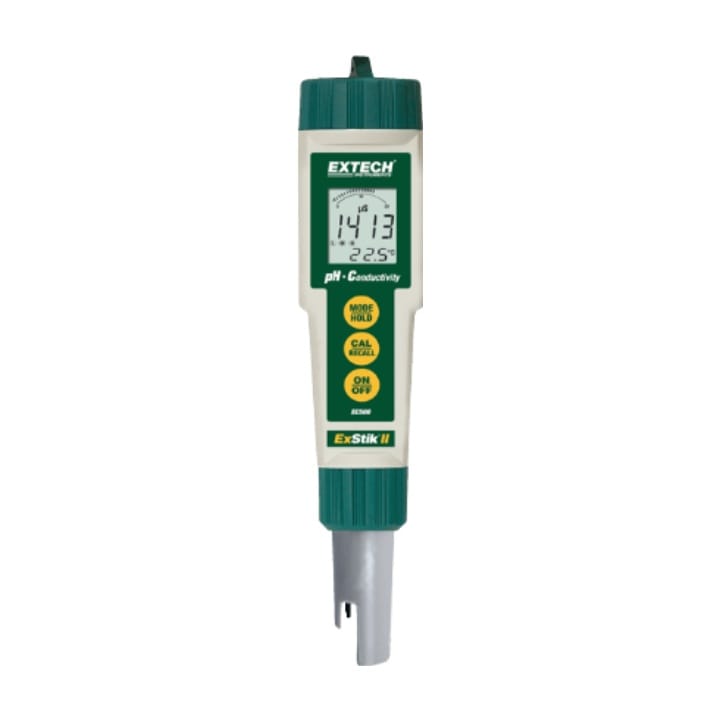
Waterproof ExStik® II pH/Conductivity Meter
Extech EC500The EC510 kit's instrument on its own, without the buffers, cups and case. The right choice when you are adding a second or third meter to a laboratory that already stocks calibration solutions.
- Same five parameters as the EC510: conductivity, TDS, salinity, pH, temperature
- Flat surface pH electrode resists breakage and junction clogging
- IP57 waterproof, floats if dropped in a tank or channel
- Uses the same EC505 replacement module as the EC510

ExStik® Refillable pH Meter
Extech PH110A refillable-junction pH meter, which matters in demanding samples: a sealed gel electrode is maintenance-free but dies when its junction clogs, whereas a refillable electrode can be flushed and topped up, extending working life considerably in dirty or protein-rich samples.
- Refillable electrode — junction can be flushed rather than discarded
- Flat surface sensing face reads liquids, semi-solids and solids
- Automatic electronic calibration, 1, 2 or 3 point buffer calibration
- Memory stores and recalls 15 readings; IP57 waterproof
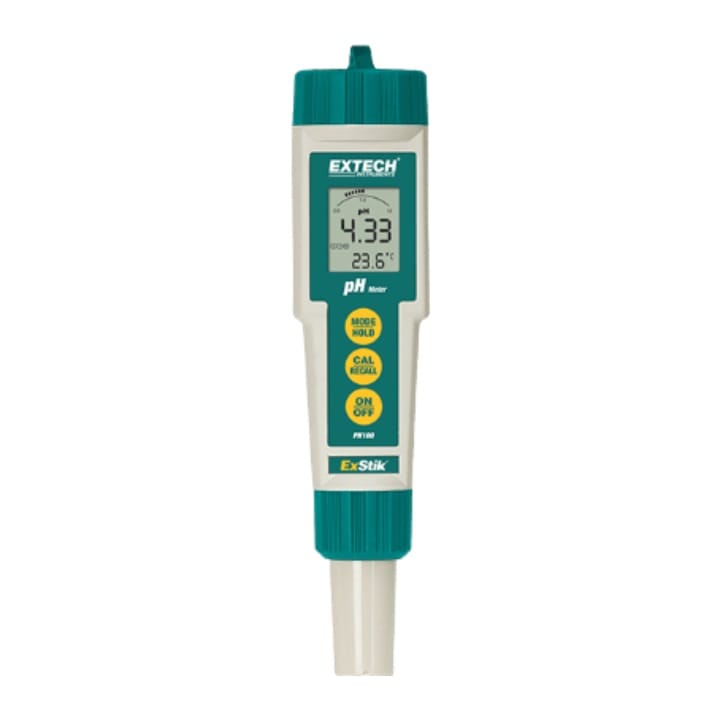
ExStik® pH Meter with Flat Surface Electrode
Extech PH100The entry point to the ExStik pH line. Fills the gap between the fixed-electrode PH220-C and the refillable PH110 — a modular, waterproof pH meter at the lowest cost in the family.
- Flat surface electrode for liquids, semi-solids and solids
- Replaceable electrode module — the body outlives several electrodes
- IP57 waterproof housing, floats in water
- Automatic electronic calibration with 15-reading memory

Waterproof Palm pH Meter with Temperature
Extech PH220-CA fixed-electrode palm meter rather than a modular ExStik. That makes it the simplest instrument here to hand to an untrained user — there is no module to fit incorrectly and no mode to select.
- Simultaneous pH and temperature display
- Automatic temperature compensation
- Waterproof housing suited to wet working areas
- Fixed electrode with cable, for sampling below the meter body

ExStik® ORP Meter
Extech RE300Measures oxidation-reduction potential from −999 to 999 mV at 1 mV resolution. ORP is the fastest practical indicator of disinfection capacity, because it responds to the actual oxidising power present rather than to a chlorine concentration that may be chemically unavailable.
- Range −999 to 999 mV, 1 mV resolution
- Automatic electronic self-calibration; saves last calibrated value
- Simulated analogue bargraph shows the direction of change as it happens
- Data validation indicator confirms the reading has stabilised
- IP57 waterproof and floats; module interchangeable with pH and chlorine modules

ExStik® 4-in-1 Chlorine, pH, ORP and Temperature Kit
Extech EX900The most complete disinfection-monitoring kit in the range. One CL200 meter body plus interchangeable pH and ORP electrodes covers the three parameters that together determine whether a water supply is actually being disinfected effectively.
- CL200 meter with interchangeable chlorine, pH and ORP flat surface electrodes
- Reagent tablets for 50 chlorine tests, four sample cups and a weighted stand
- 3½ digit (2000 count) display with bargraph; stores and recalls 15 readings
- Automatic self-calibration for chlorine and ORP; 1, 2 or 3 point buffer calibration for pH
- Complete with pH buffer pouches, four CR2032 batteries, neckstrap and hard case
Chlorine & Fluoride Meters
Both parameters are measured against a defined target band rather than a simple minimum: too little chlorine leaves water unsafe, too much creates taste and by-product problems; too little fluoride offers no dental benefit, too much causes fluorosis. Electrode and colorimetric instruments give the fast feedback needed to hold a dose inside its band.

ExStik® Chlorine Meter
Extech CL200Reads total chlorine directly, and — importantly — is unaffected by sample colour or turbidity. That is the failure point of comparator-disc and simple colorimetric methods, which become unreliable exactly when water is discoloured and testing matters most.
- Direct total chlorine reading from a low detection limit
- Unaffected by sample colour or turbidity, unlike visual comparator methods
- Automatic electronic self-calibration
- Stores and recalls 15 readings; saves last calibrated value
- IP57 waterproof, floats; the same body used in the EX800 and EX900 kits
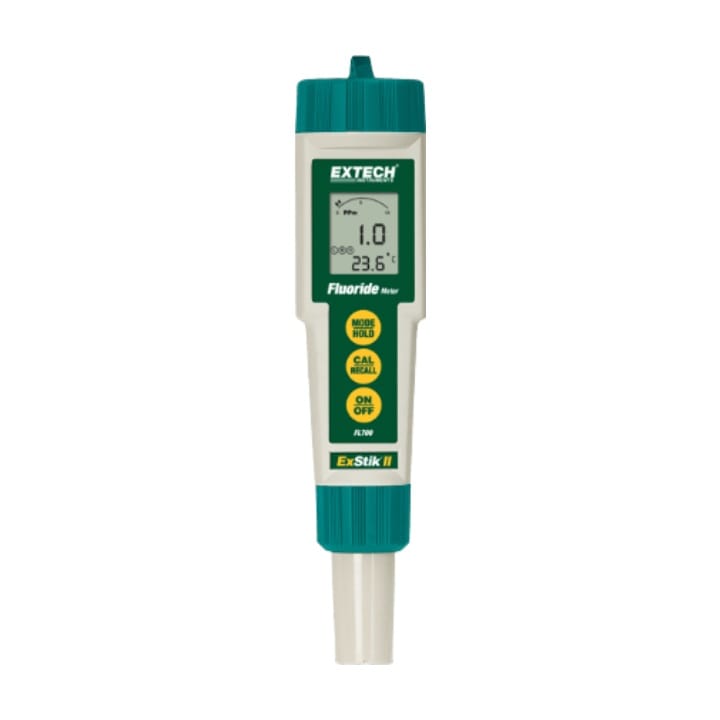
Waterproof ExStik® Fluoride Meter
Extech FL700Closes an obvious gap on this page: the FL704 TISAB reagent tablets below are consumables for a fluoride meter, and the FL700 is that meter. It reads total fluoride by ion-selective electrode in under a minute.
- Direct reading of total fluoride from 0.1 to 9.99 ppm (mg/L)
- Complies with EPA Method 340.2 (potentiometric ion-selective electrode)
- Automatic temperature compensation within ±10 °C of calibration temperature
- Stores up to 25 labelled readings; response in under one minute
- IP57 waterproof, 210 g; supplied with electrode, TISAB tablets, batteries and neckstrap
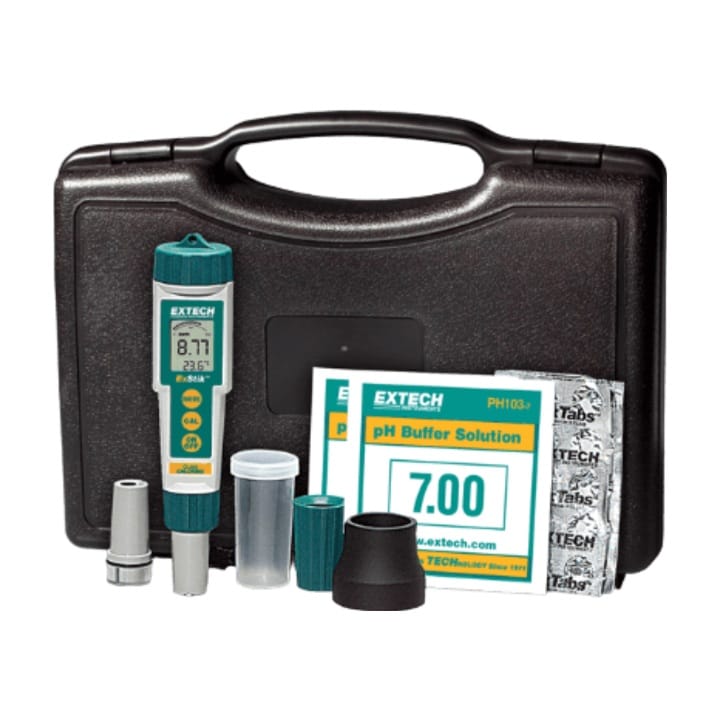
ExStik® 3-in-1 Chlorine, pH and Temperature Kit
Extech EX800The EX900 without the ORP electrode. For operators who need chlorine and pH together but have no requirement to log redox potential, this removes a parameter and its calibration burden.
- CL200 meter with interchangeable chlorine and pH flat surface electrodes
- Reagent tablets for 50 chlorine tests and four sample cups
- Weighted stand for hands-free stable readings
- Complete with pH buffer pouches, batteries, neckstrap and carrying case

TISAB Fluoride Reagent Tablets
Extech FL704TISAB stands for Total Ionic Strength Adjustment Buffer. Adding it fixes the sample's ionic strength and pH and releases fluoride bound to aluminium and iron, so the electrode reads total fluoride rather than only the free fraction — without it, results in real groundwater read low and inconsistently.
- For use with the FL700 ExStik fluoride meter
- Buffers ionic strength and pH so readings are comparable between samples
- Decomplexes fluoride bound to aluminium and iron in the sample
- Tablet format — no volumetric measurement needed in the field
Conductivity, TDS & Salinity Meters
These three readings come from one measurement. An instrument measures electrical conductivity directly, then derives TDS and salinity from it by applying conversion factors — which is why the same meter reports all three, and why the factor used matters when comparing results between instruments.

ExStik® Conductivity/TDS/Salinity Meter
Extech EC400Conductivity, TDS, salinity and temperature in the ExStik pen format. Conductivity is the single most useful screening measurement in water work: a step change at a sample point tells you something has entered the system long before you know what it is.
- Measures conductivity, TDS, salinity and temperature
- Automatic temperature compensation with selectable conversion factor
- Memory stores and recalls 15 readings
- IP57 waterproof and floats; replaceable EC405 conductivity cell module

ExStik® Conductivity/TDS/Salinity Kit
Extech EC410The EC400 supplied with everything needed to calibrate and measure from the moment it arrives — calibration solution, sample cups, weighted base and hard case.
- EC400 meter plus calibration solution and sample cups
- Weighted base holds meter and cup for hands-free stable readings
- Hard carrying case for vehicle and site transport
- Same IP57 waterproof body and replaceable module as the EC400
Dissolved Oxygen Meters
Dissolved oxygen is the parameter with the least margin for delay. In aquaculture a DO crash kills a stocked pond within hours, and in activated sludge treatment the aeration blowers are usually the single largest electricity cost on the plant — so both under- and over-aeration are expensive.

Waterproof ExStik® II Dissolved Oxygen Meter
Extech DO600Reads dissolved oxygen in mg/L and as percent saturation, with temperature. The two units answer different questions: mg/L is what the fish or the biomass actually has available, while percent saturation tells you how far the water sits from equilibrium with the atmosphere.
- Dissolved oxygen in mg/L and % saturation, plus temperature
- Automatic temperature compensation
- IP57 waterproof housing that floats
- Replaceable DO605 electrode module; DO603 membrane kit available
- Compatible with EX010 (0.9 m) and EX050 (4.9 m) extension cables for depth sampling

Waterproof ExStik® II Dissolved Oxygen Meter Kit
Extech DO600-KThe DO600 supplied with the membrane caps, electrolyte and accessories that dissolved oxygen measurement consumes faster than any other parameter in this range.
- DO600 meter with membrane kit and spare caps
- Sample cups and weighted base for stable bench readings
- Hard carrying case, batteries and neckstrap included
- Same IP57 waterproof floating body as the DO600

ExStik® II DO/pH/Conductivity Kit
Extech DO610The broadest multi-parameter kit on this page: dissolved oxygen, pH, conductivity, TDS, salinity and temperature from one meter body with interchangeable modules. Six parameters is a full water-quality profile for most aquaculture and environmental work.
- Measures dissolved oxygen, pH, conductivity, TDS, salinity and temperature
- Interchangeable ExStik modules auto-detected by the meter body
- Supplied with calibration solutions, cups, weighted base and hard case
- IP57 waterproof and floats
Particle Counters
A particle counter draws a known air volume past a laser diode and sizes each particle by the light it scatters. This is how cleanroom classification, filter validation and indoor air quality investigation are all performed — the count distribution, not a single number, is what carries the information.

Video Particle Counter with Built-in Camera
Extech VPC300Counts six particle size channels simultaneously and photographs or films the sampling location at the same time. That second capability is what separates it from a plain counter: a count with no visual record of where it was taken is difficult to defend weeks later in a report.
- Six channels measured simultaneously, from 0.3 to 25 µm
- Also reports air temperature, relative humidity, dew point and wet bulb
- Built-in 320×240 camera records 3GP video and JPEG stills
- Stores 5000 records with date, time, counts, humidity, temperature, sample volume and location label, plus 20 minutes of video
- Selectable sample time, count data and programmable delay
- Supplied with NIST-traceable calibration certificate, tripod, PC software, USB cable, 7.4 V NiMH battery and hard case
Refrigerant Leak Detectors
Refrigerant leakage is both an operating cost and a regulatory matter. A heated diode sensor detects halogenated refrigerants at concentrations far below what a soap-bubble test or a UV dye trace will reveal, which is what makes it useful for finding the slow leaks that account for most annual gas loss.

Refrigerant Leakage Detector
Extech RD300Uses a heated diode sensor, which responds specifically to halogenated compounds rather than to any volatile organic vapour. That specificity matters in a plant room, where an unselective detector alarms on cleaning solvents and lubricants and quickly stops being trusted.
- Heated diode sensor selective to halogenated refrigerants
- Flexible probe reaches joints and coils behind panels
- Adjustable sensitivity to isolate a leak once the general area is found
- Field-replaceable RD300-S sensor tip — no return-to-base service needed
Stopwatches & Heat Index Timers
Timing and heat stress are linked in laboratory and field work: many test methods specify a contact or reaction time, and many outdoor work rules specify rest intervals based on the heat index rather than air temperature alone.

HeatWatch™ Humidity/Temperature Stopwatch
Extech HW30A precision stopwatch that also reports temperature, humidity and heat index. The heat index is the figure that matters for worker safety, because it expresses how hot conditions actually feel once humidity limits the body's ability to cool by evaporation.
- Stopwatch to 1/100 second; timing capacity 9 h 59 min 59 s, accuracy ±5 s/day
- Heat index range 22 to 50 °C (70 to 122 °F) with user-adjustable alarm
- 99 lap counter with 30 lap/split memory and fastest/slowest/average recall
- 10-hour countdown timer with audible warning for the final five seconds
- 12/24-hour clock, calendar and programmable alarm; backlit display
- Supplied with lanyard, battery and operating instructions
Electrodes, Modules, Probes & Reagents
Electrodes are consumables, not permanent parts. A pH or dissolved oxygen sensor has a working life measured in months to a couple of years depending on sample chemistry and storage, and replacing the module rather than the instrument is what keeps the cost of ownership sensible across a fleet of meters.

pH/mV/Temperature Electrode
Extech PH305A gel-filled combination electrode with built-in temperature sensing and a BNC connector on a 1 m cable. Combining pH, reference and temperature in one body means one insertion per sample and automatic temperature compensation without a separate probe.
- Combination gel-filled pH electrode, maintenance-free junction
- Built-in automatic temperature compensation
- Standard BNC connector on a 1 m (39 in) cable
- For Extech portable pH/mV/temperature meters including the PH300 series

ExStik® Replacement Dissolved Oxygen Module
Extech DO605The replacement sensing module for DO600-series meters. Fitting a new module restores a meter to full accuracy for a fraction of the cost of replacing the instrument, and takes a couple of minutes with no tools.
- Direct plug-in replacement for Extech ExStik DO600 series meters
- Meter chip recognises the module automatically on connection
- No tools or recalibration of the meter body required
- Pair with the DO603 membrane kit for full sensor servicing
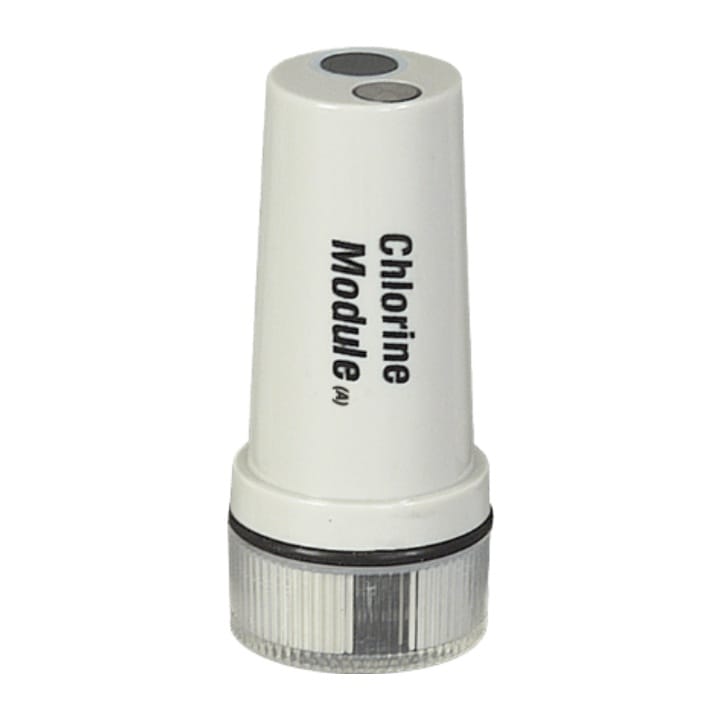
ExStik® Replacement Chlorine Electrode Module
Extech CL205The chlorine equivalent of the DO605 above, and a gap worth closing: this page lists the CL200 chlorine meter and the EX900 kit built on it, but until now not the module that keeps either of them working.
- Replacement chlorine sensing module for the CL200 meter and EX800/EX900 kits
- Auto-detected by the meter body on connection
- Restores original measurement accuracy without replacing the instrument
- Keep a spare on site — chlorine electrodes age fastest of the ExStik modules

Polymer Conductivity Cell Probe
Extech 804010AA polymer-bodied conductivity cell on a 1 m cable. Polymer construction is more tolerant of knocks than a glass cell, which is why it is the standard choice for portable rather than benchtop conductivity work.
- Polymer conductivity cell, 1 m (39 in) cable
- More impact-resistant than an equivalent glass conductivity cell
- Originally supplied for the Oyster™ 341350A-P multiparameter meter
- Note: the 341350A-P meter itself has been discontinued and superseded by the EC600 — contact us to confirm compatibility with your instrument before ordering
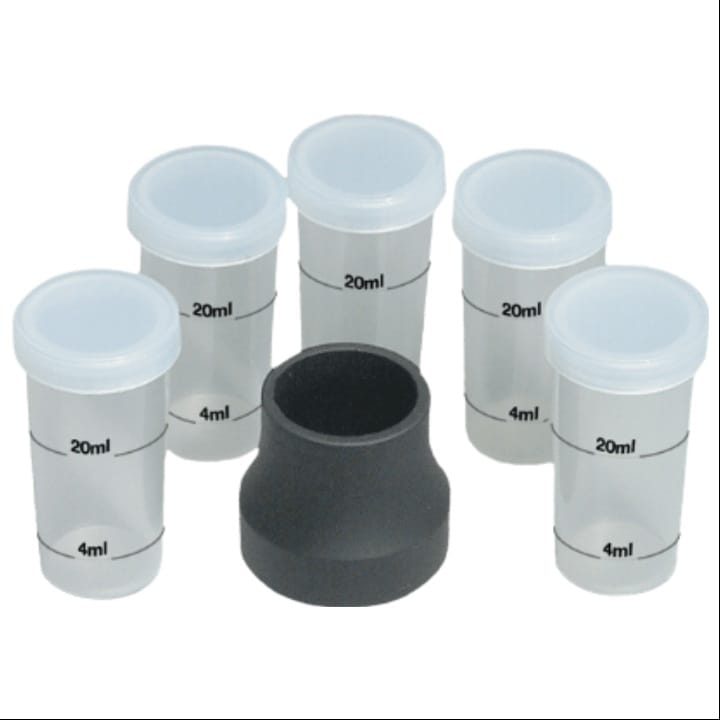
Weighted Base and Solution Cups Kit
Extech EX006A cast weighted base and five solution cups that hold any ExStik meter upright in a sample. Hands-free measurement is not a luxury — a meter held by hand introduces movement and body heat, and readings stabilise noticeably faster when the instrument is left standing.
- Iron cast weighted base holds the meter in any of five plastic solution cups
- Enables genuinely hands-free, more stable readings
- Fits ExStik and ExStik II meters including PH110, EC500 and CL200
- The accessory most often missing when a bare meter is bought instead of a kit
Further Extech consumables we can supply on request
These are part of the current Extech water quality accessory range and can be quoted alongside any instrument on this page.
← Scroll to see full table →
| Model | Item | Used with |
|---|---|---|
| CL203 / CL204 | ExTab™ chlorine reagent tablets (10pk / 100pk) | CL200, EX800, EX900 |
| CL207 | Chlorine standard solution | CL200 calibration checks |
| FL705 | ExStik® replacement fluoride electrode module | FL700 |
| EC405 | ExStik® replacement conductivity cell module | EC400, EC410 |
| EC505 | ExStik® replacement pH electrode / conductivity cell module | EC500, EC510 |
| EC-84-P / EC-1413-P / EC-12880-P | Conductivity standards, 84 / 1413 / 12880 µS (2 bottles) | All conductivity meters |
| DO603 | Membrane kit for ExStik® dissolved oxygen meters | DO600, DO600-K, DO610 |
| DO703 | Membrane caps (3 caps) | DO700 series |
| EX007 | Spare sample solution cups (24pk) | All ExStik meters |
| EX010 / EX050 | Extension cable with probe guard and weight (0.9 m / 4.9 m) | DO600 series depth sampling |
| RD300-S | Replacement heated diode sensor tip | RD300 |
| 850190 | Thermistor probe (0 to 90 °C) | Compatible Extech meters |
Using these instruments in South African conditions
Three local factors change how these instruments should be specified and maintained, and none of them appear in a manufacturer's datasheet written for a temperate northern market.
Altitude affects dissolved oxygen readings
Oxygen saturation depends on barometric pressure, which falls with altitude. Water fully saturated at sea level in Cape Town holds appreciably more oxygen than fully saturated water at 1 750 m in Johannesburg at the same temperature, so a raw mg/L figure that looks low on the Highveld may in fact represent complete saturation.
Always calibrate a DO meter at the altitude where it will be used, and record percent saturation alongside mg/L when comparing sites at different elevations. This single step resolves most of the apparent discrepancies between coastal and inland aquaculture data.
Heat shortens electrode life
Electrode ageing is a chemical process and accelerates with temperature. An instrument stored in a locked vehicle through a Lowveld or Karoo summer afternoon experiences internal temperatures well above ambient, and the electrolyte in a gel-filled electrode degrades correspondingly faster.
Store electrodes with a moist sensor cap fitted, keep instruments out of parked vehicles overnight, and shorten your calibration interval through summer. A refillable electrode such as the PH110 tolerates these conditions better than a sealed gel type.
Groundwater chemistry drives instrument choice
Large parts of South Africa depend on borehole supply, and the relevant parameters differ by region: elevated natural fluoride in parts of the Northern Cape, North West and Limpopo; salinity and high conductivity in the drier western interior and along coastal aquifers subject to intrusion; and iron staining that defeats visual comparator chlorine testing.
This is why the FL700 fluoride meter, the EC400 conductivity meter and the electrode-based CL200 chlorine meter are the three instruments most often specified together for rural and agricultural water assessment here, rather than the general-purpose kits that suit municipal networks.
Regulatory reference points
SANS 241 is the South African national standard for drinking water quality and sets the operational and acute health limits against which supplies are assessed. Cleanroom classification work follows ISO 14644-1, and occupational heat stress is commonly managed with reference to heat index or WBGT thresholds.
Handheld instruments of this class suit operational monitoring, screening and process control. Results submitted as formal compliance evidence should come from a laboratory accredited for the relevant method, with handheld readings used to direct that programme between formal sampling rounds.
Frequently asked questions
What is the difference between an ExStik meter and an ExStik kit?
An ExStik meter is the instrument and its electrode on their own, suitable when you already hold calibration solutions and sample cups. An ExStik kit adds the consumables and accessories needed to start measuring immediately: calibration buffer pouches, sample solution cups, a weighted base, a neckstrap and a hard carrying case.
On this page the EC400 is the meter and the EC410 is the same meter as a kit, and the DO600 is the meter while the DO600-K is its kit version. Choose the kit if the instrument is going to a site team or a teaching laboratory, and the bare meter if you are adding capacity to a laboratory that already stocks buffers and glassware.
What is the difference between pH and ORP, and do I need both?
pH measures the concentration of hydrogen ions and tells you how acidic or alkaline a sample is on a scale of 0 to 14. ORP, also called redox potential, measures the sample's tendency to gain or lose electrons and is read in millivolts from −999 to 999 mV.
In disinfection work the two are read together because chlorine's killing power depends on pH: the same free chlorine concentration is far less effective above pH 8 than at pH 7.2. If you are monitoring a potable water supply, a swimming pool or a process water loop, read both — the EX900 kit exists precisely for this. If you are only checking soil slurry or a food product, pH alone is usually enough.
Why does a flat surface electrode matter on a pH meter?
A conventional pH bulb is a fragile glass sphere that must be fully immersed, which rules out semi-solid and solid samples and makes breakage the most common cause of meter failure in the field. A flat surface electrode presents a flush sensing face that can be pressed against soil, sludge, cheese, meat, paper or a wet filter cake as easily as it can be dipped in liquid. It also drains cleanly, so the junction clogs less often.
The PH100, PH110, EC500 and EC510 on this page all use flat surface electrodes, which is why they suit agricultural, food-processing and civil-engineering sampling better than a laboratory bulb electrode does.
How do I choose a particle counter channel size for cleanroom monitoring?
ISO 14644-1 classifies cleanrooms by the number of particles above defined size thresholds per cubic metre, with 0.5 µm the threshold used for most ISO Class 5 to Class 8 verification work. A counter must resolve a channel at or below the threshold in your specification, so a 0.3 µm lower limit covers every ISO class commonly specified in pharmaceutical, electronics and hospital work.
The VPC300 measures six channels from 0.3 to 25 µm simultaneously, which means one sampling run produces the full distribution rather than forcing repeat runs at different thresholds.
Can Extech ExStik electrode modules be swapped between meters?
Yes, within the ExStik family. Each module carries a chip that the meter body reads on connection, so the instrument automatically recognises whether a pH, ORP, chlorine, conductivity or dissolved oxygen module has been fitted and switches its measurement mode accordingly.
This is why the EX900 kit can present four parameters from a single CL200 meter body, and why replacing a worn module such as the DO605 or CL205 costs far less than replacing the instrument. Keep the module's protective sensor cap moist in storage, as a dried-out junction is the usual reason a module fails early.
How often should a pH or conductivity meter be calibrated?
Calibrate pH before each measurement session for regulatory or reporting work, and at least weekly for routine process checks, using two or three buffer points that bracket your expected reading. Conductivity drifts more slowly and a single-point calibration against a standard close to your sample range — 1413 µS for potable water, 12880 µS for brackish and process water — is usually sufficient monthly.
Electrodes age faster in hot conditions, so instruments used through a Highveld or Lowveld summer need more frequent checking than the same model kept in an air-conditioned laboratory.
Are these instruments suitable for SANS 241 drinking water compliance testing?
SANS 241 sets the South African national standard for drinking water quality and includes operational limits for pH, conductivity, free chlorine and fluoride among many other determinands. Handheld instruments of this class are well suited to operational monitoring, process control and screening at the point of supply, and give the fast feedback that a treatment operator needs between formal sampling rounds.
Determinations submitted as formal compliance evidence should still be performed by a laboratory accredited for the relevant method, with the handheld readings used to direct and support that programme rather than replace it.
Do you supply Extech lab instruments outside South Africa?
Yes. Ecotao supplies the Extech range from its Cape Town base to customers across South Africa and into Namibia, Botswana, Zimbabwe and Mozambique.
Contact the head office on +27 21 911 5835 or email sales@ecotao.co.za with the model codes you need and the delivery destination, and we will confirm availability and lead time.
Not sure which instrument fits your application?
Tell us what you need to measure, in what sample, and how often — we will point you to the right model rather than the most expensive one. Quotes and technical advice on the full Extech range.