
Refractometers are one part of the Extech range Ecotao supplies across South Africa.
Ecotao supplies six current Extech refractometers in South Africa: the RF11, RF12 and RF15 for Brix and sugar concentration, the RF20 for salinity, and the RF40 and RF41 for engine coolant, glycol antifreeze and battery acid. All six are handheld optical instruments with automatic temperature compensation, and each needs only two or three drops of sample.
Two models that previously appeared on this page — the RF153 digital Brix refractometer and the RF30 triple-range Brix refractometer — have been discontinued by the manufacturer. Replacements are set out in the section on discontinued models below.
Extech refractometers supplied in South Africa
A refractometer measures how much light bends as it passes through a liquid. Because dissolved solids change that bending predictably, a single drop tells you the sugar content of grape juice, the concentration of a cutting fluid, the salt level in a brine tank or the freezing point of engine coolant — in seconds, with no power source and no consumables beyond a little distilled water.
The Extech RF range is handheld and optical: you place two or three drops on the prism, close the cover, hold the instrument up to any light source and read the scale through the eyepiece. Automatic temperature compensation corrects the reading across a 10 °C to 30 °C sample range, which covers most South African indoor and shaded field conditions without a correction table.
Ecotao supplies these instruments to customers throughout South Africa and into Namibia, Botswana, Zimbabwe, Mozambique, Lesotho and Eswatini.
Which Extech refractometer do you need?
Pick by what you are measuring first, then by the range you need to cover. The scale is fixed on each instrument, so a model that stops at 18 % Brix cannot be pushed higher.
| Model | Measures | Range | Resolution | Accuracy | ATC range | Typical use |
|---|---|---|---|---|---|---|
| RF11 | Sucrose / Brix | 0 to 10 % Brix | 0.1 Brix | ±0.1 % | 10 to 30 °C | Low-sugar liquids, dilute process fluids |
| RF12 | Brix | 0 to 18 % Brix | 0.2 Brix | ±0.2 % | 10 to 30 °C | Cutting fluids, lubricants, coolant emulsions |
| RF15 | Sucrose / Brix | 0 to 32 % Brix | 0.2 Brix | ±0.2 % | 10 to 30 °C | Wine and table grapes, fruit juice, soft drinks |
| RF20 | Salinity | 0 to 100 ppt | 1 ppt | ±0.1 % | 10 to 30 °C | Aquaculture, marine tanks, brine and food processing |
| RF40 | Glycol freezing point, battery acid | −60 to 25 °F (ethylene glycol); −60 to 32 °F (propylene glycol); SG 1.15 to 1.30 | 2 °F; 0.01 SG | ±5 °F | 50 to 86 °F | Workshops working to a Fahrenheit scale |
| RF41 | Glycol freezing point, battery acid | −50 to 0 °C (ethylene and propylene glycol); SG 1.15 to 1.30 | 1 °C; 0.01 SG | ±2 % | 10 to 30 °C | Fleet, mining and plant workshops in South Africa |
Scroll the table sideways on a narrow screen to see every column.
Brix and sugar refractometers
Brix is the percentage of sucrose by mass in a solution. One degree Brix is one gram of sucrose in 100 grams of solution, and in fruit juice it is close enough to total dissolved solids to be used as a ripeness and quality measure.

Extech RF11 sucrose Brix refractometer, 0 to 10 % with ATC
The narrowest and most precise Brix scale in the range. Spreading only ten Brix across the full eyepiece scale gives a 0.1 Brix resolution and ±0.1 % accuracy, so the RF11 resolves differences that the wider-scale models simply cannot show. Use it where the sugar or solids content is genuinely low and small changes matter — dilute process liquids, rinse water, low-sugar beverages and quality checks on incoming diluted stock.
- Sucrose range0 to 10 % Brix
- Resolution0.1 Brix
- Accuracy±0.1 %
- ATC10 to 30 °C

Extech RF12 Brix refractometer, 0 to 18 % with ATC
The workshop and machine-shop model. Water-miscible cutting fluids, soluble oils and synthetic coolants are normally run at a few percent concentration, and the RF12 reads that band directly — you multiply the Brix reading by the refractive index factor on your fluid's data sheet to get the true concentration. Running a coolant too weak invites bacterial growth, rust and short tool life; running it too rich wastes concentrate and irritates skin. A thirty-second check on the RF12 settles it.
- Brix range0 to 18 % Brix
- Resolution0.2 Brix
- Accuracy±0.2 %
- ATC10 to 30 °C

Extech RF15 sucrose Brix refractometer, 0 to 32 % with ATC
The most widely used model in the range, and the one that suits South African fruit and wine work. Wine grapes are typically picked somewhere between 22 and 26 °Brix depending on style, table grapes and stone fruit are graded on minimum Brix at packing, and most fruit juices and soft drinks fall well inside 32 %. A vineyard block can be walked with the RF15 in a pocket, sampling berries as you go, with no batteries to fail at harvest.
- Sucrose range0 to 32 % Brix
- Resolution0.2 Brix
- Accuracy±0.2 %
- ATC10 to 30 °C
Salinity refractometer

Extech RF20 salinity refractometer, 0 to 100 ppt with ATC
Reads dissolved salt from fresh water right through to saturated brine on a single scale. Natural seawater sits near 35 ppt, which places the working point for abalone, oyster and finfish systems comfortably mid-scale, while food-processing brines and curing solutions run much higher and are still covered. For aquaculture and marine aquarium work the RF20 is the standard cross-check against a hydrometer, which drifts with temperature and with age in a way a refractometer does not.
- Salinity range0 to 100 ppt
- Resolution1 ppt
- Accuracy±0.1 %
- ATC10 to 30 °C
Coolant, glycol and battery acid refractometers
These two models carry three scales in one eyepiece: ethylene glycol freezing point, propylene glycol freezing point, and battery acid specific gravity. A drop from the radiator tells you how much frost protection is actually left in the system, and a drop from a cell tells you the state of charge of a lead-acid battery. The difference between the two models is the temperature unit engraved on the scale, not the capability.
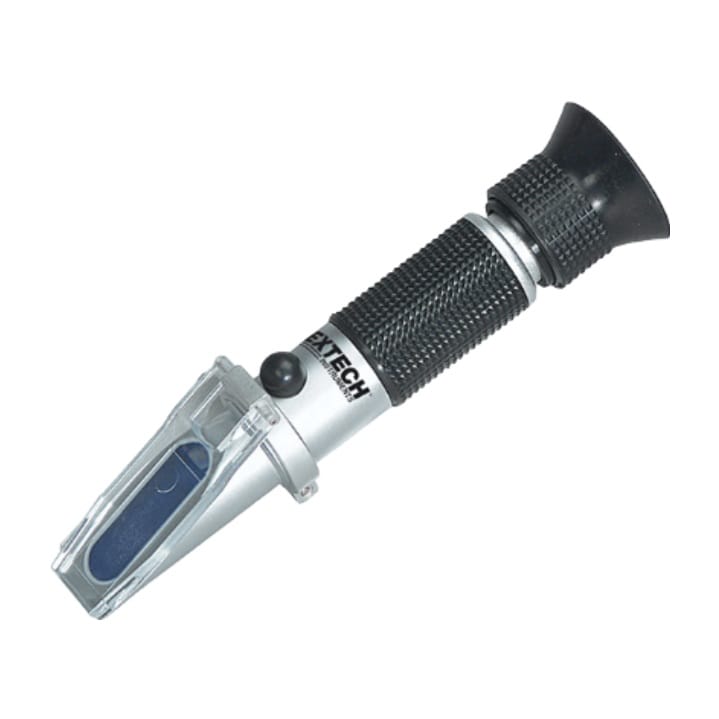
Extech RF41 coolant / glycol refractometer with ATC, Celsius scale
The Celsius version, and the sensible default for any South African workshop. It reads the freezing point of both ethylene and propylene glycol from −50 °C to 0 °C, and battery acid specific gravity from 1.15 to 1.30 as a quick state-of-charge reference. That matters on the Highveld, in the Free State and in the Karoo, where winter overnight temperatures drop below zero and a coolant mix that has been topped up with water all summer no longer protects the engine. Two or three drops give the answer without draining anything.
- Ethylene glycol−50 to 0 °C
- Propylene glycol−50 to 0 °C
- Battery acid SG1.15 to 1.30
- Resolution1 °C / 0.01 SG
- Accuracy±2 %
- ATC10 to 30 °C
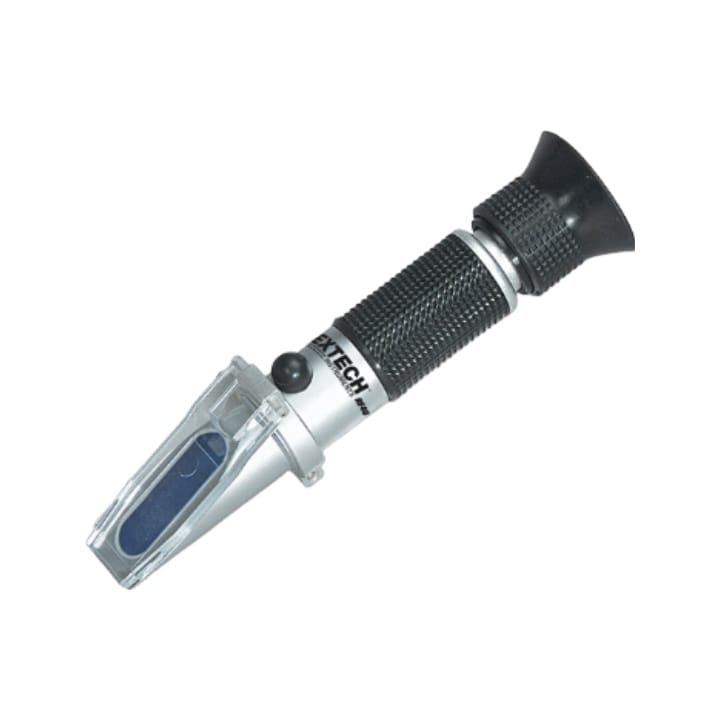
Extech RF40 coolant / glycol refractometer with ATC, Fahrenheit scale
Identical in function to the RF41 but scaled in Fahrenheit, reading ethylene glycol from −60 to 25 °F and propylene glycol from −60 to 32 °F, plus battery acid specific gravity from 1.15 to 1.30. Choose it only where your service documentation, imported equipment manuals or a parent company's procedures are written in Fahrenheit — otherwise the RF41 saves your technicians a conversion on every reading.
- Ethylene glycol−60 to 25 °F
- Propylene glycol−60 to 32 °F
- Battery acid SG1.15 to 1.30
- Resolution2 °F / 0.01 SG
- Accuracy±5 °F
- ATC50 to 86 °F
Discontinued Extech refractometer models
The models below have been withdrawn by the manufacturer. They still appear in older catalogues and search results, so they are listed here with the nearest current equivalent. If you are standardising a fleet of instruments or replacing a unit that has been dropped, tell us what the old instrument was used for and we will match the range rather than the model number.
| Discontinued model | What it was | Nearest current option |
|---|---|---|
| RF153 Discontinued | Digital Brix refractometer, 0 to 53 % Brix and refractive index, with a three-second LCD reading | Extech RF15 is the manufacturer's stated replacement for Brix work up to 32 %. If you need a digital display, a wider Brix range or a refractive index readout, see the digital refractometers in the Ecotao store. |
| RF30 Discontinued | Triple-range sucrose Brix refractometer covering 0 to 42 %, 42 to 71 % and 71 to 90 % on one instrument | No single Extech model now covers all three bands. For readings above 32 % Brix — honey, syrups, concentrates, jam and sugar processing — use the wide-range and high-range Brix refractometers stocked in the Ecotao store. |
| RF10 Discontinued | Sucrose Brix refractometer, 0 to 32 %, without ATC | Extech RF15, which adds automatic temperature compensation over the same range. |
| RF16 Discontinued | Sucrose Brix refractometer, 0 to 10 %, without ATC | Extech RF11. |
| RF18 Discontinued | Brix refractometer, 0 to 18 %, without ATC | Extech RF12. |
Refractometers beyond the Extech range
The Extech RF models are optical instruments with fixed scales. Where you need a digital readout, a range above 32 % Brix, a programmable scale or a measurement the RF range does not cover, Ecotao supplies a much wider selection:
- Digital and programmable refractometers — configurable, high-precision instruments for laboratory and production use. See the Ecotao refractometers page.
- High-range Brix — 28 to 62 %, 45 to 82 %, 58 to 90 % and 0 to 90 % handheld models for honey, syrup, jam and concentrate work.
- Specialised scales — serum protein and urine specific gravity for veterinary and clinical use, sodium chloride in food, brine and salinity, and glycol antifreeze.
- XS Instruments range — download the XS Instruments refractometer list (PDF).
- Browse refractometers in the Ecotao online store for the full current selection.
Using and calibrating an Extech refractometer
Zero the instrument before a session's work. Place two or three drops of distilled water on the prism, close the daylight plate so the water spreads without bubbles, wait about thirty seconds for the water and prism to reach the same temperature, then look through the eyepiece at a light source. Turn the calibration screw with the supplied screwdriver until the boundary line between the light and dark fields sits exactly on zero.
For a sample reading, wipe the prism dry with a soft cloth, apply the sample, close the plate and read where the boundary crosses the scale. Rinse with clean water and dry between samples — sugar residue left on the prism is the single most common cause of a drifting reading. The prism is glass: never scrape it, and keep the instrument in its case when it is not in use.
Automatic temperature compensation corrects for the sample being warmer or cooler than the reference temperature, but only within the stated 10 °C to 30 °C band. A juice sample taken straight from a cold room or a coolant sample drawn from a hot engine should be allowed to settle toward room temperature before reading.
Extech refractometer questions
Which Extech refractometer should I use for wine or table grapes?
The Extech RF15, which reads 0 to 32 % Brix. South African wine grapes are generally harvested between roughly 22 and 26 °Brix depending on the style being made, and table grapes are graded against a minimum Brix at packing. Both sit comfortably inside the RF15 scale, and the instrument needs no power, which suits sampling in the block during harvest.
What is the difference between the RF11, RF12 and RF15?
Only the scale. The RF11 covers 0 to 10 % Brix at 0.1 Brix resolution, the RF12 covers 0 to 18 %, and the RF15 covers 0 to 32 %, both at 0.2 Brix. A narrower range spreads across the same eyepiece scale, so it reads more finely. Choose the narrowest range that still contains everything you need to measure — the RF11 for dilute liquids, the RF12 for cutting fluids and coolant emulsions, and the RF15 for fruit, juice and general sugar work.
Is the Extech RF153 digital Brix refractometer still available?
No. The RF153 has been discontinued by the manufacturer. For Brix measurement up to 32 % the stated replacement is the Extech RF15, an optical instrument. If the digital display, the wider 0 to 53 % Brix range or the refractive index readout were the reason you wanted the RF153, contact us and we will point you at a digital instrument from the wider Ecotao range that covers the same ground.
Is the Extech RF30 triple-range Brix refractometer still available?
No. The RF30, which covered 0 to 42 %, 42 to 71 % and 71 to 90 % Brix on one instrument, has been discontinued and no current Extech model replaces all three bands. Ecotao stocks separate wide-range and high-range Brix refractometers that cover the upper bands for honey, syrup, jam and concentrate work.
Should I buy the RF40 or the RF41?
The RF41 for almost every South African user, because its scale is in Celsius. The two instruments are otherwise the same: both read the freezing point of ethylene and propylene glycol and the specific gravity of battery acid. The RF40 is the Fahrenheit version, worth choosing only if your service procedures or equipment manuals are written in Fahrenheit.
Can an Extech refractometer read above 32 % Brix?
Not in the current range — the RF15 tops out at 32 % Brix, and the triple-range RF30 that once covered up to 90 % has been discontinued. Honey, syrups, molasses, jam and sugar concentrates need a high-range instrument. Ecotao supplies handheld refractometers covering 28 to 62 %, 45 to 82 %, 58 to 90 % and 0 to 90 % Brix.
What does ATC mean on a refractometer?
Automatic temperature compensation. Refractive index changes with temperature, so a warm sample reads differently from a cold one. A built-in bimetallic strip shifts the internal optics to correct for this, which removes the need for a manual correction table. On the Extech RF range the compensation is valid for samples between 10 °C and 30 °C, or 50 °F to 86 °F on the RF40.
How often should a refractometer be calibrated?
Zero it with distilled water at the start of each working session, and again if the instrument has been knocked, left in a hot vehicle or moved between very different ambient temperatures. It is a single-screw adjustment that takes under a minute, and the screwdriver is supplied with the instrument. Under a formal quality system you may also need periodic verification against a certified standard solution — tell us if that applies and we will advise on the standards to use.
Do you deliver outside South Africa?
Yes. Ecotao supplies customers in South Africa and in Namibia, Botswana, Zimbabwe, Mozambique, Lesotho and Eswatini. Email aqua@ecotao.co.za with the model and destination and we will quote including delivery.
Request a quote or ask which model fits
Tell us what you are measuring and the range you expect, and we will confirm the right model before you order.
- Email: aqua@ecotao.co.za or sales@ecotao.co.za
- Head office: +27 21 911 5835
- Zak: 086 142 8716 | Zaid: 082 390 3989
- 39 Olienhout Avenue, Plattekloof, Cape Town