
Industrial videoscopes · South Africa
4-Way Articulating Borescope
A 4-way articulating borescope is an industrial video inspection instrument whose camera tip can be steered up, down, left and right from the handset. You feed the flexible probe through a small opening, watch the live picture on the built-in colour screen, and point the camera at the surface you need to see, including surfaces around corners and behind obstructions that a fixed-tip scope cannot reach.
Ecotao supplies this articulating videoscope from Cape Town across South Africa and neighbouring countries, for maintenance, quality-control and engineering inspection teams.
- The videoscope
- What is it?
- How articulation works
- 2-way vs 4-way
- How to choose
- Applications
- Care
- FAQ
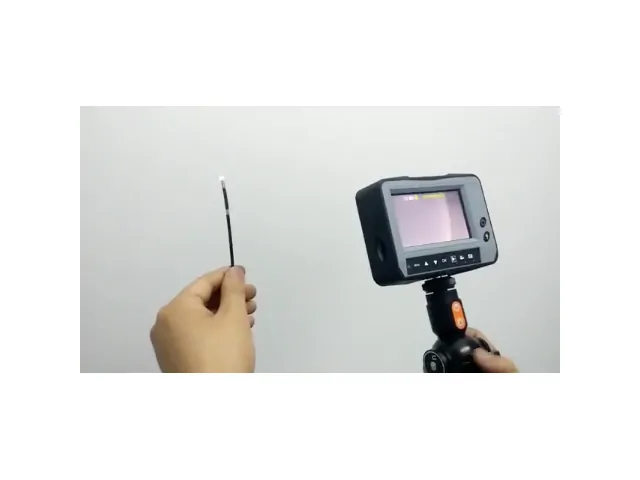
4-Way Articulating Videoscope (Borescope)
An all-in-one handheld inspection videoscope. The camera at the end of the flexible insertion tube bends in four directions under control from the handset, so one operator can steer the view and read the screen at the same time.
- 4-way tip articulation – up, down, left and right, steered from the handset
- Built-in colour screen on the handheld control unit for a live view of the inspection
- Flexible insertion tube that follows bends in engines, ducts and pipework
- One-person operation – steer, view and inspect from a single handset
- Configuration on request – ask Ecotao for the current probe diameter, working length and kit contents
Watch the 4-way articulation in action
The short clip shows the camera tip being steered in each direction while the live image is displayed on the handset.
What you need to confirm before ordering
Articulating videoscopes are built in several configurations. The table shows what is fixed for this unit and which details Ecotao confirms per order, so you get the right probe for your access holes.
← Scroll to see full table →
| Feature | This videoscope | Why it matters |
|---|---|---|
| Tip articulation | 4-way: up, down, left, right | Point the camera in any direction without twisting the probe |
| Display | Built-in colour screen on the handset | No laptop or separate monitor needed on site |
| Insertion tube | Flexible | Follows curved routes through engines, ducts and pipes |
| Probe diameter | Ask Ecotao | Must pass through the smallest access hole |
| Working length | Ask Ecotao | Must reach the furthest point you need to see |
| Articulation angle | Ask Ecotao | Larger angles let you look further back toward the entry point |
| Image and video recording | Ask Ecotao | Needed for inspection reports and before-and-after records |
| Lighting and power | Ask Ecotao | Adjustable LEDs reduce glare on shiny metal; battery runtime sets shift length |
What is a 4-way articulating borescope?
A borescope is any instrument used to look inside an enclosed space through a small opening, without dismantling the equipment. A videoscope is a borescope with a miniature digital camera and LED lighting at the tip, sending a live image to a screen instead of through lenses or optical fibres.
Articulation means the last section of the probe can bend independently of the rest of the cable. On a 4-way articulating borescope, that bending section moves in two planes, up-down and left-right, so the camera can be aimed at any point around it. This is the feature that turns a borescope from a camera on a cable into a precise remote visual inspection (RVI) tool.
Because the operator steers the tip instead of twisting or re-inserting the whole probe, a 4-way videoscope inspects more surface from a single access port, finds defects on walls that sit side-on to the opening, and navigates past bends and junctions on the way in.
How 4-way articulation works
- 1. Control wiresFine steering wires run the length of the insertion tube alongside the camera and lighting cables, anchored at the tip.
- 2. Bending sectionJust behind the camera, a flexible, segmented section bends when one of the wires is pulled and its opposite is released.
- 3. Two planes of movementOne pair of wires controls up-down and a second pair controls left-right. Combining them points the tip diagonally, giving all-round viewing.
- 4. Handset controlThe articulation control on the handset pulls the wires, so the operator steers the camera with one hand while watching the screen.
Practical tip: straighten the tip before you insert or withdraw the probe. Pulling a bent tip back through an access hole is the most common cause of bending-section damage on any articulating scope.
4-way vs 2-way articulation vs fixed-tip and rigid borescopes
The right inspection tool depends on the shape of the space you need to see into. This comparison answers the most common question: do I need 4-way articulation?
← Scroll to see full table →
| Type | Tip movement | Looking around corners | Best suited to | Limitations |
|---|---|---|---|---|
| Rigid borescope | None (fixed optics in a straight tube) | No; view direction is set by the optic | Straight-line access such as gun barrels, bores and drilled holes | Cannot follow bends |
| Fixed-tip flexible inspection camera | None | Only by twisting or re-routing the cable | Quick checks in walls, ducts and vehicles | Hard to aim at a specific surface |
| 2-way articulating videoscope | One plane (usually up and down) | Yes, in one plane; rotate the probe for sideways views | Engine cylinders, simple cavities, general maintenance | Slower to aim in complex geometry |
| 4-way articulating videoscope | Two planes (up, down, left, right) | Yes, in any direction without twisting the probe | Turbines, gearboxes, heat exchangers, branched pipework, welds and castings | More moving parts; tip must be straightened before withdrawal |
| Push-rod pipe inspection camera | None (self-levelling head on some systems) | No; designed to travel along a pipe | Long runs of drain, sewer and conduit | Too large for small access ports |
For long drain and sewer runs, see Ecotao's industrial borescope and pipe inspection camera systems.
How to choose an articulating borescope
Work through these criteria in order. Each one narrows the configuration you need.
- 1. Smallest access holeMeasure the narrowest opening the probe must pass through, such as a turbine borescope port, spark plug hole or drilled inspection hole. The probe diameter must be comfortably smaller.
- 2. ReachMeasure from the access point to the furthest surface you need to see, following the actual route. Choose a working length with spare length for bends.
- 3. GeometryStraight bores suit a rigid scope. If you must look sideways, backwards or around junctions, choose 4-way articulation.
- 4. Surface and environmentShiny machined metal needs adjustable lighting to control glare. Oil, coolant, water and dust call for a sealed, wipe-clean probe.
- 5. ReportingIf inspections feed into maintenance records, insurance or quality reports, confirm image and video capture before ordering.
Not sure which probe fits? Send Ecotao the access hole size, the distance you need to reach and a photo of the equipment, and we will advise on a suitable configuration.
Applications: what a 4-way articulating borescope inspects
Gas turbines and aircraft engines
Entered through borescope ports, the steerable tip is aimed at compressor and turbine blades, combustors and seals to check for cracks, erosion, burning and foreign-object damage without stripping the engine.
Petrol and diesel engines
Through the spark plug or injector hole, the tip is turned down onto the piston crown and back up to the valves and cylinder walls to find carbon build-up, scoring and valve damage before committing to a teardown.
Gearboxes and bearings
Steering around gear teeth through a fill or inspection plug reveals pitting, chipped teeth and wear patterns on mining, conveyor and wind-turbine drivetrains during planned shutdowns.
Heat exchangers, boilers and tubes
The probe travels into tube bundles and headers, and the tip is aimed at tube walls and welds to find scaling, corrosion and blockages in power, petrochemical and sugar-processing plants.
Welds, castings and machined parts
Quality-control teams inspect the inside of welded pipe joints, cast housings and cross-drilled passages for porosity, burrs and incomplete penetration that cannot be seen from outside.
Pipework, HVAC and building cavities
Articulation lets the camera turn into elbows and branches of ducts and small pipes, and scan up, down and sideways inside wall and ceiling voids from one small drilled hole.
Hydraulics and process equipment
Inspect cylinder bores, valve bodies, pumps and tanks for scoring, contamination and corrosion before deciding whether a component needs replacement.
Vehicle and fleet maintenance
Check behind panels, inside chassis rails and in engine bays for corrosion, wiring damage and lost parts during fleet inspections and pre-purchase checks.
Using a videoscope in South African conditions
- Mining and heavy industry: fine dust is the main enemy of an articulating probe. Wipe the insertion tube down before retracting it into its case and keep the camera window clean between inspections.
- Planned shutdowns: power stations, refineries and mills schedule inspections into short outage windows. A handheld videoscope with its own screen sets up in minutes and needs no laptop at the inspection point.
- Remote sites: for work far from a workshop, carry spare charged batteries or a charging option and keep the scope in its protective case during transport on gravel roads.
- Supply: Ecotao supplies inspection equipment from its Cape Town base throughout South Africa and to Namibia, Botswana, Zimbabwe, Mozambique, Lesotho and Eswatini.
Care and handling of an articulating borescope
- Return the tip to the straight position before inserting and before withdrawing the probe.
- Never force the articulation control when you feel resistance; ease the probe back and re-route instead.
- Avoid kinking the insertion tube or coiling it tighter than the case allows.
- Keep the probe away from hot surfaces and moving parts; isolate machinery before inspection.
- Clean and dry the probe after use, especially after oily, wet or dusty inspections, and store it in its case.
Frequently asked questions
What is a 4-way articulating borescope?
A 4-way articulating borescope is a flexible video inspection instrument whose camera tip can be bent up, down, left and right from controls on the handset. Steering the tip lets the operator look around corners and scan the walls of a cavity from a single access hole, which a fixed-tip borescope cannot do.
What is the difference between a 2-way and a 4-way articulating borescope?
A 2-way borescope bends its tip in one plane only, usually up and down, so the operator must rotate the whole insertion tube to look sideways. A 4-way borescope bends in both planes, so the tip can be pointed in any direction without twisting the probe. That makes 4-way articulation the better choice for complex geometry such as turbine stages, gearboxes and branching pipework.
What is the difference between a borescope, a videoscope and an endoscope?
Borescope is the general industrial term for any instrument used to look inside an enclosed space through a small opening. A videoscope is a borescope with a digital camera at the tip and an electronic screen, instead of lenses or optical fibres. Endoscope is the medical term, but many suppliers also use it for industrial videoscopes. A 4-way articulating borescope is a flexible videoscope with a steerable tip.
What can I inspect with a 4-way articulating borescope?
Typical uses include gas turbine and aircraft engine inspection through borescope ports, petrol and diesel engine cylinders through the spark plug or injector hole, gearbox teeth and bearings, heat exchanger and boiler tubes, the inside of welds, castings and machined bores, pipework and HVAC ducts, and wall or ceiling cavities. The steerable tip lets you inspect surfaces that sit at an angle to the access hole.
How do I choose the right probe diameter and length for a borescope?
Measure the smallest opening the probe must pass through and choose a probe diameter comfortably smaller than it. Then measure the distance from the access hole to the furthest point you need to see and choose a working length longer than that, allowing for bends along the route. Smaller probes reach tighter openings, while larger probes generally offer brighter lighting and a sharper image. Ecotao can confirm which probe diameters and lengths are available for this videoscope.
Which specifications should I confirm before ordering an articulating borescope?
Confirm the probe diameter, working length, articulation angle in each direction, screen size, whether the unit records still images and video, how the LED lighting is adjusted, the battery runtime and the probe's resistance to oil and water. Contact Ecotao on +27 21 911 5835 or sales@ecotao.co.za for the current configuration and lead time.
How do I look after an articulating borescope?
Straighten the tip before inserting or withdrawing the probe, never force the articulation control against resistance, avoid kinking or tightly coiling the insertion tube, and wipe the probe clean and dry after use, especially after oily or dusty inspections. Store it in its case so the bending section is not crushed.
Does Ecotao supply 4-way articulating borescopes outside Cape Town?
Yes. Ecotao supplies inspection equipment from its Cape Town base across South Africa and to neighbouring countries including Namibia, Botswana, Zimbabwe, Mozambique, Lesotho and Eswatini.
Related inspection equipment
Get a quote for a 4-way articulating borescope
Tell us your access hole size, the reach you need and what you are inspecting. Ecotao will confirm the configuration and lead time.
- Head Office: +27 21 911 5835
- Zak: 086 142 8716
- Zaid: 082 390 3989
- sales@ecotao.co.za
- aqua@ecotao.co.za