
Ecotao · Authorised Extech Supplier · South Africa
The full Extech Instruments range, in one place
Gas detection is one of more than thirty Extech categories Ecotao supplies — from thermal imagers and clamp meters to water quality, airflow and sound level instruments.
Browse All Extech Instruments →Looking for something specific? Email sales@ecotao.co.za or call +27 21 911 5835 for pricing and lead times.
Gas Analyzers & Gas Testers
Portable gas detectors, combustible gas leak detectors, refrigerant leak detectors, carbon monoxide meters and carbon dioxide analyzers — supplied and supported across South Africa and neighbouring countries by Ecotao Enterprises, Cape Town.
What is a gas analyzer or gas tester? A gas analyzer is an instrument that measures the concentration of one or more specific gases in an air sample and reports it as a calibrated number — in parts per million (ppm), percent by volume (%vol), or percent of the Lower Explosive Limit (%LEL). A gas tester or gas detector is the safety-oriented form of the same instrument: it monitors continuously and raises an audible, visual and often vibrating alarm the moment a preset threshold is crossed. Both work by exposing a sensor to the sample and converting its response into a reading — using electrochemical cells for toxic gases such as carbon monoxide and hydrogen sulphide, catalytic bead elements for combustible gases, non-dispersive infrared (NDIR) optics for carbon dioxide, semiconductor films for general leak sniffing, and heated diodes for halogenated refrigerants.
Range status, August 2026. Every Extech model listed on this page — EZ40, FG100, CO10, CO100 and CO220 — remains current in the Extech catalogue; none has been discontinued. The Extech RD350 refrigerant leak detector has been added to this page as a new listing: it is Extech's current heated-diode refrigerant detector and the replacement for the now-discontinued RD300. Seven Bosean portable and fixed gas detectors stocked on the Ecotao store have also been added below, covering confined space entry, pumped sampling and domestic LP gas alarms.
How to choose a gas detector or analyzer
Choosing correctly comes down to four questions, answered in order. Getting the first one wrong is the most common and most expensive mistake — a combustible gas sniffer will not find a refrigerant leak, and a carbon dioxide monitor will not warn anyone about carbon monoxide.
Which gas, specifically?
Name the actual molecule, not the hazard category. Methane, propane and butane are combustible gases detected on a %LEL scale. Carbon monoxide and hydrogen sulphide are toxic gases measured in ppm. Carbon dioxide is an asphyxiant and ventilation indicator measured in hundreds to thousands of ppm. R-410A and R-32 are halogenated refrigerants that need a heated-diode detector. No single sensor covers all four families.
Find a leak, or monitor an atmosphere?
Leak location wants a flexible probe, a fast rising-tone response and high relative sensitivity — the EZ40, FG100 and RD350 are built for this and are used sweeping along joints and fittings. Atmosphere monitoring wants calibrated absolute readings, alarm setpoints and logging — the CO10, CO100, CO220 and the Bosean portables are built for that instead.
Can you safely enter to take the reading?
If yes, a diffusion instrument such as the Bosean BH-4A or K-40 is sufficient — ambient air reaches the sensors naturally. If no — sewers, manholes, digesters, tanks, silos, ship holds — you need pumped sampling. The Bosean K-600M draws the atmosphere out through a sampling line at 300 to 800 ml/min so the space is cleared before anyone enters.
Portable inspection, or permanent cover?
A person carrying a portable instrument only protects the space while they are standing in it. Unattended risks — an LP gas installation in a restaurant kitchen, guest house or workshop — need a fixed alarm that runs continuously. The Bosean BH-H5 wall alarm fills that role and can drive a solenoid shut-off valve through its volt-free relay contacts.
Gas sensor technologies compared
Sensor type determines what an instrument can detect, how fast it responds, how it fails and how it must be maintained. This is the single most useful thing to understand before buying, because the sensor — not the housing or the display — sets the limits of the instrument.
← Scroll to see full table →
| Sensor technology | Detects | Typical scale | Strengths | Limitations to plan for | On this page |
|---|---|---|---|---|---|
| Catalytic bead (pellistor) | Methane, propane, butane, hydrogen and most combustible gases | 0–100% LEL | Responds to almost any flammable gas; the standard for confined space %LEL channels | Needs oxygen to work, so reads low in oxygen-deficient or high-altitude air; can be poisoned by silicones, sulphides and lead compounds | Bosean BH-4A, K-40, K-600N, K-600M |
| Electrochemical cell | Carbon monoxide, hydrogen sulphide, oxygen, and many other toxic gases | ppm (or %vol for oxygen) | Gas-specific, low power, accurate at low concentrations, fast alarm response | Finite consumable life, typically around two years; cross-sensitivity to related gases; drifts with age | Extech CO10; Bosean BH-90A, K10, BH-4A, K-40, K-600N, K-600M |
| NDIR (non-dispersive infrared) | Carbon dioxide, and hydrocarbons in some designs | ppm to %vol | No consumable element, very long life, unaffected by oxygen level, stable over years | More expensive; needs occasional baseline correction, usually automatic against fresh air | Extech CO100, CO220 |
| Semiconductor (metal oxide) | Broad range of combustible and volatile gases | Relative response, ppm on some models | Very sensitive, inexpensive, ideal for sniffing out the location of a leak | Not gas-selective and not a compliance measurement; humidity and temperature affect response | Extech EZ40, FG100; Bosean BH-H5 |
| Heated diode | CFC, HCFC and HFC refrigerants including R-22, R-32, R-134a, R-410A | Relative, with g/year sensitivity rating | Highly selective for halogenated compounds; ignores ordinary combustible gases so no false chasing | Sensor element is consumable and replaced periodically; requires a short warm-up before use | Extech RD350 |
Extech Instruments gas detectors & analyzers
Why Extech for gas detection
Extech Instruments has built test and measurement tools for trades and professionals since 1971 and is now part of Teledyne FLIR. Its gas instruments are designed around field realities rather than laboratory conditions: single-handed operation, gooseneck probes that hold their shape in awkward positions, and alarm thresholds referenced to recognised safety limits. Ecotao supplies the Extech range across South Africa with local support, and can advise on the correct instrument for a specific application before you order.

Extech EZ40
EzFlex™ Combustible Gas Detector
The EZ40 is built for the awkward half of leak hunting — the joint behind the geyser, the union inside a ceiling void, the fitting under a gas hob. Its 406 mm (16 in) gooseneck holds any shape you bend it into, so the sensor tip stays where you put it while both eyes stay on the readout. A thumb-controlled sensitivity wheel lets you dial out background gas as you get closer, which is what converts a general "there is a leak in this room" into an exact fitting. Visual and audible alarm triggers at 10% of the Lower Explosive Limit for methane, well below any ignition risk.
- Probe406 mm (16 in) gooseneck
- AlarmVisual + audible at 10% LEL methane
- AdjustmentOne-hand thumb sensitivity wheel
- Power3 × C batteries (supplied)
- Best forPinpointing leaks in tight, hidden spaces

Extech FG100
Combustible Gas Leak Detector — LNG & LPG
Where the EZ40 is about reach, the FG100 is about speed and range. It responds to liquefied natural gas and liquefied petroleum gas from 500 to 6500 ppm, which brackets the concentrations you encounter walking a gas line from bottle to appliance: a faint background at the far end of the run, climbing sharply as you approach the leaking joint. Audible and visual alarms fire together, and separate LED indicators distinguish a real gas reading from static absorption so you are not chased by false positives. Up to four hours of continuous operation covers a full inspection round.
- DetectsLNG & LPG, 500–6500 ppm
- AlarmAudible + visual
- IndicatorsSeparate LEDs for gas leak and static absorption
- RuntimeUp to 4 hours continuous
- Best forWalking LPG and natural gas lines quickly
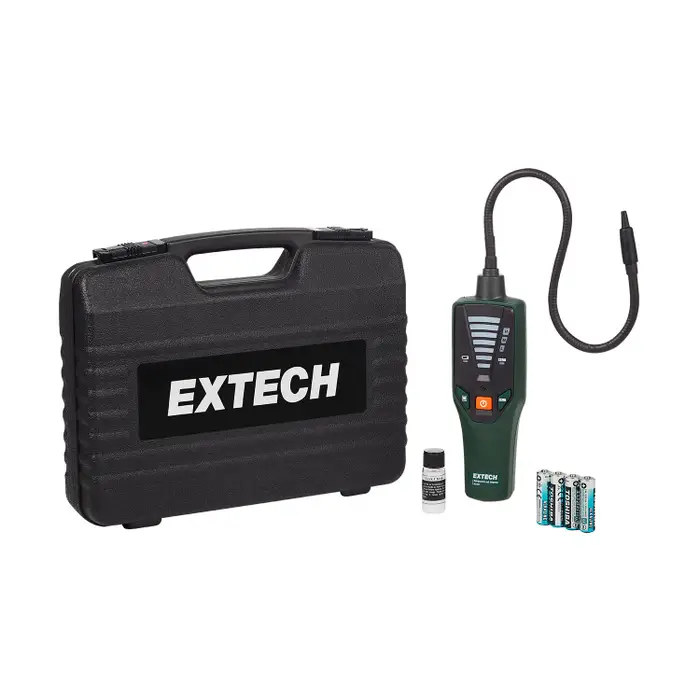
Extech RD350
Refrigerant Leak Detector with Audible & Visual Alerts
Modern HFC refrigerants are non-flammable, so a combustible gas sniffer walks straight past a leaking R-410A joint. The RD350 uses a heated diode sensor that responds specifically to halogenated compounds, covering R-22, R-32, R-134a, R-404A, R-407C, R-410A, HFO-1234yf and all CFCs, HCFCs and HFCs. At its high setting it resolves a loss of roughly 3 g per year — small enough to catch a slow seep long before the system loses performance. A tri-colour LED bar shows leak level rather than a bare on-off alarm, so you can follow the concentration gradient along a pipe run to the exact fitting, and the variable-tone audible alarm lets you work with your eyes on the joint. The 400 mm flexible probe reaches into condenser coils and behind evaporator panels; warm-up takes 45 seconds.
- SensorHeated diode
- RefrigerantsR-22, R-32, R-134a, R-404A, R-407C, R-410A, HFO-1234yf, all CFC/HCFC/HFC
- SensitivityHigh 3 g/yr (HFC group); 4 g/yr for R-22
- Probe400 mm (15.5 in) flexible
- Warm-up45 seconds
- CertificationCE · 2 year warranty

Extech CO10
Carbon Monoxide (CO) Meter — 0 to 1000 ppm
Carbon monoxide has no colour, smell or taste, which is precisely why it kills people who had no reason to suspect anything was wrong. The CO10 makes it visible. A gas-specific electrochemical sensor gives a stabilised, fast-response reading from 0 to 1000 ppm at 1 ppm resolution, with basic accuracy of ±5% or ±10 ppm, whichever is greater. The audible alarm starts at 35 ppm, the level at which prolonged exposure becomes a health concern rather than the level at which symptoms appear — giving you margin to ventilate and investigate. The backlit 1999-count display stays readable in the dim plant rooms, roof spaces and generator enclosures where CO problems usually live.
- Range0–1000 ppm CO, 1 ppm resolution
- Accuracy±5% or ±10 ppm (greater of)
- SensorGas-specific electrochemical, fast response
- AlarmAudible from 35 ppm
- DisplayBacklit 1999-count LCD

Extech CO100
Desktop Indoor Air Quality CO2 Monitor
Carbon dioxide is the cheapest reliable proxy for whether a room is actually being ventilated. People exhale it continuously, so a rising CO2 curve in an occupied classroom, boardroom or clinic waiting area means air is being recirculated rather than replaced — and the same stagnant air carries everything else with it. The CO100 reads 0 to 9999 ppm on a maintenance-free NDIR infrared sensor with no consumable element to replace, and translates the number into plain guidance on screen: Good below 800 ppm, Normal from 800 to 1200 ppm, Poor above 1200 ppm. Temperature and humidity are logged alongside, a user-programmable alarm warns when a threshold is crossed, and automatic baseline calibration against fresh air keeps it honest over years of use.
- CO2 range0–9999 ppm, NDIR sensor
- Temperature−10 to 60°C
- Humidity0.1–99.9% RH
- IAQ bandsGood <800 · Normal 800–1200 · Poor >1200 ppm
- ExtrasProgrammable alarm, max/min recall, clock, ABC calibration

Extech CO220
Desktop CO2 Monitor with TWA & STEL Statistics
The CO220 is the CO100's reporting-grade sibling. It carries the same maintenance-free NDIR carbon dioxide sensor and the same temperature and humidity channels, then adds the calculations that turn a spot reading into evidence. Dew point and wet bulb are derived on board — useful when you are chasing condensation and mould alongside ventilation. More importantly it computes the two statistics occupational hygiene reports are written around: the 8-hour Time Weighted Average and the 15-minute Short Term Exposure Limit. Six facial icons give an at-a-glance verdict for non-technical occupants, high and low audible alarms flag excursions, and 99 readings can be stored and recalled manually. Supplied with an AC adaptor for continuous desktop monitoring.
- MeasuresCO2 (NDIR), air temperature, humidity
- CalculatesDew point, wet bulb, 8-hr TWA, 15-min STEL
- Displayppm reading + six-icon air quality scale
- AlarmAudible high/low
- Memory99 manually stored readings
- PowerAC adaptor supplied
For particle counters, formaldehyde and VOC meters and multi-parameter environmental instruments, see the Ecotao Extech air quality meters page. Ozone-specific instruments are listed under ozone sensors & instruments.
Bosean portable & fixed gas detectors
Why Bosean sits alongside Extech
Extech's gas range is aimed at leak location and indoor air quality. Bosean covers the other half of the problem: certified personal and confined space gas detection. Henan Bosean Electronic manufactures portable and fixed gas instruments with explosion-proof certification — Ex ib IIC T4 Gb on the BH-4A, Ex ib IIC T3 Gb with IP65 on the K-600M — which is what a safety file requires for entry into a classified hazardous area. The models below are stocked on the Ecotao store with typical lead times of one to three weeks; click through to any product for live availability.

Bosean BH-90A
Economical Portable Single Gas Detector
The entry point into personal gas detection. The BH-90A is configured for one gas — combustible gas (EX), oxygen, hydrogen sulphide or carbon monoxide — which keeps the cost per person down when a whole team needs cover against a single known hazard. A rechargeable lithium battery gives long standby between charges, the LCD shows concentration alongside instrument status rather than just a bare number, and the anti-slip compound housing survives being dropped down a manhole. Common where the risk profile is well understood: H²S at a wastewater works, CO around generators, oxygen depletion in a cold store.
- ConfigurationSingle gas — EX, O2, H2S or CO
- SensorElectrochemical or catalytic, natural diffusion
- PowerBuilt-in rechargeable lithium battery
- HousingAnti-slip, compact and portable
- Best forTeam-wide cover against one known hazard

Bosean K10
Portable Gas Detector — EX, H2S, CO, O2
The K10 is the ruggedised step up from the BH-90A. It detects combustible gas, hydrogen sulphide, carbon monoxide and oxygen using natural diffusion sampling on high-quality sensor elements, driven by a large-scale integrated circuit with proprietary digital and analogue hybrid communication for stable, repeatable readings. Where it earns its place is the housing: high-strength engineering plastic with a composite non-slip rubber overmould, waterproof, dustproof and explosion-proof. That combination is why it is specified across oil and gas, chemical processing, environmental services, metallurgy, refining, gas transmission and distribution, biochemical pharmaceuticals and agriculture — environments where the instrument takes as much abuse as the operator.
- DetectsEX (combustible), H2S, CO, O2
- SamplingNatural diffusion
- HousingWaterproof, dustproof, explosion-proof
- IndustriesOil, chemical, environmental, metallurgy, gas, agriculture
- Best forHarsh-duty single-operator monitoring
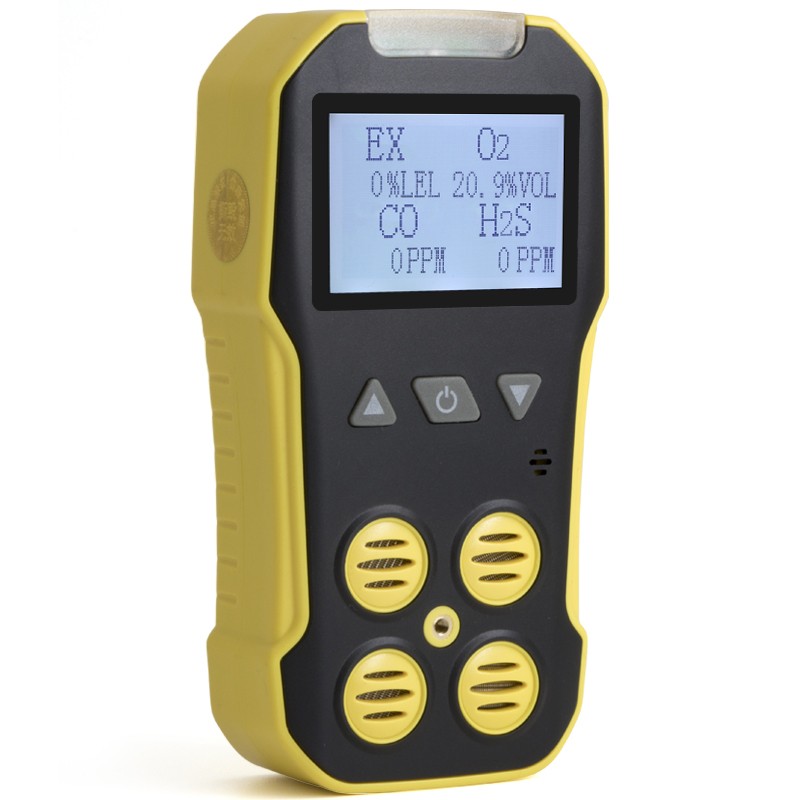
Bosean BH-4A
Portable Multi Gas Detector — 4 gases simultaneously
This is the classic confined space instrument and the practical minimum for entry work. It monitors the four gases that account for most confined space fatalities at the same time: carbon monoxide 0–1000 ppm, combustible gas 0–100% LEL, hydrogen sulphide 0–100 ppm and oxygen 0–30% vol. Oxygen, hydrogen sulphide and carbon monoxide are read on plug-in electrochemical cells; combustible gas on a plug-in catalytic combustion element — plug-in meaning sensors are replaced individually rather than scrapping the instrument. Alarms fire four ways: LCD, LED, audible and vibration, so the warning gets through in a noisy pump station or through a hood and ear defenders. Ex ib IIC T4 Gb certified, with an 1800 mAh battery good for eight hours or more of continuous operation.
- GasesCO 0–1000 ppm · EX 0–100% LEL · H2S 0–100 ppm · O2 0–30% vol
- SensorsPlug-in electrochemical + catalytic combustion
- Accuracy≤±5% F.S. · response ≤30 s
- AlarmsLCD, LED, audible and vibration
- CertificationEx ib IIC T4 Gb
- Battery3.7 V 1800 mAh Li-ion, ≥8 h continuous
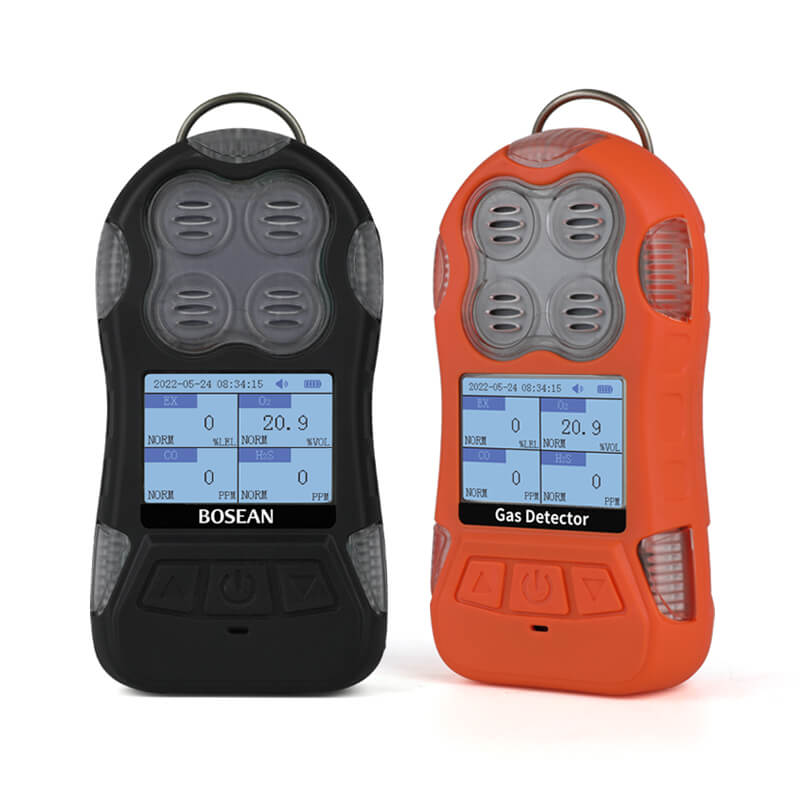
Bosean K-40
4-in-1 Multi Gas Detector
The K-40 covers the same four-gas ground as the BH-4A in a different form factor, built on large-scale integrated circuit technology with proprietary digital and analogue hybrid communication. Sampling is by natural diffusion through high-quality sensor elements, giving excellent sensitivity and, more usefully in practice, excellent repeatability — the same atmosphere reads the same way today as it did last month, which is what makes trend data worth keeping. Maintenance is deliberately simple. Where a site already runs BH-4A units, the K-40 is the common alternative when a different display layout or ergonomic suits the crew better.
- Configuration4-in-1 multi gas
- SamplingNatural diffusion
- ElectronicsLarge-scale IC, digital/analogue hybrid comms
- StrengthHigh repeatability, simple maintenance
- Best forRoutine multi-gas safety rounds
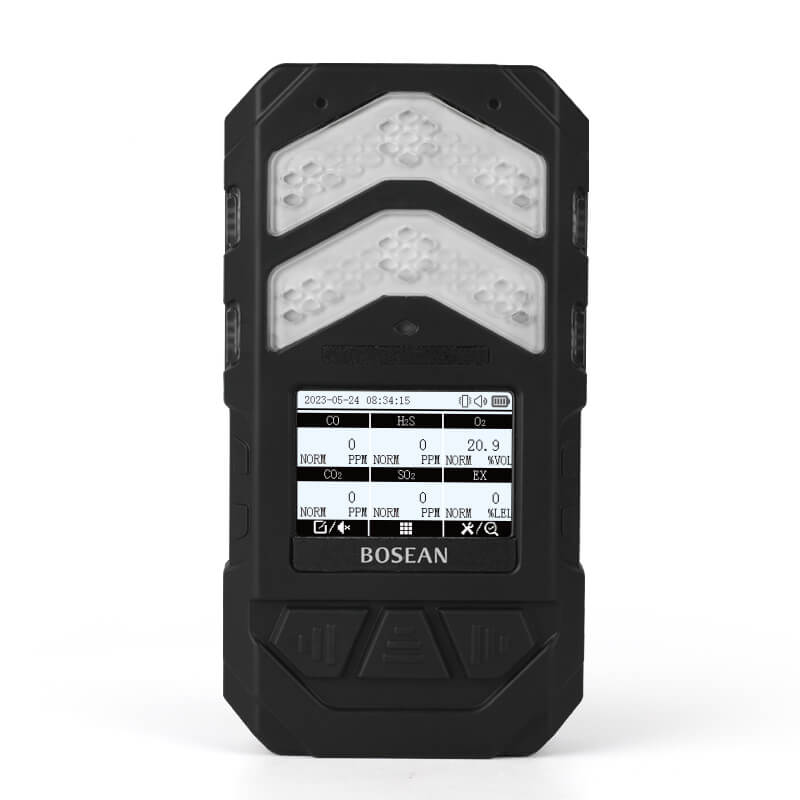
Bosean K-600N
6-in-1 Diffusion Multi Gas Detector
Six channels on one instrument, sampled by natural diffusion. The K-600N steps beyond the standard four-gas configuration for sites where the hazard list is longer — adding carbon dioxide and nitrogen dioxide alongside the usual combustible, oxygen, carbon monoxide and hydrogen sulphide set, or substituting other toxics from Bosean's sensor range. A dot-matrix graphical display replaces the segment LCD, so six live readings fit on one screen without cycling, and three-button operation keeps it usable with gloves on. Four alarm modes run in parallel: sound, light, vibration and on-screen. Housed in high-strength engineering plastic with composite non-slip rubber, waterproof, dustproof and explosion-proof.
- Channels6 gases simultaneously
- SamplingNatural diffusion
- DisplayDot-matrix graphical, all readings at once
- ControlsThree-button, glove-friendly
- AlarmsSound, light, vibration, on-screen
- HousingWaterproof, dustproof, explosion-proof
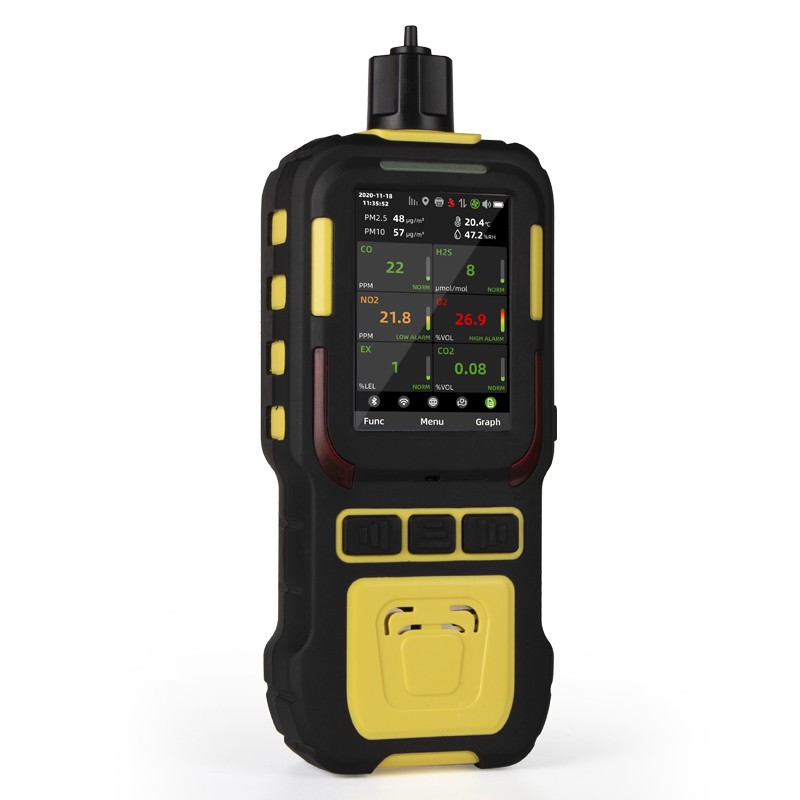
Bosean K-600M
6-in-1 Multi Gas Detector with Sampling Pump
The instrument to specify when the whole point is not entering the space until you know what is in it. An integrated vacuum sampling pump draws the atmosphere out through a line so a manhole, digester, tank or silo can be cleared from outside before anyone descends. Flow is adjustable across six gears from 300 to 800 ml/min to suit line length, and the pump self-alarms if it fails or blocks — a blocked line reading clean air is the failure mode that matters. Six gases are read simultaneously: carbon monoxide 0–1000 ppm, combustible gas 0–100% LEL, hydrogen sulphide 0–100 ppm, oxygen 0–30% vol, carbon dioxide 0–5% vol and nitrogen dioxide 0–20 ppm, with temperature and humidity alongside and a switchable real-time curve view for watching a purge take effect. Records go to a TF card as CSV — up to 100,000 entries, by alarm, fixed interval or manual trigger — and can be printed on site over Bluetooth or tagged by GPS. An optional module adds PM2.5 and PM10 from 0 to 1000 µg/m³. Ex ib IIC T3 Gb, IP65, 4000 mAh battery.
- GasesCO, EX, H2S, O2, CO2, NO2 simultaneously
- PumpBuilt-in, 300–800 ml/min, 6 gears, failure alarm
- LoggingTF card CSV, up to 100,000 records
- ExtrasTemp/RH, live curve view, Bluetooth printing, GPS
- OptionalPM2.5 / PM10 module, 0–1000 µg/m³
- ProtectionEx ib IIC T3 Gb · IP65 · 4000 mAh
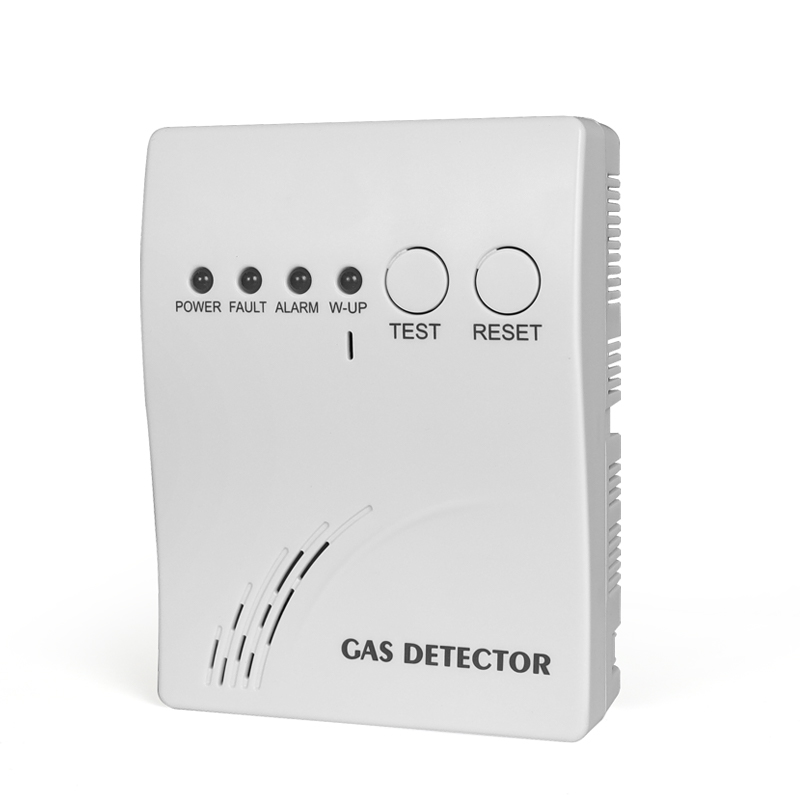
Bosean BH-H5
Domestic Combustible Gas Alarm — LP Gas
Portable detectors only protect a space while someone is standing in it. The BH-H5 is the unattended answer: a wall-mounted semiconductor alarm that watches an LP gas installation continuously in homes, guest houses, restaurant kitchens, hotels and apartments. It reads 0 to 20% LEL and alarms at 10% LEL — a tenth of the concentration needed to ignite — with a combined sound and light alarm above 75 dB and a response time under 30 seconds. Two outputs are provided and can act together, including a volt-free normally-open / normally-closed contact set for driving a solenoid shut-off valve or feeding a building alarm panel. Sensor life is around five years in normal conditions, and the design references BS EN 50194:2000. Mounting matters: LP gas is heavier than air, so fit within 0.3 m of the floor and 2 to 4 m horizontally from the appliance, away from windows, draughts, steam and heat.
- GasPropane / LP gas, 0–20% LEL
- Alarm point10% LEL
- AlarmSound + light, ≥75 dB, response ≤30 s
- OutputsActive output + volt-free NO/NC relay contacts
- Sensor life~5 years, semiconductor
- StandardReferenced to BS EN 50194:2000
Mains supply note for fixed alarms. The published BH-H5 datasheet quotes a 110 V / 60 Hz supply, which is the North American variant. South African mains is 230 V / 50 Hz. Confirm the supply variant with Ecotao when ordering so the correct unit is shipped for local installation — call +27 21 911 5835 or email sales@ecotao.co.za. Portable battery-powered detectors on this page are unaffected; only their chargers need a local plug.
Compare all gas detectors and analyzers
← Scroll to see full table →
| Model | Type | Gases detected | Sensor | Sampling | Choose it when |
|---|---|---|---|---|---|
| Extech EZ40 | Leak detector | Combustible gases (methane, LPG and similar) | Semiconductor | Gooseneck probe | The suspected leak is behind, above or inside something you cannot reach |
| Extech FG100 | Leak detector | LNG and LPG, 500–6500 ppm | Semiconductor | Handheld sweep | You need to walk a whole gas line quickly and narrow the search area |
| Extech RD350 | Refrigerant leak detector | R-22, R-32, R-134a, R-404A, R-407C, R-410A, HFO-1234yf, all CFC/HCFC/HFC | Heated diode | 400 mm flexible probe | An HVAC or refrigeration system is losing charge and you must find where |
| Extech CO10 | Toxic gas meter | Carbon monoxide, 0–1000 ppm | Electrochemical | Diffusion | Combustion appliances, generators or vehicles could be producing CO |
| Extech CO100 | Air quality analyzer | Carbon dioxide 0–9999 ppm, temperature, humidity | NDIR | Diffusion, desktop | You want a simple, permanent read on whether a room is ventilated |
| Extech CO220 | Air quality analyzer | CO2, temperature, humidity, dew point, wet bulb | NDIR | Diffusion, desktop | You need TWA and STEL figures for an occupational hygiene report |
| Bosean BH-90A | Single gas detector | One of EX, O2, H2S or CO | Electrochemical / catalytic | Diffusion | A whole team needs personal cover against one well-defined hazard |
| Bosean K10 | Portable gas detector | EX, H2S, CO, O2 | Electrochemical / catalytic | Diffusion | Conditions are wet, dusty or classified and the instrument takes punishment |
| Bosean BH-4A | 4-gas detector | CO, EX (%LEL), H2S, O2 | Plug-in electrochemical + catalytic | Diffusion | Confined space entry where the space can be safely entered to test |
| Bosean K-40 | 4-in-1 detector | Four-gas configuration | Electrochemical / catalytic | Diffusion | Routine multi-gas safety rounds with an emphasis on repeatability |
| Bosean K-600N | 6-in-1 detector | Six gases simultaneously | Electrochemical / catalytic | Diffusion | The hazard list runs past four gases but the space can be entered |
| Bosean K-600M | Pumped 6-in-1 detector | CO, EX, H2S, O2, CO2, NO2 (+ optional PM2.5/PM10) | Electrochemical / catalytic | Built-in pump, 300–800 ml/min | The space must be tested from outside before entry, and results logged |
| Bosean BH-H5 | Fixed alarm | Propane / LP gas, 0–20% LEL | Semiconductor | Diffusion, wall mounted | An LP gas installation needs continuous unattended protection |
Gas detection in South African conditions
Generic international specifications only take you so far. Four things about operating in South Africa change how these instruments should be specified, calibrated and used — and getting them wrong produces readings that look fine and are not.
Altitude and catalytic LEL sensors: the Highveld problem
Catalytic bead sensors measure combustible gas by burning it on a heated element, so their output depends on how much oxygen is available in the sample. At altitude there is less. An instrument calibrated at sea level in Cape Town or Durban and then used on the Highveld will typically under-read combustible gas — the error runs in the dangerous direction, showing a safer atmosphere than actually exists. The effect is real and sizeable: atmospheric pressure at Johannesburg is roughly 18% lower than at the coast.
← Scroll to see full table →
| Location | Approx. elevation | Approx. atmospheric pressure | Effect on catalytic %LEL reading |
|---|---|---|---|
| Cape Town | 0–100 m | ~101 kPa | Reference condition |
| Durban | ~10 m | ~101 kPa | Reference condition |
| Kimberley | ~1 230 m | ~88 kPa | Under-reads if calibrated at the coast |
| Pretoria | ~1 340 m | ~86 kPa | Under-reads if calibrated at the coast |
| Bloemfontein | ~1 395 m | ~86 kPa | Under-reads if calibrated at the coast |
| Johannesburg | ~1 753 m | ~82 kPa | Significant under-reading if calibrated at the coast |
What to do about it: calibrate the instrument at, or close to, the altitude where it will be used, and bump test on site before each day's work. If a detector is bought in Cape Town for a Gauteng site, say so at the point of order so calibration can be planned. Electrochemical toxic sensors and NDIR carbon dioxide sensors are also pressure-sensitive, but the effect is smaller and usually within specification across the SA range.
Load shedding, generators and carbon monoxide
Every hour of load shedding puts more petrol and diesel generators, gas heaters and paraffin appliances into service, frequently in garages, storerooms, passages and partially enclosed yards that were never designed to exhaust combustion products. Carbon monoxide accumulates fastest exactly where people assume ventilation is adequate because a door is open. An Extech CO10 gives a technician or facilities manager a defensible number when assessing a generator enclosure, plant room or workshop, and a Bosean BH-90A configured for CO provides continuous personal cover for staff working around running plant. The same load shedding has driven a large shift to LP gas for cooking and heating, which is what makes fixed alarms such as the BH-H5 relevant in ordinary homes and small restaurants, not just industrial sites.
Wastewater, agriculture and aquaculture: hydrogen sulphide
Hydrogen sulphide is the hazard most often underestimated on South African municipal and agricultural sites, because its warning smell disappears at concentrations well below the lethal range — olfactory fatigue sets in and the atmosphere seems to improve as it gets worse. Sewer chambers, pump stations, digesters, sludge lagoons, slurry pits, silage clamps and fish farm sumps all generate it. Any of these is confined space work: use a four-gas instrument such as the BH-4A or K-40, and where the chamber cannot be entered to take the first reading, a pumped instrument such as the K-600M to clear it from outside first.
Refrigerant transition and the R-22 phase-out
South Africa's HCFC phase-out under the Montreal Protocol has moved installed plant off R-22 and onto R-410A and R-407C, and newer equipment increasingly onto R-32 and the HFO refrigerants. A technician's leak detector therefore has to span two generations of chemistry at once: legacy R-22 systems still in service, and current R-32 and HFO-1234yf equipment coming out of warranty. The Extech RD350 covers the full span, which is the main practical reason to choose it over an older single-family detector.
Regulatory context
Atmospheric testing before and during confined space entry is a requirement of the Occupational Health and Safety Act 85 of 1993 and its General Safety Regulations, and forms part of the permit-to-work documentation an inspector or insurer will ask for. Hazardous location classification is addressed in SANS 10108, and LP gas installation in SANS 10087. This page is a product guide, not legal advice — confirm the current requirements applicable to your site with a registered safety practitioner, and keep instrument calibration certificates in the safety file.
Calibration, bump testing and sensor life
A gas detector is the only tool on a site that is trusted to say nothing is wrong. That makes verifying it a different discipline from maintaining ordinary instruments: a detector that has quietly failed gives exactly the same reassuring display as one that is working.
- Bump test before each day of use. Apply a certified span gas and confirm the sensors respond and the alarms actually sound, light and vibrate. This is a pass/fail functional check; it does not adjust accuracy.
- Full calibration at least every six months, or more frequently where the manufacturer, site safety file or insurer requires it. Calibration adjusts the reading against a known concentration.
- Recalibrate after any of the following: a sensor replacement, a physical shock or drop, exposure to a concentration above full scale, a failed bump test, or a change in operating altitude.
- Plan for sensor replacement. Electrochemical cells are consumable — roughly two years of service on instruments such as the BH-4A, and they drift as they age. Semiconductor sensors on fixed alarms such as the BH-H5 run around five years. NDIR carbon dioxide sensors, as used in the CO100 and CO220, have no consumable element and last far longer.
- Protect catalytic beads from poisons. Silicones (sealants, some sprays and personal care products), sulphur compounds and lead compounds degrade catalytic LEL sensors, sometimes permanently and often without any visible fault indication until the next bump test.
- Keep the records. Bump test and calibration logs are the evidence that a reading taken on a given day can be relied on.
Frequently asked questions
What is the difference between a gas detector and a gas analyzer?
A gas detector answers a safety question: is a hazardous gas present, and has it crossed an alarm threshold? It is optimised for fast response, loud alarms and rugged portability, and a leak detector such as the Extech EZ40 or FG100 may not give a calibrated numerical concentration at all. A gas analyzer answers a measurement question: what exactly is the concentration, and how has it changed over time? Instruments such as the Extech CO100 and CO220 give calibrated readings in ppm with logging, statistical averaging and reporting features. In practice most confined space and leak work needs a detector, while indoor air quality assessment, ventilation commissioning and occupational exposure reporting need an analyzer.
What is the difference between %LEL and ppm on a gas detector?
%LEL measures explosion risk and ppm measures toxicity, and the two scales are thousands of times apart. LEL stands for Lower Explosive Limit, the lowest concentration at which a gas will ignite. For methane the LEL is roughly 5% by volume in air, so 100% LEL equals about 50,000 ppm and a typical 20% LEL low alarm equals about 10,000 ppm. Toxic gases are alarmed far lower: hydrogen sulphide typically alarms at 10 ppm and carbon monoxide at 50 ppm. A combustible gas reading of 5% LEL is not an explosion risk, but a hydrogen sulphide reading of 5 ppm is already an exposure concern — which is why multi gas detectors such as the Bosean BH-4A display both scales at the same time.
Which gas detector should I use for confined space entry in South Africa?
Confined space entry requires atmospheric testing before entry and monitoring during occupancy under the Occupational Health and Safety Act 85 of 1993 and its General Safety Regulations. The practical minimum is a four-gas instrument covering oxygen, combustible gas as %LEL, carbon monoxide and hydrogen sulphide — the Bosean BH-4A or K-40. Where the space cannot be safely entered to take the first reading, which covers most sewers, manholes, digesters, silos and tanks, a pump-sampling instrument such as the Bosean K-600M is required so the atmosphere can be drawn out through a sampling line from outside before anyone goes in. Ecotao can advise on sensor configuration for a specific site.
Do catalytic LEL gas sensors read accurately at Highveld altitude?
Not without attention to calibration. Catalytic bead LEL sensors work by burning the sample gas on a heated bead, so their output depends on the partial pressure of oxygen available. Johannesburg sits at roughly 1 753 m and Gauteng generally around 1 300 to 1 750 m, where atmospheric pressure is close to 82 to 86 kPa against roughly 101 kPa at sea level in Cape Town or Durban. An instrument calibrated at the coast and used inland will typically under-read combustible gas, which is the dangerous direction of error. Calibrate at the altitude of use, or apply the manufacturer's altitude correction, and bump test on site. Electrochemical toxic sensors and NDIR carbon dioxide sensors are also pressure sensitive, but the effect is smaller.
How often should a portable gas detector be calibrated and bump tested?
Industry practice is a functional bump test with certified span gas before each day of use, and a full span calibration at least every six months — or more often where the manufacturer, the site safety file or an insurer requires it. A bump test confirms that the sensors respond and the alarms sound; it does not adjust accuracy. A calibration adjusts the reading against a known gas concentration. Electrochemical sensors in instruments such as the Bosean BH-4A have a typical service life of about two years and drift as they age, so a detector that passes a bump test can still be out of calibration. Record every test in the safety file.
What is the difference between a carbon monoxide meter and a carbon dioxide monitor?
Carbon monoxide (CO) is a toxic gas produced by incomplete combustion in generators, gas heaters, geysers, braais and vehicle engines. It is measured in ppm with an electrochemical sensor, as in the Extech CO10, and alarms in the tens of ppm because it is lethal at a few hundred ppm. Carbon dioxide (CO2) is a normal product of breathing and complete combustion, is not acutely toxic at indoor levels, and is measured in the hundreds to thousands of ppm with an NDIR infrared sensor, as in the Extech CO100 and CO220. A CO2 monitor is a ventilation and occupancy tool; a CO meter is a life-safety tool. Neither substitutes for the other.
Which detector finds a refrigerant leak, and does it detect R-32 and R-410A?
Use a purpose-built refrigerant leak detector rather than a combustible gas detector, because most modern HFC refrigerants are non-flammable and will not register on a catalytic or semiconductor combustible sensor. The Extech RD350 uses a heated diode sensor and covers R-22, R-32, R-134a, R-404A, R-407C, R-410A, HFO-1234yf and all CFCs, HCFCs and HFCs, with high sensitivity down to about 3 g per year for the HFC group and 4 g per year for R-22. Its 400 mm flexible probe and tri-colour LED leak level indicator let a technician follow the concentration gradient to the leak point. The RD350 replaces the discontinued Extech RD300.
What indoor CO2 level is considered unhealthy?
Outdoor air currently sits at roughly 420 ppm. Indoors, readings up to about 800 ppm indicate good ventilation, 800 to 1200 ppm is acceptable but shows air is being recirculated, and sustained readings above 1200 ppm indicate poor ventilation and are associated with drowsiness, headaches and measurable reductions in concentration and decision-making performance. The Extech CO100 displays exactly these bands on screen. Because exhaled CO2 rises and falls with occupancy, it is widely used as a proxy for how well a classroom, boardroom or clinic waiting room is exchanging air.
Can I use a combustible gas leak detector to find an LPG leak at home?
Yes. The Extech FG100 detects LPG and LNG from 500 to 6500 ppm, and the Extech EZ40 with its 406 mm gooseneck probe reaches behind appliances and into cupboards where a bottle or regulator connection may be leaking. These are inspection tools used by a person, not permanent protection. For continuous unattended cover in a home, restaurant kitchen, guest house or workshop, install a fixed alarm such as the Bosean BH-H5, which alarms at 10% LEL with a sound and light alarm above 75 dB. Because LPG is heavier than air it must be mounted low — within about 0.3 m of the floor and 2 to 4 m horizontally from the appliance. A natural gas alarm is mounted high instead.
Does Ecotao supply and deliver gas detectors outside Cape Town?
Yes. Ecotao Enterprises is based at 39 Olienhout Avenue, Plattekloof 3, Cape Town, and delivers throughout South Africa and to neighbouring countries including Namibia, Botswana, Zimbabwe, Mozambique, Zambia, Eswatini and Lesotho. For pricing, sensor configuration, lead times or calibration advice contact the head office on +27 21 911 5835, Zak on 086 142 8716, Zaid on 082 390 3989, or email sales@ecotao.co.za.
Not sure which detector fits your site?
Tell us the gas, the space and where in the country it will be used — we will specify the right sensor configuration and calibration approach before you order.
Ecotao Enterprises CC · 39 Olienhout Avenue, Plattekloof 3, Cape Town, 7500
Head Office +27 21 911 5835 · Zak 086 142 8716 · Zaid 082 390 3989 · sales@ecota