
Material Testing · Engineering
Cement & Concrete Testing Equipment
Laboratory and site equipment for every stage of concrete quality control: fresh-concrete tests, mixing, specimen making and curing, hardened-concrete and core testing, and non-destructive testing of existing structures. Supplied from Cape Town to labs, contractors, ready-mix plants, precast yards and engineers across South Africa and neighbouring countries.
What is cement and concrete testing?
Cement and concrete testing is the set of standardised laboratory and site tests that show whether concrete, mortar and cement meet their specification. Tests on fresh concrete (slump, air content) are done at the time of placing to accept or reject a load. Tests on hardened concrete (compressive strength of cubes or cores, stiffness, water penetration) prove the concrete reached its design strength and durability. Non-destructive tests (rebound hammer, cover meter, crack measurement) assess concrete already in a structure without damaging it.
Fresh concrete & mortar tests
Workability, air content and flow are measured within minutes of mixing, before the concrete is placed. These are the site and batching-plant acceptance tests.
Slump Cone Set (Stainless Steel)
The slump test is the most widely used check on the workability (consistence) of fresh concrete. The cone is filled in three layers, each rodded, then lifted vertically; the drop in height of the concrete is the slump.
- Stainless steel resists corrosion from wet cement paste and cleans easily between tests
- Standard cone geometry: 300 mm high, 200 mm base diameter and 100 mm top diameter
- Used for site acceptance, batching-plant quality control and checking a mix against its specified slump class
- Not suitable for very stiff or self-compacting mixes; those need a different consistence test
Air Entrainment Meter (Pressure Gauge Type)
Measures the total air content of freshly mixed concrete by the pressure method. A sealed bowl of compacted concrete is pressurised and the drop in pressure, read off the gauge, is calibrated directly in percentage of air.
- Checks that an air-entraining admixture has produced the specified air content
- Too little entrained air reduces freeze-thaw resistance; too much reduces strength
- Pressure method suits normal-weight concrete with dense aggregates; lightweight and highly porous aggregates need the volumetric method
Electric Cement Mortar Flow Table
Measures the flow (spread) of cement mortar. A mould of mortar is placed on the table, lifted, and the table is dropped a set number of times by a motor-driven cam; the spread diameter is the flow value.
- Motor drive gives a consistent drop rate, removing the variation of hand-cranked tables
- Used to set water content for cement strength mortars and to compare mortar mixes
- Also used for repair mortars, grouts and masonry mortars
Laboratory mixers
Trial mixes and cement tests only mean something if every batch is mixed the same way. A controlled mixer removes the operator from the result.

Cement Mixer (5 L Volume)
A planetary bowl mixer for preparing cement mortar for strength testing. The paddle turns on its own axis while orbiting the bowl, so the whole batch is mixed at controlled speeds for controlled times.
- 5 L bowl, the nominal bowl size used for standard cement mortar mixing
- Programmed speed and time sequence makes every batch repeatable between operators
- Prepares mortar for cement strength prisms, flow tests and setting time tests
Mortar Mixer / Mortar Blender (Protective Type)
A laboratory mortar mixer with a protective guard around the bowl and paddle. Mixes mortar and cement paste for testing while keeping hands and loose clothing away from moving parts.
- Guarded bowl area for safer use in busy teaching and commercial labs
- Suitable for cement mortar, masonry mortar and repair mortar trial mixes
- Listed on our range as both Mortar Mixer and Mortar Blender (Protective Type)
Blender (Mobile and Drum Type)
A laboratory concrete mixer for trial batches. The drum type tumbles the mix in a rotating drum, while the mobile type is built on a wheeled frame so it can be moved between the mixing area and the specimen-casting area.
- Mixes full concrete with coarse aggregate, not just mortar
- Used for mix design trials, admixture trials and making test specimens
- Drum mixers suit most normal concretes; very stiff or fibre mixes may need a forced-action pan mixer
Portable Concrete Mixer
A compact mixer for small concrete batches on site or in the lab, for making test specimens and small trial mixes where a full-size mixer is impractical.
- Small batches for cubes, cylinders and beams
- Easy to move between site locations
- Useful for testing small changes to a mix before a full plant trial
Specimen making & curing
Most strength results are decided before the specimen reaches the press: how it was compacted, and at what temperature and humidity it cured.
Cube Mould
Rigid moulds for casting concrete cubes for compressive strength testing. Machined, square and tightly clamped moulds produce cubes with flat, parallel faces, which the compression test depends on.
- 100 mm and 150 mm cubes are the common sizes; smaller cubes suit mixes with smaller aggregate
- Cubes are demoulded, cured and crushed at set ages, usually 7 and 28 days
- Out-of-square or worn moulds give low and scattered results, so moulds should be checked regularly

Magnetic Vibrating Table
Compacts fresh concrete in moulds by vibration. Electromagnets hold steel moulds firmly to the table top, so the moulds don't bounce and every specimen receives the same compaction energy.
- Removes entrapped air from specimens without hand rodding
- Magnetic clamping holds steel moulds without straps or bolts
- Consistent compaction narrows the scatter in compressive strength results
Curing Cabinet (Standard)
A temperature- and humidity-controlled cabinet for curing concrete and mortar specimens at the conditions the test standard specifies, until they are tested.
- Holds temperature constant and humidity high so specimens don't dry out
- EN 12390-2 calls for 20 ± 2 °C and at least 95% relative humidity (or water storage); ASTM C511 specifies 23 ± 2 °C
- Especially important in South Africa's hot, dry inland climate, where uncontrolled curing loses moisture fast
Steaming Cabinet
A cabinet that cures specimens in steam at raised temperature. Used to simulate the accelerated steam curing cycles of precast concrete production, and to get early-age strength results sooner.
- Lets precast producers match test specimens to the curing cycle their elements receive
- Useful for checking early strength before stripping or transferring prestress
- Separate from standard curing: specimens for 28-day acceptance tests still need standard conditions
Hardened concrete & core preparation
Equipment for testing durability and stiffness, and for drilling and preparing cores and specimens so that the ends are flat and parallel before testing.
Elastic Modulus Testing Apparatus
Measures the static modulus of elasticity of concrete: how much a cylinder or prism shortens under load. Gauges clamped to the specimen record strain while a compression machine applies load in cycles.
- Provides the stiffness value structural engineers use to calculate deflection and creep
- Used alongside a compression testing machine
- Important for high-rise frames, post-tensioned slabs and precast elements
Intelligent Concrete Impervious Apparatus
Tests the resistance of hardened concrete to water penetration. Specimens are sealed into the apparatus and water is applied under controlled pressure, and the depth or pressure at which water gets through is recorded. The automatic ("intelligent") controller holds and steps the pressure without an operator.
- Key durability test for water-retaining structures, basements, reservoirs and tunnels
- Several specimens tested together under the same pressure
- Results show how well the mix design and curing have produced a dense, low-permeability concrete
Cutting Machine (Portable)
A portable saw for cutting concrete cores, cylinders and prisms to length and trimming specimen ends.
- Brings cores to the length-to-diameter ratio the core test needs
- Removes reinforcement-affected or damaged ends from cores
- Portable, so it can be used where cores are taken
Grinding Machine (Double-Heads)
Grinds both end faces of a core or cylinder flat and parallel in one setup. Flat, parallel ends spread the load evenly in the compression machine; uneven ends concentrate load and give falsely low strengths.
- Two grinding heads finish both ends together, saving time and keeping the ends parallel
- An alternative to capping specimens with sulphur or other compounds
- Used on drilled cores and cast cylinders before compression or modulus testing
Multifunctional Concrete Core Drilling Machine
Drills cylindrical cores from hardened concrete in existing structures and in slabs or blocks. Cores are the most direct way to find the strength of concrete as built.
- Used when cube results are low or disputed, or when assessing an older structure
- Also used to check slab thickness and take samples for chloride and carbonation tests
- Locate the reinforcement first so cores avoid cutting through bars
In-situ & non-destructive testing
Assess an existing structure without breaking it: surface hardness, cover to reinforcement and crack width.
Concrete & mortar test hammers (rebound hammers)
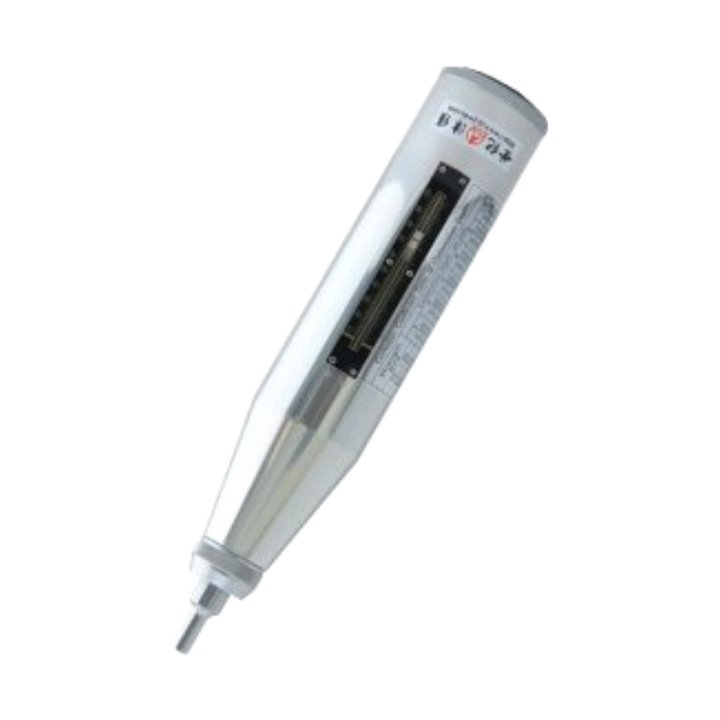
A rebound hammer, often called a Schmidt-type hammer, fires a spring-loaded mass at the concrete surface and measures how far it rebounds. Harder, stronger concrete gives a higher rebound number, which is converted to an estimated compressive strength. It is fast and leaves no damage, so it is used to survey large areas and decide where cores should be taken.

TH-01 Concrete Test Hammer (Type N)
The classic mechanical Type N rebound hammer, the design every major rebound standard is based on. Use it to estimate compressive strength, map uniformity across a structure and check strength before formwork is removed.
- Range 10 to 70 MPa
- Usable to ISO 8045, ASTM C805, EN 12504-2, BS 1881-202 and DIN 1048
- No batteries: read directly from the scale

HT450-A High-Strength Concrete Test Hammer (4.5 J)
A higher-energy rebound hammer for high-strength concrete, where a standard Type N hammer runs out of range. Used in structural engineering on high-strength columns, precast elements and bridge members.
- Range 20 to 110 MPa
- Higher impact energy for high-strength concrete
- Aluminium casing

T Measurement TEM912 Digital Concrete Test Hammer
A digital rebound hammer that records every reading, calculates the mean and the estimated strength, and lets you enter carbonation depth for the correction. Saves the time and transcription errors of writing readings by hand.
- 2.0-inch colour screen with voice announcement of readings
- Records rebound values, carbonation depth input and strength calculation
- PC data transfer and Bluetooth printing; rechargeable lithium battery
TH-05H Mortar Test Hammer
A low-energy point-type hammer for the mortar joints in brick and stone masonry, where a concrete hammer would be far too heavy. Used for quality control on new brickwork and for assessing heritage and restoration work.
- Range 1 to 25 MPa; impact energy 0.196 J
- Supplied with carry case, spare spring and grinding stone
- 268 mm long, 1.0 kg
← Scroll to see full table →
| Model | Type | Range | Best for | Readout |
|---|---|---|---|---|
| TH-01 | Mechanical, Type N | 10 to 70 MPa | Normal structural concrete, formwork-striking checks | Scale |
| HT450-A | Mechanical, high energy (4.5 J) | 20 to 110 MPa | High-strength concrete, precast, bridges | Scale |
| TEM912 | Digital | Ask Ecotao | High-volume surveys needing recorded data and carbonation correction | Colour screen, PC transfer, Bluetooth printing |
| TH-05H | Mechanical, point type (0.196 J) | 1 to 25 MPa | Masonry mortar joints, heritage and restoration | Scale |
Cover, reinforcement & cracks
Steel Bar Position Mensuration Apparatus
A rebar locator, or cover meter. It finds reinforcing bars inside hardened concrete using an electromagnetic field and measures the depth of concrete covering them.
- Checks that cover meets the design, which is the main protection against reinforcement corrosion
- Marks bar positions before coring, drilling or cutting
- Essential for condition surveys of coastal structures, where chloride-driven corrosion depends on cover
Crack Width Measurement Instrument
Measures the width of surface cracks in concrete by magnifying the crack and reading it against a scale or on a screen.
- Checks cracks against the limits set in the structural design
- Repeat readings at the same points show whether a crack is still moving
- Records evidence for condition surveys, defect reports and warranty claims
How to choose concrete testing equipment
- Start with your specification. The project specification or your lab's accreditation scope names the test methods (SANS, EN or ASTM). Choose equipment built to those methods, because dimensions and procedures differ between standards.
- Decide where the testing happens. Site testing needs portable, robust kit: slump cone, air meter, cube moulds, rebound hammer. A central lab adds mixers, a vibrating table, curing cabinets, and core preparation equipment.
- Control the variables that drive scatter. If strength results vary, look first at compaction (vibrating table), mould condition and curing temperature (curing cabinet) before questioning the concrete supplier.
- Match the hammer to the concrete. Use a Type N hammer for normal concrete, a high-energy hammer above about 70 MPa, and a mortar hammer for masonry joints. Go digital when the number of readings makes hand recording a bottleneck.
- Plan for in-situ investigation. For existing structures, combine a rebound survey to find weak zones, a rebar locator to check cover and mark bars, and cores from the critical areas for a definitive strength.
South African conditions
Hot, dry and windy weather inland, and on the West Coast, speeds up slump loss and dries out specimens quickly, so test fresh concrete promptly and get specimens into controlled curing early. Along the coast, chloride exposure makes cover to reinforcement the critical durability check on existing structures.
Concrete tests, standards and equipment at a glance
← Scroll to see full table →
| Test | Material | Standards | Equipment |
|---|---|---|---|
| Workability (slump) | Fresh concrete | SANS 5862-1 · EN 12350-2 · ASTM C143 | Slump Cone Set |
| Air content | Fresh concrete | SANS 6252 · EN 12350-7 · ASTM C231 | Air Entrainment Meter |
| Mortar flow | Fresh mortar | EN 1015-3 · ASTM C1437 | Electric Mortar Flow Table |
| Cement mortar mixing | Cement | SANS 50196-1 · EN 196-1 · ASTM C305 | Cement Mixer (5 L) |
| Making & curing specimens | Fresh to hardened | SANS 5861-3 · EN 12390-2 | Cube Mould, Vibrating Table, Curing Cabinet |
| Modulus of elasticity | Hardened concrete | EN 12390-13 · ASTM C469 | Elastic Modulus Apparatus |
| Water penetration | Hardened concrete | EN 12390-8 | Concrete Impervious Apparatus |
| Drilled cores | In-situ concrete | SANS 5865 · EN 12504-1 · ASTM C42 | Core Drill, Cutter, Double-Head Grinder |
| Rebound number | In-situ concrete | EN 12504-2 · ASTM C805 | Concrete & Mortar Test Hammers |
| Cover to reinforcement | In-situ concrete | BS 1881-204 | Steel Bar Position Apparatus |
Compressive strength of cubes and cylinders (SANS 5863) is tested on a compression machine. See our material testing machines.
Frequently asked questions
What equipment do I need to set up a basic concrete testing laboratory?
At minimum: a slump cone set for workability, cube moulds and a vibrating table for making specimens, a curing cabinet or curing tank held at the standard temperature, and access to a compression testing machine for crushing cubes. Add an air entrainment meter if you use air-entrained concrete, and a rebound hammer and rebar locator for site assessment.
What is the difference between a slump test and a flow table test?
The slump test measures the workability of fresh concrete by how far it drops after the cone is lifted. The flow table test measures how far mortar spreads after the table is dropped a set number of times. Slump is for concrete with coarse aggregate; the flow table is for mortar, grout and cement paste.
Can a rebound hammer replace cube or core tests?
No. A rebound hammer measures surface hardness, which only correlates with strength. It is excellent for comparing areas of a structure, finding weak zones and deciding where to take cores, but strength results for acceptance or dispute should come from cubes or drilled cores. Correlating rebound numbers against cores from the same structure gives the most reliable estimate.
Which rebound hammer should I choose?
For normal structural concrete, a Type N hammer such as the TH-01 (10 to 70 MPa) is the standard choice. For high-strength concrete above that range, use the HT450-A (20 to 110 MPa). For mortar joints in brickwork, use the TH-05H (1 to 25 MPa). Choose the digital TEM912 if you take many readings and want them recorded and calculated automatically.
Why do my concrete cube results vary so much?
Most variation comes from specimen preparation rather than the concrete itself: uneven compaction, worn or out-of-square moulds, specimens left to dry out in the first 24 hours, curing at the wrong temperature, or uneven loading faces. A vibrating table, good moulds and a controlled curing cabinet address the biggest causes.
Which South African standards cover concrete testing?
The main SANS test methods include SANS 5862-1 (slump), SANS 6252 (air content), SANS 5861-3 (making and curing test specimens), SANS 5863 (compressive strength) and SANS 5865 (drilled cores). Cement strength testing follows SANS 50196-1, which is the South African adoption of EN 196-1.
Why does concrete cover to reinforcement matter?
The concrete cover protects steel bars from carbonation and chlorides, which cause corrosion. Too little cover is one of the most common causes of early deterioration, particularly in coastal structures. A rebar locator measures cover without breaking the concrete.
Do you deliver concrete testing equipment outside Cape Town?
Yes. Ecotao supplies customers throughout South Africa and in Namibia, Botswana, Zimbabwe, Mozambique, Lesotho and Eswatini. Contact us for lead times and delivery to your site.
Related material testing equipment
Equipping a concrete lab or site?
Send us your test list or specification and we'll put together the equipment you need, with lead times and delivery throughout South Africa, Namibia, Botswana, Zimbabwe, Mozambique, Lesotho and Eswatini.
- Head Office: +27 21 911 5835
- Zak: 086 142 8716
- Zaid: 082 390 3989
- Email: sales@ecotao.co.za · aqua@ecotao.co.za