
Explore the Complete Extech Instrument Range
Bench power supplies are one category within a much wider Extech line-up supplied by Ecotao — multimeters, clamp meters, power analyzers, electrical testers, calibrators, environmental meters and more.
Extech Bench DC Power Supplies
A bench DC power supply is a mains-powered instrument that converts 230 V AC into a stable, adjustable DC output, with independent control over both the output voltage and the maximum current the load is allowed to draw. That second control is what separates a bench supply from a plug pack or a battery: it lets you cap the current before you energise an untested circuit, so a solder bridge or a reversed component causes the supply to fold back harmlessly instead of destroying the board.
Ecotao supplies the Extech bench power supply range from Cape Town, with delivery throughout South Africa, Namibia, Botswana, Zimbabwe, Mozambique, Lesotho and Eswatini. The range spans six models, from a 30 W single-output linear supply for quiet analogue work up to a 600 W switching unit that will hold 13.8 V at 20 A for automotive, radio and battery testing.
Every model in this range provides automatic constant-voltage / constant-current crossover, front-panel metering of both voltage and current, and short-circuit protection as standard. What differs between them is the topology (linear or switching), how much power they can deliver, how many independent rails they provide, and how quiet the output is.
How to choose a bench DC power supply
Four decisions settle almost every selection. Work through them in order — the first two eliminate most of the range on their own.
1. Voltage and current, with headroom
Take the highest voltage your circuit needs and add roughly 20% headroom, because a supply running at the very top of its range has nothing left to regulate with. Then size for peak current, not average. Motors, relays, solenoids and switch-mode regulators pull an inrush surge several times their running draw, and a supply that current-limits during that surge simply will not start the load.
2. Check the power product, not just the numbers
On a constant-power design such as the DCP36, the 80 W ceiling means you can have 36 V at 2.2 A or 16 V at 5 A — but not 36 V at 5 A. Multiply your target voltage by your target current and check the result against the model's rated output power before you commit.
3. How quiet does the output need to be?
Digital logic and motor loads shrug off tens of millivolts of ripple. Analogue signal chains, precision sensor front ends, low-noise amplifiers and RF stages do not — supply ripple lands directly in the measurement as noise or spurious tones. If that describes your work, choose a linear model (0.5 mV ripple) rather than a switching one (5–35 mV).
4. How many independent rails?
A single adjustable rail is enough for most component-level work. If you are powering a mixed board with a 5 V logic section and a 12 V analogue section alongside a variable rail, the 382213 gives you all three at once. If you need a genuine dual-rail supply, or a ±30 V split, or 60 V in series, only the 382270 is designed for it.
A rule of thumb for current limiting
Set the voltage your circuit needs, then set the current limit to roughly 1.5× its expected running draw. High enough that normal operation and inrush do not trip it; low enough that a genuine fault folds the supply into constant-current mode before anything burns. Watch the front-panel CC indicator on first power-up — if it lights immediately, you have a short, not an under-set limit.
Which Extech power supply fits your bench?
A side-by-side view of the six current models, ordered by output capability.
← Scroll to see full table →
| Model | Topology | Adjustable output | Additional rails | Ripple & noise | Display | Best suited to |
|---|---|---|---|---|---|---|
| Extech 382200 | Linear | 0–30.0 V / 0–1.00 A | — | <0.5 mV / <3 mA | Dual backlit LCD | Low-noise analogue, sensor and RF prototyping at modest current |
| Extech 382202 | Linear | 18.0 V / 0–3.00 A | — | <0.5 mV / <3 mA | Dual backlit LCD | Quiet supply where current, not voltage, is the constraint |
| Extech DCP36 | Switching | 0.5–36 V / 0–5 A (80 W autoranging) | — | ≤35 mV p-p | 4-digit LED ×2 | Cramped benches and field service; presets and remote sensing |
| Extech 382213 | Linear | 0–30 V / 0–3 A | Fixed 5 V and 12 V | <5 mV | Digital LCD | Mixed-rail boards needing logic and analogue supplies together |
| Extech 382270 | Linear | Two × 0–30 V / 0–5 A | 3–6.5 V/3 A and 8–15 V/1 A | <0.5 mV RMS | Multi-channel | Split rails, series to 60 V or parallel to 10 A |
| Extech 382276 | Switching | 1–30 V / 1–20 A (600 W) | 13.8 V/20 A factory preset | <5 mV RMS | Dual LED | Automotive, two-way radio, battery and high-current load testing |
The Extech power supply range
Six current models. Each description explains what the unit actually does on a bench and where it earns its place, rather than repeating the datasheet.

Extech 382200
30 V / 1 A Single Output DC Power Supply
The quietest and most affordable entry into the range. Its linear pass-transistor regulation produces ripple and noise below 0.5 mV — roughly two orders of magnitude cleaner than a typical switching supply — which matters when the supply rail is feeding an instrumentation amplifier, an ADC reference, a photodiode front end or an RF oscillator, where ripple shows up directly in the measurement.
The 1 A ceiling is the trade-off. This is a supply for signal-level electronics and small sensor loops, not for driving motors or heaters. Both voltage and current appear on their own backlit LCD, so you can see what the load is genuinely drawing rather than inferring it.
- Output voltage0–30.0 V DC
- Output current0–1.00 A DC
- Voltage accuracy±1.5% of reading
- Current accuracy±2% of reading
- Ripple & noise<0.5 mV / <3 mA
- Load regulation<0.01% + 2 mV
- Automatic constant-voltage / constant-current crossover
- Dual backlit LCD displays for voltage and current
- Short circuit protection and adjustable current limiting
- High load and line regulation, low noise and ripple
- Banana plug output terminals

Extech 382202
18 V / 3 A Single Output DC Power Supply
The 382200's sibling, with the trade made in the opposite direction: it gives up the top 12 V of range to deliver three times the current. That makes it the better choice for 12 V automotive accessories, LED strips and arrays, small pumps and valves, relay banks, and any 5 V or 12 V logic board whose regulators need real current behind them.
Because it keeps the same linear topology and the same sub-0.5 mV ripple figure as the 382200, you are not paying for the extra current with a noisier rail. Same dual backlit LCD metering, same current limiting and short-circuit protection.
- Output voltage18.0 V DC
- Output current0–3.00 A DC
- Voltage accuracy±1.5% of reading
- Current accuracy±2% of reading
- Ripple & noise<0.5 mV / <3 mA
- Load regulation<0.01% + 2 mV
- Automatic constant-voltage / constant-current crossover
- Dual backlit LCD displays for voltage and current
- Short circuit protection and adjustable current limiting
- High load and line regulation, low noise and ripple
- Banana plug output terminals
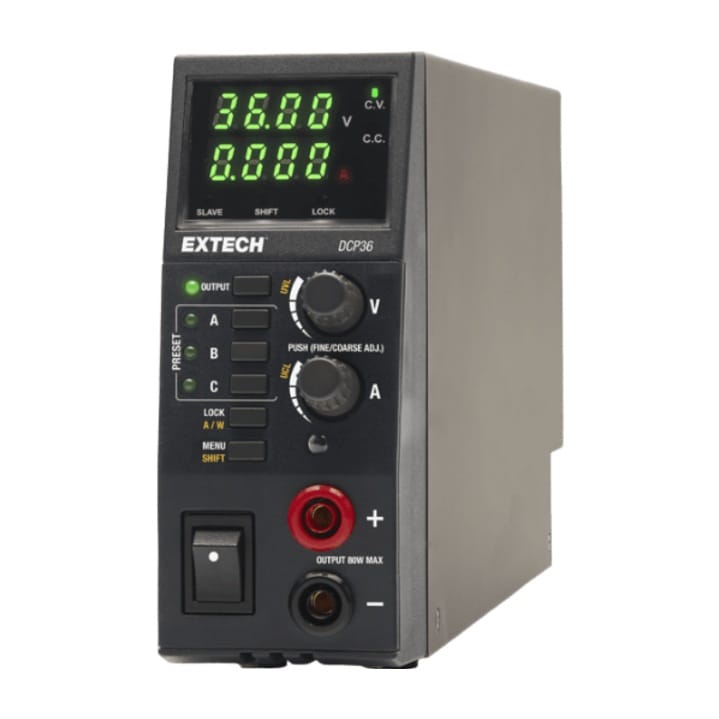
Extech DCP36
80 W Switching Mode DC Power Supply
A constant-power design, which is a genuinely different way of specifying a supply. Instead of a fixed maximum current at every voltage, the DCP36 autoranges within an 80 W envelope: 36 V at 2.2 A, or 16 V at 5 A, or anything else whose product stays under 80 W. One unit therefore covers what would otherwise need two.
Switching regulation makes it small and light enough to move between benches or take to site — useful where a linear supply of similar capability would be a two-hand lift. Remote sensing is the standout feature: sense leads measure voltage at the load itself rather than at the terminals, so the supply compensates for drop in the test leads and the device actually receives the voltage you set. Three programmable presets and both front and rear terminals suit repetitive test routines.
- Output voltage0.5–36 V
- Output current0–5 A autoranging
- Max output power80 W (V × I ≤ 80 W)
- Basic accuracy±(0.5% + 5 counts)
- Ripple & noise≤35 mV p-p
- Load voltage reg.≤30 mV
- 80 W constant power topology with autoranging V and I output
- Four-digit LED displays for voltage and current
- Three programmable presets for repeatable test setups
- Front and rear output terminals
- Remote sensing for accurate applied voltage at the load point
- Compact and lightweight for tight benches and field service

Extech 382213
Digital Triple Output DC Power Supply
Most real circuit boards need more than one rail. The 382213 provides an adjustable 0–30 V / 0–3 A main output alongside fixed 5 V and 12 V rails, which is precisely the combination a mixed digital-and-analogue assembly asks for: 5 V for the logic, 12 V for the op-amps or the relay driver, and the variable rail for whatever is actually under test.
The two fixed rails use snap terminals for quick connection, while the variable output runs to proper binding posts. Doing the same job with three separate supplies costs three times the bench space and leaves you managing three independent earth references. A front-panel current-limit LED shows at a glance when the variable rail has crossed into constant-current mode.
- Adjustable output0–30 V DC / 0–3 A
- Fixed rail 15 V / 0.5 A cont. (1 A max)
- Fixed rail 212 V / 0.5 A cont. (1 A max)
- Ripple & noise<5 mV
- Line voltage reg.<0.05% + 10 mV
- Load voltage reg.<0.05% + 10 mV
- Adjustable voltage and current output with digital LCD metering
- Easy snap terminals for the fixed 5 V and 12 V rails
- Binding post terminals for the variable supply
- Constant voltage or constant current operation
- Current limiting indicator on the front panel
- Overload and short circuit protection
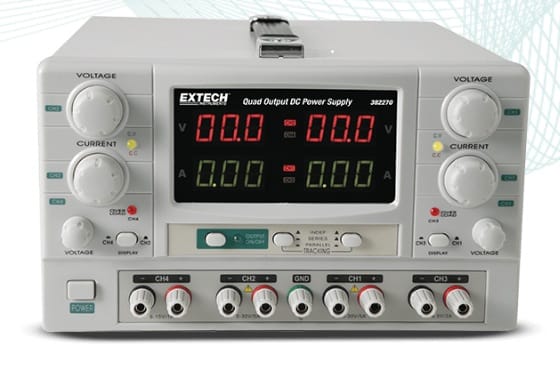
Extech 382270
Quad Output DC Power Supply
The most capable multi-rail unit in the range, and the only one that solves the split-supply problem properly. Its two independent 0–30 V / 0–5 A rails are designed to be combined: place them in series for up to 60 V, or in parallel for up to 10 A, or run them as a ±30 V split rail for op-amp and audio circuits that need a true bipolar supply.
This is the reason to buy a designed-for-it quad supply rather than improvise. Wiring the outputs of two separate single-output supplies together is not equivalent — neither unit is built to track the other or to tolerate reverse current pushed back into its output stage, and the usual result is damage to both. Two further fixed auxiliary rails (3–6.5 V at 3 A and 8–15 V at 1 A) cover logic and bias duties at the same time, and ripple stays below 0.5 mV RMS across the board.
- Main rails2 × 0–30 V / 0–5 A
- Auxiliary rail 13–6.5 V / 3 A
- Auxiliary rail 28–15 V / 1 A
- Series modeUp to 60 V
- Parallel modeUp to 10 A
- Ripple & noise<0.5 mV RMS
- Two independent 30 V / 5 A outputs, series- or parallel-combinable
- Two fixed auxiliary outputs for logic and bias rails
- Very low ripple and noise across all outputs
- Supplied with four pairs of banana plug to alligator clip test leads
- Supplied with AC power cord
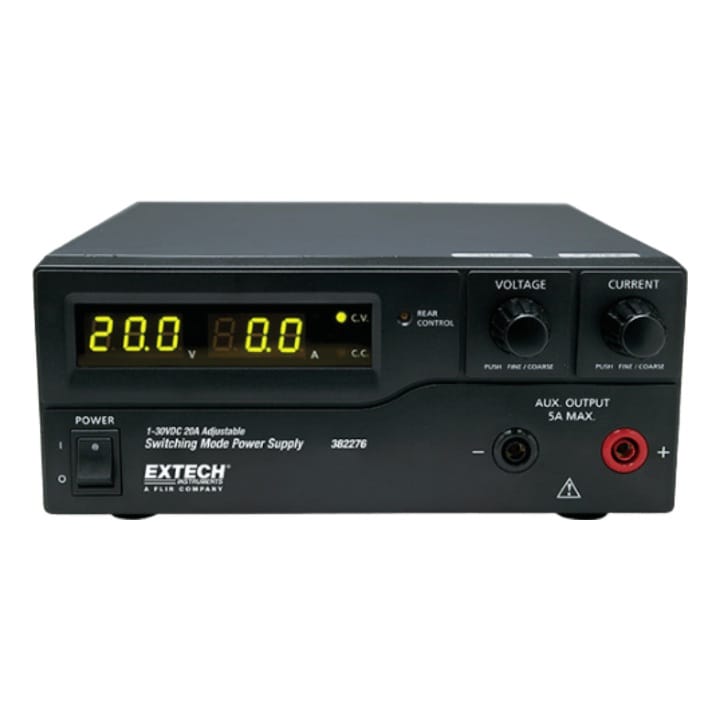
Extech 382276
600 W Switching Mode DC Power Supply (230 V)
The high-current unit in the range, and the correct variant for South African mains. It operates at 220 V, 50/60 Hz and delivers an adjustable 1–30 V at 1–20 A — 600 W of continuous DC that a linear supply of the same capability could not sensibly provide without becoming enormous.
Its 13.8 V at 20 A factory preset is the giveaway as to what it is really built for: 13.8 V is the nominal float voltage of a charged 12 V lead-acid system, so the unit substitutes directly for a vehicle or standby battery when bench-testing two-way radios, vehicle electronics, alarm and access-control panels, inverter logic boards and DC motors. Two further user-defined presets recall your own test points instantly.
A thermostatically controlled fan ramps from zero to full speed with load, so the unit stays quiet at low output instead of running at full noise continuously. High RFI immunity and low EMI keep it usable alongside sensitive instruments, and over-voltage, over-temperature and short-circuit protection guard both the supply and the device under test.
- Output voltage1–30 V (100 mV res.)
- Output current1–20 A (100 mA res.)
- Max output power600 W
- Basic accuracy±(0.5% rdg + 2 digits)
- Ripple & noise<5 mV RMS
- Mains input220 V, 50/60 Hz
- Two user-defined presets plus a 13.8 V / 20 A factory preset
- Automatic constant-current crossover
- Dual LED displays for voltage and current
- Thermostatic control fan, zero to full speed with load
- High RFI immunity and low EMI
- Overload, over-temperature and short circuit protection
- Supplied complete with AC power cord
Note on the Extech 382275 — superseded for South African supply
The Extech 382275 was the 120 V mains variant of the 600 W switching mode supply and no longer appears in Extech's current European catalogue. Because it is built for a 120 V supply, running it on South Africa's 230 V, 50 Hz mains would require a step-down transformer.
The direct replacement is the Extech 382276. It shares the same chassis, the same 1–30 V / 1–20 A output, the same 13.8 V / 20 A factory preset and the same user manual and datasheet, but is built for 220 V, 50/60 Hz operation. If you have been quoted a 382275, ask us to substitute the 382276.
Linear vs switching mode: what is the difference?
This is the single decision that most often gets made by accident. Both topologies produce regulated DC; they arrive there by opposite routes, and the consequences show up in noise, weight, efficiency and heat.
A linear supply regulates by dropping the surplus voltage across a series pass transistor and dissipating it as heat. Nothing is switching, so nothing is generating high-frequency noise — which is why linear designs reach ripple figures around 0.5 mV. The cost is a mains-frequency transformer, considerable mass, and efficiency that falls as the gap between input and output widens. Set a 30 V linear supply to 5 V and most of the energy leaves as heat.
A switching mode supply chops its input at tens of kilohertz and regulates by varying the duty cycle. High-frequency switching allows a far smaller transformer, which is why a 600 W switching unit is portable while a 600 W linear one would not be. The penalty is switching noise on the output rail, typically in the single-digit to tens-of-millivolts range.
← Scroll to see full table →
| Characteristic | Linear (382200, 382202, 382213, 382270) | Switching (DCP36, 382276) |
|---|---|---|
| Output ripple & noise | Very low — 0.5 mV to 5 mV | Higher — 5 mV RMS to 35 mV p-p |
| Efficiency | Lower, and falls as output voltage drops | High and broadly consistent across the range |
| Size and mass for a given power | Large and heavy — mains-frequency transformer | Compact and light — high-frequency transformer |
| Heat generated | Significant; surplus voltage becomes heat | Modest; usually fan-assisted at high output |
| Practical power ceiling | Limited by transformer mass | Comfortably to 600 W and beyond |
| Transient response | Fast and well behaved | Good, but with switching artefacts on fast steps |
| Best for | Analogue front ends, precision sensors, audio, RF, metrology | Motors, heaters, battery and automotive work, general power |
| Avoid for | High-current loads where mass and heat become impractical | Low-noise measurement chains without additional filtering |
If you are unsure, ask what the rail is feeding
If the supply rail feeds something that measures — an amplifier, an ADC, a bridge, a receiver — choose linear. If it feeds something that does work — a motor, a heater, a battery, a solenoid — choose switching. Where a bench does both, the usual answer is a small linear unit for the sensitive side and one high-current switching unit for the rest.
Full specification comparison
Manufacturer specifications for the six current models, gathered in one place.
← Scroll to see full table →
| Specification | 382200 | 382202 | 382213 | DCP36 | 382270 | 382276 |
|---|---|---|---|---|---|---|
| Output voltage | 0–30.0 V DC | 18.0 V DC | 0–30 V DC | 0.5–36 V | 0–30 V ×2 | 1–30 V |
| Output current | 0–1.00 A | 0–3.00 A | 0–3 A | 0–5 A | 0–5 A ×2 | 1–20 A |
| Fixed / auxiliary rails | — | — | 5 V, 12 V | — | 3–6.5 V/3 A; 8–15 V/1 A | 13.8 V/20 A preset |
| Ripple & noise | <0.5 mV | <0.5 mV | <5 mV | ≤35 mV p-p | <0.5 mV RMS | <5 mV RMS |
| Voltage accuracy | ±1.5% rdg | ±1.5% rdg | — | ±(0.5% + 5 cts) | — | ±(0.5% + 2 dgt) |
| Current accuracy | ±2% rdg | ±2% rdg | — | ±(0.5% + 5 cts) | — | ±(0.5% + 2 dgt) |
| Line voltage regulation | <0.01% + 3 mV | <0.01% + 3 mV | <0.05% + 10 mV | ≤4 mV | 0.1 mV ±3 mV | 20 mV |
| Load voltage regulation | <0.01% + 2 mV | <0.01% + 2 mV | <0.05% + 10 mV | ≤30 mV | 0.5 mV ±3 mV | 50 mV |
| Load current regulation | <0.2% + 3 mA | <0.2% + 3 mA | — | ≤10 mA | 2 mA ±5 mA | 100 mA min |
| Topology | Linear | Linear | Linear | Switching | Linear | Switching |
What these supplies are used for
Electronics development and board bring-up
The first power-up of a newly assembled board is where current limiting earns its keep. Set the rail voltage, cap the current just above expected draw, and a solder bridge or reversed electrolytic trips the supply into constant-current mode instead of releasing smoke. The 382213 suits this best because a real board usually wants 5 V, 12 V and a variable rail simultaneously.
Instrumentation and sensor work
Loop-powered 4–20 mA transmitters, bridge sensors and precision analogue front ends are directly sensitive to supply ripple, which appears in the output as noise or as a fixed offset error. The linear 382200 and 382202, at under 0.5 mV, keep the supply out of the measurement rather than in it.
Automotive, radio and battery-backed systems
Anything designed around a 12 V lead-acid system expects roughly 13.8 V and can pull heavy current on transmit or on start. The 382276 holds 13.8 V at 20 A from a single-button preset, standing in for the vehicle or standby battery while you test two-way radios, ECUs, alarm and access-control panels, inverter logic and DC motors.
Field service and multi-site test benches
Where a supply has to move — between benches, into a vehicle, out to a plant room — mass matters more than the last millivolt of ripple. The switching DCP36 covers 0.5–36 V within an 80 W envelope in a package small enough to carry, and its remote sensing keeps the applied voltage correct even down a long pair of test leads.
Bipolar and split-rail circuits
Op-amp circuits, audio stages and analogue signal chains often need a symmetrical ±15 V or ±30 V supply, which a single-output unit cannot provide. The 382270's two tracked 30 V rails do it properly, and the same pair can be reconfigured in series for 60 V or in parallel for 10 A when the requirement changes.
Training, laboratories and teaching benches
Technical colleges and university laboratories need supplies that survive being mis-wired by a first-year. Overload and short-circuit protection across the whole range, along with clear digital metering of both voltage and current, make these units suitable for supervised teaching environments where the same instrument is set up and taken down many times a week.
Specifying a bench power supply for South African conditions
Imported test equipment is usually catalogued for a North American or European market, and a few local realities are worth checking before you order.
Mains voltage and frequency
South Africa's low-voltage supply is nominally 230 V at 50 Hz. That directly determines which variant of the 600 W supply you should order: the 382276 is the 220 V, 50/60 Hz model and is correct for local use, while the discontinued 382275 was built for 120 V and would need a step-down transformer. Always confirm the mains variant on the order rather than assuming it, particularly on high-current units where the input stage differs between markets.
Plug and socket standards
These instruments ship with an AC power cord, but the moulded plug will not necessarily match a South African socket. Local installations use the older SANS 164-1 (BS 546) three-pin outlet and, increasingly, the compact SANS 164-2 (Type N) outlet mandated for new installations. Most bench and laboratory sockets accept an IEC C13 lead, so the simplest fix is usually a locally terminated IEC cord rather than a travel adapter — adapters add contact resistance in the earth path, which is undesirable on an instrument you may be probing.
Load shedding, inverters and UPS backup
If the supply will run behind an inverter or UPS, specify a pure sine wave unit. Modified sine wave output stresses the input rectifier and mains transformer of a linear supply, causing audible buzzing, extra heating and, over time, shortened component life. Also remember that a bench supply provides no ride-through of its own: when mains drops, the output collapses and the device under test loses power. For an overnight soak test or a burn-in run, size the UPS for the supply's full input draw — a 600 W unit at full output pulls appreciably more than 600 W from the wall once efficiency and power factor are accounted for.
Altitude and ambient temperature
Bench instruments of this class are typically specified for operation up to 2 000 m, which comfortably covers the Highveld: Johannesburg sits at roughly 1 750 m and Pretoria at about 1 350 m. Thinner air is still less effective at carrying heat away, so a fan-cooled unit such as the 382276 will run its fan harder at Gauteng altitude than at the coast for the same load. Leave clear space around the ventilation openings, avoid stacking instruments directly on top of a switching supply, and treat continuous full-power operation in an unventilated Highveld workshop in midsummer as the worst case when sizing.
Earthing and probing safety
Bench supplies have a floating output referenced to nothing, and the chassis is earthed via the mains cord. When you connect an earthed oscilloscope to a circuit powered by a bench supply, the scope's earthed probe ground defines the reference point — connecting it to the wrong node effectively shorts part of the circuit through the mains earth. Establish the ground reference deliberately before probing rather than discovering it by accident.
Frequently asked questions
What is a bench DC power supply used for?
It converts mains AC into a stable, adjustable DC output so a circuit, module or instrument can be powered and tested without relying on batteries or a fixed plug pack. You set an exact voltage, cap the current so a fault cannot destroy the device under test, and read back what the load is actually drawing. Typical uses include prototyping electronics, burning in assembled boards, powering 12 V and 24 V field instruments on the bench, simulating a vehicle or solar battery rail, running electroplating and anodising cells, and providing a controlled supply for laboratory and teaching experiments.
What is the difference between a linear and a switching mode DC power supply?
A linear supply regulates by dropping the excess voltage across a series pass transistor as heat — quiet and clean, but heavy and inefficient. The 382200, 382202, 382213 and 382270 are linear designs with ripple as low as 0.5 mV, which suits sensitive analogue, audio, sensor and RF work. A switching supply chops the input at high frequency and regulates the duty cycle, delivering far more power per kilogram at higher efficiency but with more switching noise. The DCP36 and 382276 are switching designs, at 35 mV p-p and 5 mV RMS respectively — entirely acceptable for motors, heaters, battery charging, automotive and general power work.
What does constant voltage and constant current mean on a power supply?
Constant voltage means the supply holds the voltage you set and lets the load draw whatever current it needs, up to the current limit. Constant current means the supply has reached that limit and now holds current steady, dropping voltage as far as necessary to do so. Crossover between the two modes is automatic. In practice you set the voltage your circuit needs, then set the current limit slightly above its expected draw, so a short circuit or wiring mistake causes the supply to fold back into constant current instead of destroying the board. A front-panel indicator shows which mode is active.
Which Extech power supply should I buy for South African 230V mains?
For the 600 W high-current unit, specify the Extech 382276, built for 220 V at 50/60 Hz and correct for South Africa's 230 V, 50 Hz supply. The older 382275 is the 120 V North American version and would need a step-down transformer, so it should not be ordered for local use. The smaller bench supplies in the range are supplied for local mains as standard. Confirm the mains variant on your order with us before shipping.
Has the Extech 382275 been discontinued and what replaces it?
The 382275 no longer appears in Extech's current European catalogue. It was the 120 V mains variant of the 600 W switching mode supply. The direct equivalent is the Extech 382276, which shares the same chassis, the same 1–30 V / 1–20 A output, the same 13.8 V at 20 A factory preset and the same user manual and datasheet, but is built for 220 V, 50/60 Hz operation. If you were quoted a 382275, ask us to substitute the 382276.
How do I size a DC power supply for my load?
Start with the highest voltage your circuit needs and add roughly 20% headroom, because a supply at the very top of its range has no room to regulate. Then work out peak current, not average: motors, relays, solenoids and switching regulators draw an inrush surge several times their running current, and a supply that current-limits during that surge will fail to start the load. Finally check the power product. On a constant-power supply such as the DCP36, the 80 W ceiling means 36 V at 2.2 A or 16 V at 5 A, but not 36 V at 5 A. If you need 20 A at 13.8 V for automotive, radio or battery work, only the 600 W 382276 in this range will do it.
Can I connect two power supply outputs in series or parallel for more voltage or current?
Only on a supply designed for it. The Extech 382270 has two independent 0–30 V, 0–5 A rails specifically rated for series operation up to 60 V or parallel operation up to 10 A. Connecting the outputs of two separate single-output supplies together is not equivalent and risks damaging both, because neither unit is designed to track the other or to tolerate reverse current into its output stage. If you need a split rail or a higher voltage, use the 382270 rather than improvising.
How much ripple and noise is acceptable on a bench power supply?
It depends entirely on the load. Digital and motor loads tolerate tens of millivolts without effect, so the DCP36 at 35 mV p-p or the 382276 at 5 mV RMS is more than adequate. Analogue signal chains, precision sensor front ends, low-noise amplifiers and RF work are far more sensitive, because supply ripple appears directly in the measurement as noise or spurious tones. For that work choose a linear unit: the 382200 and 382202 specify ripple below 0.5 mV and the 382270 below 0.5 mV RMS, roughly two orders of magnitude quieter than a comparable switching supply.
Do these power supplies work with load shedding and inverter or UPS backup?
They can, with two precautions. Run the supply from a pure sine wave inverter or UPS rather than a modified sine wave unit — modified sine output stresses the input rectifier and transformer of a linear supply and causes audible buzzing and extra heating. And remember that a bench supply provides no ride-through itself: when mains drops, the output collapses and the device under test loses power. For a long soak test, place the supply behind a UPS sized for its full input draw, bearing in mind that a 600 W supply at full output pulls appreciably more than 600 W from the wall once efficiency and power factor are taken into account.
Where can I buy Extech power supplies in South Africa?
Ecotao Enterprises CC supplies the Extech bench power supply range from its Cape Town base at 39 Olienhout Avenue, Plattekloof, with delivery throughout South Africa, Namibia, Botswana, Zimbabwe, Mozambique, Lesotho and Eswatini. For availability, lead times and a quotation, email sales@ecotao.co.za or call the head office on +27 21 911 5835, Zak on 086 142 8716 or Zaid on 082 390 3989.
Request a quotation on Extech power supplies
Tell us the voltage, peak current and noise requirement of your load and we will confirm the right model, availability and lead time.