
Borescopes & Videoscopes in South Africa
A borescope is an inspection instrument with a long, slim probe that you pass through a small opening to see inside equipment you cannot otherwise look into: engine cylinders, turbine stages, gearboxes, heat-exchanger tubes, pipes, castings and wall cavities. A light at the tip illuminates the area and a camera or eyepiece shows the image, so you can find cracks, corrosion, wear, blockages and foreign objects without dismantling anything.
Ecotao supplies four families of inspection scope from our Cape Town base to customers across South Africa, Namibia, Botswana, Zimbabwe, Mozambique, Lesotho and Eswatini: professional Olympus IPLEX videoscopes, a 4-way articulating borescope, 30 m and 100 m push-rod pipe inspection cameras, and compact Extech and Wöhler handheld borescopes.
What is a borescope, and what types are there?
Borescope, videoscope or endoscope? “Borescope” is the general industrial term. A videoscope (or video borescope) is a borescope with a miniature camera in the tip that sends a digital image to a screen, so it can record photos and video and, on better models, steer the tip. “Endoscope” is the medical word for the same idea, though some manufacturers, including Wöhler, also use “video endoscope” for industrial inspection cameras.
Handheld gooseneck borescopes
A camera on a semi-rigid cable that holds its shape. Quick, simple checks behind walls, under dashboards and inside ducts and machinery.
Articulating videoscopes
A flexible insertion tube whose tip you steer from the handset, so you can look sideways and behind components inside engines, turbines and gearboxes.
Push-rod pipe cameras
A rugged camera head on a stiff fibreglass push cable wound on a reel, built to travel tens of metres along drains, sewers and conduits.
Long-reach videoscopes
Professional systems such as the Olympus IPLEX GAir that push a steerable camera 20 m or 30 m through bends and elbows in boiler tubes and pipework.
Borescopes and videoscopes supplied by Ecotao
Each family below has its own detailed page with full specifications, model comparisons and FAQs.

Olympus IPLEX Videoscopes
The IPLEX range is the professional choice for aviation, power generation, petrochemical, mining and wind-turbine inspection. Three platforms cover most jobs: the handheld IPLEX G Lite (from 1.15 kg, light enough to carry up a ladder or tower), the modular IPLEX GX/GT with an 8-inch screen and swappable scope units, and the long-reach IPLEX GAir for 20 m or 30 m runs through bends. The G Lite includes scaler measurement for sizing defects, with stereo measurement as an option.
- Tube diameter4.0 mm or 6.0 mm (G Lite, GX/GT); 8.5 mm (GAir)
- Working lengthG Lite 2.0, 3.5 or 10 m; GX/GT 2.0 to 10 m; GAir 20 or 30 m
- Screen4.3-inch (G Lite) or 8-inch (GX/GT, GAir) touch screen
- ProtectionIP65 main unit; MIL-STD-810G tested (G Lite, GX/GT)
Best for: engine, turbine and gearbox inspection where you need to steer, record and measure. Wind turbines: the G Lite-W version with an oil-clearing tip.
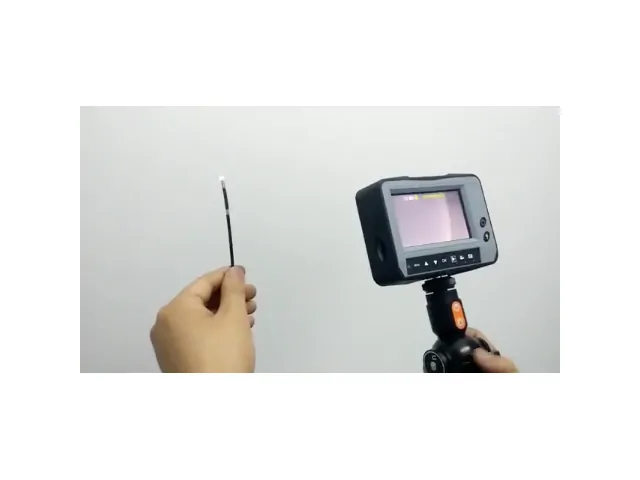
4-Way Articulating Borescope
An industrial video borescope whose camera tip steers up, down, left and right from a handheld control unit with a built-in colour screen. Because the tip bends in both planes, you can look at the side wall of a cylinder, the root of a turbine blade or the back of a gear tooth without twisting the whole probe, which a fixed or 2-way scope cannot do. It is a practical step up from a handheld gooseneck camera for maintenance teams who inspect engines, gearboxes, heat exchangers, pipework, welds and enclosed cavities.
- Articulation4-way (up, down, left, right)
- DisplayBuilt-in colour screen on the handset
- ProbeFlexible insertion tube; diameter and length: ask Ecotao
Best for: regular plant and engine inspection where the defect may be beside or behind a component.

Industrial Borescope: Bor-GT30 & Bor-GT100
Push-rod inspection cameras for drains, sewers, stormwater lines, conduits and long pipe runs. A 1080P camera with a 23 mm stainless-steel head and 12 adjustable LEDs travels on a 7 mm fibreglass push cable, while a metre counter on the 9-inch sunlight-readable monitor tells you exactly where a crack, root intrusion or blockage sits. Record video with voice commentary to a TF card for reports, quotes and insurance claims. The Bor-GT30 covers 30 m building and plot drainage; the Bor-GT100 reaches 100 m and adds a self-levelling IP68 head with a 512 Hz transmitter so you can locate the head from the surface.
- Cable length30 m (Bor-GT30) or 100 m (Bor-GT100)
- Camera head23 mm stainless steel, 1080P, 145° view
- Monitor9-inch IPS with sun visor, 0–5x digital zoom
- Battery12 V 4500 mAh, rated about 8 hours
Best for: plumbers, municipalities, property managers and contractors surveying pipes before repair or handover.

Extech & Wöhler Handheld Borescopes
Compact, affordable inspection cameras for building inspectors, HVAC and plumbing technicians, electricians, mechanics and maintenance staff. The range runs from the Extech BR50 and BR250 gooseneck borescopes (the BR250 has a detachable wireless monitor) to the Extech HDV620 and HDV640 HD videoscopes, and Wöhler VE-series video endoscopes with probes from Ø3.9 mm for the tightest openings, WiFi streaming to a phone or tablet (VE 220) and a 7-inch split-screen flagship (VE 500).
- ModelsExtech BR50, BR250, HDV620, HDV640; Wöhler VE 220, VE 320, VE 400, VE 500
- Probe optionsGooseneck, semi-rigid and articulating (HDV640)
- WaterproofingVE 400: IP67
Best for: quick visual checks in walls, ceilings, ducts, vehicles and machinery.
Borescope comparison: which family fits the job?
Side-by-side summary of the main differences. Full model-level specifications are on each family’s own page.
← Scroll to see full table →
| Range | Type | Probe / head diameter | Working length | Tip steering | Screen | Typical use |
|---|---|---|---|---|---|---|
| Olympus IPLEX G Lite | Handheld videoscope | 4.0 mm or 6.0 mm | 2.0 or 3.5 m; 10 m on 6.0 mm | Electronic, up / down / left / right | 4.3-inch touch | Field inspection, wind turbines (G Lite-W) |
| Olympus IPLEX GX/GT | Modular videoscope | 4.0 mm or 6.0 mm | 4.0 mm: 2.0 or 3.5 m; 6.0 mm: 2.0, 3.5, 7.5 or 10 m | Electronic | 8-inch touch | Aviation, power plant, multi-job service teams |
| Olympus IPLEX GAir | Long-reach videoscope | 8.5 mm | 20 m or 30 m | Pneumatic, 90° all directions | 8-inch touch | Boiler tubes, long pipework, large turbines |
| 4-Way Articulating Borescope | Articulating videoscope | Ask Ecotao | Ask Ecotao | 4-way | Built-in colour screen | Engines, gearboxes, heat exchangers, welds |
| Bor-GT30 | Push-rod pipe camera | 23 mm head on 7 mm cable | 30 m | Ask Ecotao | 9-inch IPS | Building drains, shorter sewer runs |
| Bor-GT100 | Push-rod pipe camera | 23 mm self-levelling head on 7 mm cable | 100 m | Self-levelling image | 9-inch IPS | Municipal sewers, long runs, locating faults |
| Extech & Wöhler handheld | Gooseneck, semi-rigid and video endoscopes | From Ø3.9 mm (Wöhler VE 400) | Varies by model; see handheld range page | Articulating on Extech HDV640 | 2.4-inch to 7-inch | Building, HVAC, plumbing, automotive checks |
How to choose a borescope
Work through these six questions in order. The first two rule out most options; the rest decide between what is left.
-
How small is the access opening?
Measure the narrowest point the probe must pass through, such as a spark-plug hole, inspection port or drain trap, and choose a probe clearly smaller than it. Turbine and engine ports usually call for 4.0 mm to 6.0 mm; pipes and drains suit a 23 mm pipe-camera head.
-
How far away is the target?
Measure from the access point to the furthest area you need to see and add a margin for bends. Up to about 1 m suits a handheld gooseneck; up to 10 m an IPLEX G Lite or GX/GT; 20 m to 30 m an IPLEX GAir; 30 m or 100 m a Bor-GT push-rod camera.
-
Do you need to look sideways?
If defects may sit on a side wall, under a blade platform or behind a component, choose a 4-way articulating scope. For straight pipes and simple cavities, a forward-looking camera is enough.
-
Do you need to record or measure?
Reports, insurance claims and maintenance records need photo and video capture. If you must size a crack or pitting, choose a videoscope with measurement, such as the IPLEX G Lite’s scaler measurement (stereo optional).
-
What is the environment?
Check the probe’s and handset’s ingress rating separately for oil, water, mud or dust, and confirm the operating temperature range for hot plant rooms. Oil-filled gearboxes benefit from an oil-clearing tip such as the IPLEX G Lite-W.
-
How often will you use it?
For occasional checks, a handheld borescope is cost-effective. For daily inspection work in mining, power or aviation, a professional articulating videoscope pays for itself through faster, documented inspections and less equipment downtime.
What borescopes are used for
Power generation
Inspecting boiler tubes, steam and gas turbine stages, condensers and heat exchangers during outages, so erosion, cracking and deposits are found before a forced shutdown.
Wind farms
Checking gearbox teeth and bearings inside the nacelle for pitting, micropitting and spalling, without draining oil or removing covers. A light handheld scope matters when it has to be carried up the tower.
Aviation maintenance
Looking inside jet and piston engines through borescope ports to inspect blades, combustors and cylinders for damage, burns and foreign objects as part of scheduled maintenance.
Mining & heavy equipment
Inspecting diesel engines, final drives, hydraulic cylinders and gearboxes on haul trucks and loaders, so condition-based decisions replace guesswork on component change-outs.
Plumbing, drains & municipal pipes
Surveying drains and sewers with a push-rod camera to find root intrusion, collapsed sections, fat build-up and joint displacement, then locating the fault from the surface before digging.
Manufacturing & quality control
Checking internal bores, castings, welds and machined passages for porosity, burrs, cracks and debris before parts ship or go into assembly.
Refineries & petrochemical plants
Inspecting pipework, vessels and heat-exchanger tubes for internal corrosion and fouling during turnarounds. In classified areas, follow the site’s hazardous-area procedures before use.
Building & HVAC
Looking inside wall cavities, ceilings, ducting and fire dampers for moisture damage, pests, blockages and hidden wiring without opening up finished surfaces.
Automotive
Checking cylinders, valves and pistons through the spark-plug or injector hole for carbon build-up, scoring and damage before deciding on a strip-down.
Using borescopes in South African conditions
- Heat. Plant rooms, mine workshops and Northern Cape or Lowveld summers can push handsets past their rated operating temperature. Check the main unit’s range, which is often narrower than the probe’s, and keep the unit shaded between shots.
- Dust and mud. Mining, quarrying and construction sites call for a sealed handset. The Olympus IPLEX G Lite and GX/GT main units are rated IP65 and tested to MIL-STD-810G, which includes blowing-dust and salt-fog tests.
- Coastal sites. Salt air at Saldanha, Durban, Richards Bay and Gqeberha corrodes connectors and battery contacts. Wipe the probe and handset after each job and store them in their case.
- Battery runtime on long shifts. Plan for jobs away from mains power: about 90 minutes for the IPLEX G Lite, about 186 minutes for the GX/GT and about 8 hours for the Bor-GT pipe cameras. Carry a spare battery for full-day work.
- Wind energy. With wind farms in the Eastern, Northern and Western Cape, gearbox inspection is a growing use. Oil-clearing tips such as the IPLEX G Lite-W are designed for this work.
- Delivery. Ecotao supplies borescopes from Cape Town throughout South Africa and to Namibia, Botswana, Zimbabwe, Mozambique, Lesotho and Eswatini.
Borescope FAQs
What is a borescope?
A borescope is an optical inspection instrument with a long, slim probe that is passed through a small opening to look inside equipment or structures that cannot be seen directly, such as engine cylinders, turbine stages, gearboxes, pipes, wall cavities and castings. A light source at the tip illuminates the area and an eyepiece, camera or screen shows the image, so defects can be found without dismantling the equipment.
What is the difference between a borescope, a videoscope and an endoscope?
Borescope is the general term for any industrial instrument inserted through an opening to inspect a hidden space. A videoscope is a borescope with a miniature camera at the tip that sends a digital image to a screen, so it can record photos and video and usually steer its tip. Endoscope is the medical term for the same idea, but some manufacturers such as Wöhler also call their industrial inspection cameras video endoscopes. In industrial use the three words often describe the same type of instrument.
Which type of borescope do I need?
Choose by job. For occasional checks in walls, ducts, vehicles and machinery, a handheld Extech or Wöhler borescope is usually enough. For regular engine, turbine, gearbox or heat-exchanger inspection where you must steer around corners and document findings, choose an articulating videoscope such as the 4-way articulating borescope or an Olympus IPLEX. For drains, sewers and long pipe runs, choose a push-rod pipe camera such as the 30 m Bor-GT30 or 100 m Bor-GT100. For very long reach through bends, the Olympus IPLEX GAir offers an 8.5 mm tube in 20 m or 30 m lengths.
What probe diameter and length do I need for a borescope?
Measure the smallest opening the probe must pass through and choose a probe that is clearly smaller than it. Then measure the distance from the access point to the furthest point you need to see and add a margin for bends. As a guide, Olympus IPLEX G Lite and GX/GT tubes come in 4.0 mm or 6.0 mm diameters, with 6.0 mm tubes available up to 10 m; the IPLEX GAir uses an 8.5 mm tube in 20 m or 30 m; and the Bor-GT pipe cameras use a 23 mm head on a 7 mm push cable in 30 m or 100 m lengths.
What is an articulating borescope and do I need one?
An articulating borescope lets you bend the camera tip from the handset to look sideways or backwards once the probe is inside. A 2-way scope bends in one plane, while a 4-way scope bends up, down, left and right, so it can point in any direction without twisting the whole probe. You need articulation when the defect may be on a side wall or behind a component, for example on turbine blades, gear teeth or tube sheets. For straight pipes and simple cavities a non-articulating camera is usually enough.
Can a borescope be used to inspect sewer and drain pipes?
Yes, but a push-rod pipe inspection camera is the right tool for that job rather than a slim engine borescope. The Bor-GT30 has a 30 m, 7 mm fibreglass push cable for building drains and shorter runs, while the Bor-GT100 has a 100 m cable, a self-levelling camera head that keeps the image upright, an IP68 rating and a built-in 512 Hz transmitter so a locator (optional accessory) can find the head from above ground. See the industrial borescope page for the full comparison.
Which borescope is best for wind turbine gearbox inspection?
Olympus offers the IPLEX G Lite-W specifically for wind turbine inspection. It uses a 4.0 mm insertion tube with a sealed, oil-clearing tip adapter, an oil-resistant tube coating and forward-view optics with a 120° field of view, in a handheld unit light enough to carry up the tower. See the Olympus IPLEX page for the full comparison.
Can a borescope measure the size of a crack or defect?
Professional videoscopes can. Every Olympus IPLEX G Lite includes scaler measurement, which sizes a defect against a reference of known length in the image, and stereo measurement is an optional upgrade on the G Lite for distance, depth and area. Basic handheld borescopes show and record the defect but do not measure it.
Are borescopes waterproof?
It depends on the model. The Olympus IPLEX G Lite and GX/GT main units are rated IP65, and their insertion tubes can be used underwater with a viewing tip adaptor fitted, to about 3.5 m depth for 4.0 mm tubes and about 10 m for 6.0 mm tubes. The Bor-GT100 pipe camera is rated IP68 and the Wöhler VE 400 is rated IP67. Always check the rating of the probe and the handset separately.
Are Olympus IPLEX videoscopes still available?
Yes. Olympus moved its industrial inspection business into Evident in 2022, and in 2025 Wabtec completed its acquisition of Evident’s Inspection Technologies division. The IPLEX G Lite, GX/GT and GAir are now sold under the Evident name, but most buyers still search for them as Olympus IPLEX. Ecotao supplies them across South Africa and neighbouring countries.
How much does a borescope cost in South Africa?
Prices range widely, from compact handheld borescopes to professional articulating videoscopes, and depend on probe diameter, length, articulation and accessories. Check current pricing and stock on the Ecotao store or contact Ecotao on +27 21 911 5835 or sales@ecotao.co.za for a quotation on the configuration you need.
Does Ecotao deliver borescopes outside Cape Town?
Yes. Ecotao supplies borescopes and videoscopes from its Cape Town base to customers throughout South Africa, including Gauteng, KwaZulu-Natal, the Eastern Cape and the Northern Cape, and to Namibia, Botswana, Zimbabwe, Mozambique, Lesotho and Eswatini.
Not sure which borescope you need?
Tell us what you need to inspect, the size of the access opening and how far in you need to see, and we will recommend the right scope and configuration.
- Head Office: +27 21 911 5835
- Zak: 086 142 8716
- Zaid: 082 390 3989
- Email: sales@ecotao.co.za · aqua@ecotao.co.za