
Sound Level Meters
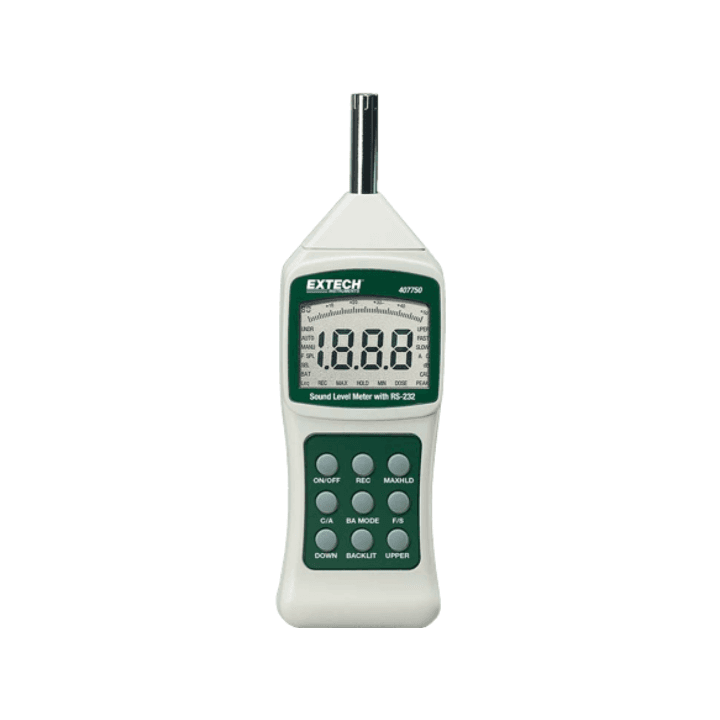
A sound level meter is a handheld instrument that measures sound pressure level — the loudness of an environment — and reports it as a weighted decibel (dB) reading. A small condenser microphone converts air pressure fluctuations into an electrical signal, which the instrument filters, time-weights and displays as an instantaneous, minimum, maximum or time-averaged dB value.
Ecotao supplies Type/Class 2 sound level meters, a combined sound-and-climate meter, and a traceable acoustic calibrator for occupational hygiene officers, environmental consultants, facilities teams and acoustic contractors working across South Africa. Every instrument on this page is suited to general workplace, environmental and equipment-noise measurement under SABS 083 and the OHS Act's Noise-Induced Hearing Loss Regulations.
Where sound level meters are used
Decibel measurement is rarely an end in itself — it feeds a decision about hearing protection, an acoustic enclosure, a noise complaint response, or a compliance file. The application determines which weighting, logging capacity and accuracy class actually matters.
Occupational hygiene & OHS Act compliance
Workshops, blower rooms, compressor houses and processing floors are assessed against the 85 dB(A) 8-hour noise-rating limit, identifying which zones need engineering controls, signage, or hearing protection before exposure becomes a recordable health risk.
Environmental & community noise monitoring
Construction sites, industrial boundary fences and neighbouring-property disputes are measured against municipal noise control bylaws, giving consultants and site managers a defensible record of ambient and intrusive noise levels at a given time and place.
Machinery & equipment noise testing
Blowers, compressors, pumps, generators and HVAC plant are tested before and after fitting acoustic enclosures, silencers or vibration isolation, quantifying whether a noise-control retrofit actually reduced sound pressure at the operator position.
Acoustic surveys & building commissioning
Offices, clinics, classrooms and plant rooms are surveyed for background noise during HVAC commissioning or facility handover, confirming the space meets the ambient noise criteria specified in the building design brief.
South Africa's 85 dB(A) noise-rating limit
The Noise-Induced Hearing Loss Regulations, made under the Occupational Health and Safety Act (Act 85 of 1993), set the 8-hour equivalent noise-rating limit and action level at 85 dB(A), referencing SABS 083 for measurement method. Once a workplace reaches or exceeds this level, employers must apply the hierarchy of controls — engineering controls first, then administrative measures, with hearing protection as the last line of defence rather than the default response.
Updated 2025 regulations carry an 18-month transition period, with full enforcement from September 2026, and place greater emphasis on documented assessment, engineering remediation and long-term record-keeping. A Type/Class 2 sound level meter, checked against a calibrator before each survey, is the standard tool for generating that documentation.
How to choose a sound level meter
Four questions narrow the choice quickly. Work through them in order before deciding between a basic meter, a logging meter, or a combined instrument.
Accuracy class
Type/Class 2 instruments meet the IEC 61672 Class 2 tolerance and are accepted for the large majority of workplace, environmental and equipment-noise surveys. Reserve Type/Class 1 instruments — tighter tolerance, higher cost — for laboratory work or measurements that may be contested in a legal dispute.
Frequency weighting
A-weighting is the default for hearing-conservation and most environmental work, since it approximates human ear sensitivity. C-weighting suits peak or impulse noise and audio checks. Z (linear) weighting is for acoustic engineering work that needs the unfiltered spectrum — confirm which weightings a meter offers if your assessment scope specifies one.
Logging requirement
A single spot-check meter such as the TA652A suits walk-through surveys and quick verification readings. Where a compliance file needs continuous, time-stamped records over a shift or longer, a logging meter such as the TA652B — with internal memory and PC software — removes the need for someone to stand and watch a display.
Combined measurement needs
If ambient temperature and humidity are also relevant to the survey — livestock housing, greenhouses, plant rooms, cold storage — a combined instrument such as the LSTH-1306 records all three readings from a single handheld unit, instead of carrying separate meters.
Calibration
Any reading intended for a compliance report needs to be traceable. Pair a sound level meter with an acoustic calibrator such as the AZ8930, and field-check the offset immediately before and after each measurement session.
Compare the range
The store meters all use a 1/2-inch electret condenser microphone and meet IEC 61672 / IEC 60942 Class 2 tolerance where applicable. The Triplett SLM400 uses a dual-range design and meets ANSI S1.4 / IEC 61672-1 Type 2. The deciding factors across the range are logging capacity, frequency weighting options, dual vs. single range, and whether climate data is needed alongside sound.
← Scroll to see full table →
| Model | Range | Accuracy | Frequency weighting | Data logging | Best suited to |
|---|---|---|---|---|---|
| TA652A | 30–130 dB, 31.5Hz–8kHz | ±1.5 dB | A or C | — | General OHS & environmental spot checks |
| TA652B | 30–130 dB, 31.5Hz–8kHz | ±1.5 dB | A, C or Z | 10,000 readings + PC software | Unattended compliance logging |
| LSTH-1306 | 30–130 dB, 50Hz–8kHz | ±1.5 dB | Real-time SPL | — | Combined noise + temperature/humidity surveys |
| SLM400 | Low: 35–100 dB / High: 65–130 dB, 31.5Hz–8kHz | ±1.5 dB | A or C | — | Spot checks; NIST traceability option; enquire to order |
| AZ8930 Calibrator | 94 / 104 / 114 dB ref. tones | ±0.4 dB | 1000Hz ±1.7% | — | Field calibration of any 1/2" mic Type 2 meter |
The range

TA652A Basic Type 2 Sound Meter
An entry-point Type/Class 2 meter for general workplace and environmental spot checks, with SPL Min/Max/Average and a backlit colour bar-graph display.
- Range: 30–130 dB
- Accuracy: ±1.5 dB
- Frequency: 31.5Hz–8kHz, A or C weighting
- Time weighting: Fast (125ms) or Slow (1s)
- Supplied with: carry case, wind shield, batteries, manual

TA652B Basic Type 2 Sound Meter/Data Logger
The TA652A's logging sibling: 10,000-reading internal memory and bundled software turn it into an unattended compliance recorder for shift-length or multi-day surveys.
- Range: 30–130 dB
- Accuracy: ±1.5 dB
- Frequency: 31.5Hz–8kHz, A, C or Z weighting
- Memory: 10,000 groups of data + PC download software
- Supplied with: carry case, wind shield, batteries, manual

LSTH-1306 Large Display Sound Meter and Thermohygrometer
Sound level, temperature and humidity from one handheld unit, with a large colour LED display and four noise-comfort icons for quick at-a-glance readings.
- Sound range: 30–130 dB, ±1.5 dB, 50Hz–8kHz
- Temperature: -10 to +50°C (±1°C)
- Humidity: 20–85% RH (±5%)
- Power: 5VDC adapter + 3.7V/2000mAh battery back-up
- Size: 270 × 90 × 35mm, approx. 350g
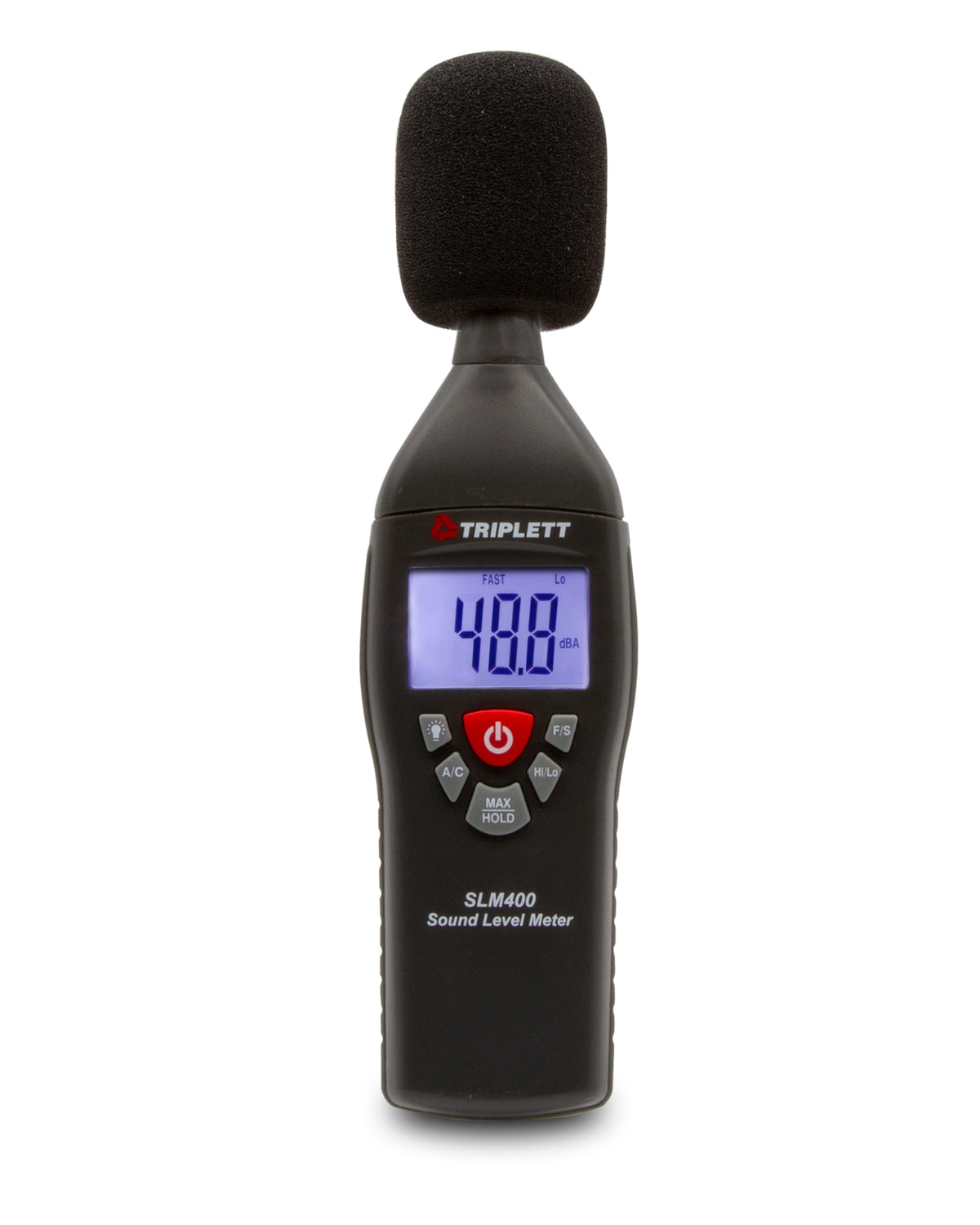
Triplett SLM400 Sound Level Meter
A compact, lightweight Type 2 meter with two independently optimised measurement ranges for finer resolution at both low and high decibel levels. Available with a N.I.S.T. Certificate of Traceability and as a complete kit with calibrator.
- Range (Low): 35–100 dB
- Range (High): 65–130 dB
- Accuracy: ±1.5 dB, 0.1 dB resolution
- Frequency: 31.5Hz–8kHz, A or C weighting
- Standards: ANSI S1.4 / IEC 61672-1 Type 2
- Warranty: 2-year; RoHS & CE certified
- Supplied with: 9V battery, windscreen, pouch case

Sound Level Calibrator AZ8930
The field reference for every meter on this page: a IEC 60942:2018 Class 2 calibrator that confirms or adjusts a sound level meter's offset before readings go into a report.
- Standard: IEC 60942:2018 Class 2
- Reference tones: 94dB, 104dB, 114dB
- Accuracy: ±0.4 dB at 1000Hz ±1.7%
- Fits: 13.2mm (1/2") diameter microphones
- Power: 1.5V AA batteries
Frequently asked questions
What is a Type 2 (Class 2) sound level meter, and is it accurate enough for OHS Act compliance in South Africa?
A Type/Class 2 sound level meter meets the IEC 61672 Class 2 accuracy tolerance, which is the standard generally accepted for industrial hygiene, environmental and workplace noise assessments referenced under SABS 083 and the OHS Act's Noise-Induced Hearing Loss Regulations. Type/Class 1 instruments hold a tighter tolerance and are typically reserved for laboratory work or legal dispute measurements rather than routine site surveys.
What decibel level triggers action under South Africa's Noise-Induced Hearing Loss Regulations?
The Regulations set the 8-hour equivalent noise-rating limit and action level at 85 dB(A). Once exposure reaches or exceeds this level, employers must apply the hierarchy of controls, starting with engineering controls, followed by administrative measures, with hearing protection used only where those controls cannot bring exposure below the limit. Updated 2025 regulations carry an 18-month transition period, with full enforcement from September 2026.
Do I need a separate sound level calibrator?
Yes. Producing traceable, defensible noise readings for a compliance report or client record requires checking the meter against a known reference tone immediately before and after a measurement session. An acoustic calibrator such as the AZ8930 generates fixed 94dB, 104dB or 114dB tones at 1kHz so the meter's offset can be confirmed or adjusted on site.
What is the difference between A, C and Z frequency weighting on a sound meter?
A-weighting filters the signal to approximate how the human ear perceives loudness across frequencies, and is used for most workplace hearing-conservation and environmental noise measurements. C-weighting applies a flatter filter and is used for peak or impulse noise and audio system checks. Z-weighting (zero, or linear) applies no frequency filtering, which suits acoustic engineering work and environmental assessments that need the unfiltered spectrum.
Can one instrument measure sound level together with temperature and humidity?
Yes. The LSTH-1306 combines a sound level meter with a thermohygrometer in a single handheld unit, displaying decibel, temperature and relative humidity readings together. This suits site surveys where ambient conditions are recorded alongside noise data, such as livestock housing, greenhouses, plant rooms or general facility walk-throughs.
How often should a sound level meter be calibrated?
Field-check the meter against an acoustic calibrator immediately before and after every measurement session. For formal compliance documentation, a full laboratory recalibration and certificate is generally recommended on an annual basis, in line with the record-keeping expectations of South Africa's noise regulations.
Need help choosing the right sound level meter?
Tell us what you're measuring — a workplace noise survey, an equipment test, or a compliance file that needs logged data — and our team will recommend the right instrument and calibration approach.
Zak: 086 142 8716 · Zaid: 082 390 3989 · sales@ecotao.co.za