

Civil engineering · Material testing
Soil & Civil Engineering Testing Apparatus
Soil testing apparatus is the laboratory and field equipment used to measure the engineering properties of soil: grading, plasticity, compaction, bearing capacity, shear strength, settlement and permeability. Engineers use these results to design foundations, roads, embankments and dams, and to prove on site that earthworks meet specification.
Ecotao supplies a range of soil and civil engineering apparatus from several manufacturers, from a single liquid limit device to a full road-materials lab, with delivery across South Africa and neighbouring countries.
More soil testing equipment


Which soil test measures what?
Every soil test answers one engineering question. This table maps each property to the test and the apparatus on this page that measures it.
← Scroll to see full table →
| Soil property | What it tells you | Test | Apparatus on this page |
|---|---|---|---|
| Grading | Soil type and whether it meets a layer specification | Sieve analysis | Lab Test Sieve |
| Plasticity | Swell, shrinkage and moisture sensitivity of clays | Liquid & plastic limit | Disc Type Liquid Limit Device, Liquid Plastic Limit United Device, Liquid Limit Test Set |
| Compaction | Target density (MDD) and water content (OMC) | Proctor / Mod AASHTO | Standard Proctor Compactor, Digital Multifunction Electric Compactor |
| Bearing | Suitability as subgrade or pavement layer | CBR, plate load | CBR Machine, Field CBR Test Set, K-30 Plate Load Test |
| Stiffness | Behaviour under repeated traffic loads | Resilient modulus | Resilience Modulus Test Apparatus |
| Field density | Whether a layer was compacted to spec | Sand cone, sand replacement | Sand Cone Test Sets, Sand Replacement Test Set |
| Moisture | Water content on site and in the lab | Calcium carbide, rapid drying | Speedy Moisture Test Set, Precision Moisture Teller |
| Shear strength | Slope, wall and foundation stability | UCS, direct shear, triaxial | UCS tester, direct shear and triaxial apparatus |
| Settlement | How far and how fast a structure settles | Oedometer consolidation | Triplex and Pneumatic Consolidation Equipment |
| Permeability | Seepage and drainage rate | Constant / falling head | Constant Head and Falling Head Permeameters |
Compaction & sample preparation
Compaction tests set the target density for every earthworks and road layer. These units prepare, compact and extract the specimens that the rest of the lab tests on.

Standard Proctor Compactor
A hand-operated rammer and cylindrical mould used to find a soil’s maximum dry density (MDD) and optimum moisture content (OMC). The soil is compacted in layers at several moisture contents and the dry density of each is plotted to find the peak.
Use it for: Setting the target density for fill, subgrade and layer works, and checking a borrow pit before it is used.
Standard Proctor effort (ASTM D698): 2.5 kg rammer, 305 mm drop, 3 layers of 25 blows in a 944 cm³ mould. Modified effort (ASTM D1557, Mod AASHTO) uses a 4.54 kg rammer, 457 mm drop and 5 layers. Ask Ecotao which rammer and mould sizes are supplied.
Enquire about this unitDigital Multifunction Electric Compactor
A motor-driven compactor that lifts and drops the rammer automatically and counts the blows on a digital controller. It replaces hand ramming, which gives more consistent compactive effort and less operator fatigue.
Use it for: Labs that run many compaction or CBR moulds a day, where hand-rammed results start to vary between operators.
“Multifunction” refers to running more than one compaction effort or mould size on one machine. Ask Ecotao which rammer, drop and mould combinations this configuration supports.
Enquire about this unitUniversal Electric Hydraulic Extruder 150 kN (Overload Protection)
An electrically driven hydraulic ram that pushes compacted specimens out of moulds without damaging them. The 150 kN rating gives enough force for stiff, stabilised or cemented samples, and overload protection stops the ram before the frame or mould is damaged.
Use it for: Removing samples from Proctor, CBR and similar moulds so they can be tested, trimmed or the moulds reused.
Ask Ecotao for the mould adaptor sizes included with this configuration.
Enquire about this unitUniversal Stripper (Manual)
A hand-operated frame for pushing soil specimens out of moulds, sampling tubes or cutting rings. It needs no power, so it suits site labs and lower-volume work.
Use it for: Small labs and field labs that extract a few specimens a day, or as a backup to a powered extruder.
Ask Ecotao which mould and tube diameters the adaptors fit.
Enquire about this unit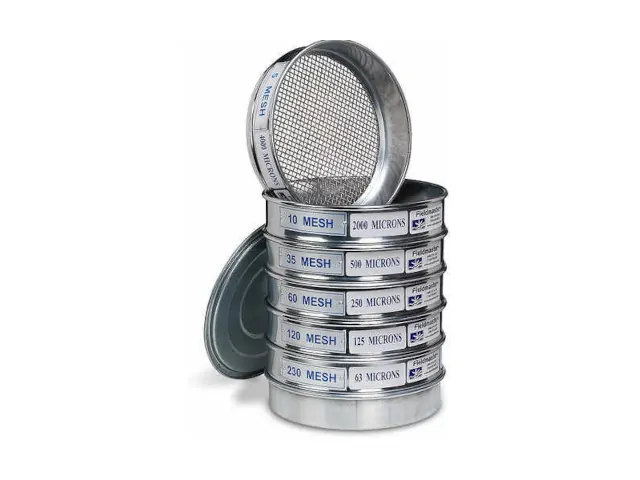
Lab Test Sieve
Woven-wire test sieves with a fixed aperture size, stacked from coarse to fine to measure a soil’s particle size distribution (grading). Grading tells you whether a material is a gravel, sand, silt or clay, and whether it meets a layer specification.
Use it for: Classifying soils, checking gravel and sand against a grading envelope, and preparing material for limits and compaction tests.
Full sieve sets and individual apertures are covered on the Soil Sieve Sets page linked above.
Enquire about this unitBearing capacity & stiffness
How much load a soil layer carries, and how far it deflects under that load, decides pavement layer thicknesses and foundation design.

CBR Machine (Dial Gauge)
A motorised load frame that pushes a standard piston into a compacted soil specimen at a constant rate. A proving ring and dial gauges record load and penetration. The California Bearing Ratio (CBR) is the measured load expressed as a percentage of the load a standard crushed rock carries at the same penetration.
Use it for: Classifying subgrade, selected layer and subbase materials for road and pavement design.
Penetration rate is 1.27 mm/min, with CBR read at 2.54 mm and 5.08 mm penetration (ASTM D1883; SANS 3001-GR40 in South Africa). Ask Ecotao for the frame capacity and proving-ring range of this configuration.
Enquire about this unitField CBR Test Set
A portable kit that runs the CBR penetration test on the ground itself, using a loaded truck or similar heavy vehicle as the reaction. It measures the in-place bearing ratio at the soil’s actual density and moisture.
Use it for: Checking a constructed subgrade or layer in place, or when an undisturbed sample cannot be taken to the lab.
Test method: ASTM D4429 (CBR of soils in place). Ask Ecotao what the set includes.
Enquire about this unitK-30 Plate Load Test
A static plate load test using a 300 mm diameter bearing plate. Load is applied in steps by a hydraulic jack against a reaction load and settlement is read on dial gauges. The K30 value is the plate pressure at 1.25 mm settlement divided by that settlement, in MPa/m.
Use it for: Verifying subgrade and formation stiffness on railway, road and platform earthworks, where the specification asks for a K30 value.
K30 is common in railway subgrade specifications. Ask Ecotao for the jack capacity and gauge setup supplied.
Enquire about this unitResilience Modulus Test Apparatus
Measures the resilient modulus of a compacted soil: the ratio of applied stress to the deformation the soil recovers when the load is removed. It describes how a subgrade behaves under repeated traffic loading, which a single CBR value cannot.
Use it for: Mechanistic pavement design and research, where layer stiffness under repeated loads is needed.
Resilient modulus can be measured by plate (lever-loaded) or cyclic triaxial methods. Ask Ecotao which method and standard this apparatus follows.
Enquire about this unitField density & moisture
Field density and moisture tests are how site engineers prove that a layer has been compacted to specification before the next one goes down.
Sand Cone Test Sets
Measures the in-place density of a compacted layer. A hole is dug and the soil removed is weighed; the hole’s volume is found by filling it with calibrated sand from a jar fitted with a valve and cone. Density is the soil’s mass divided by the hole volume.
Use it for: Routine compaction control on earthworks and road layers, expressed as a percentage of the lab MDD.
Test method: ASTM D1556.
Enquire about this unitSand Replacement Test Set (Galvanized Steel)
Works on the same principle as the sand cone, but uses a sand-pouring cylinder sitting on a tray over the hole. This is the method most South African road specifications have historically used. Galvanised steel resists corrosion from repeated site use.
Use it for: In-place dry density testing of road layers and fills, especially where the specification follows South African methods.
South African method: SANS 3001-GR35 (in-place dry density, sand replacement).
Enquire about this unitRelative Density Apparatus (Motorized)
Determines the maximum and minimum index densities of clean, free-draining sands and gravels. Proctor tests don’t give a clear peak on these materials, so their compaction is specified as relative density instead. Motorised operation gives repeatable compaction energy.
Use it for: Specifying and checking compaction of clean sands, drainage layers and backfill around structures.
Test methods: ASTM D4253 (maximum) and D4254 (minimum index density). Ask Ecotao which method this unit follows.
Enquire about this unitSpeedy Moisture Test Set
A sealed pressure vessel in which a weighed soil sample reacts with calcium carbide reagent. The reaction produces gas, and the pressure gauge reading converts to moisture content. A result takes minutes on site, with no oven or power.
Use it for: Quick moisture checks during compaction, so water can be adjusted before rolling rather than after oven results come back.
Test method: ASTM D4944. Results should be correlated against oven-dry moisture (SANS 3001-GR20) for each material.
Enquire about this unitPrecision Moisture Teller
A rapid drying unit that dries a weighed sample with forced hot air and gives moisture content from the mass lost. It is much faster than a conventional drying oven while still being a drying method.
Use it for: Labs and site labs that need moisture results between compaction tests without waiting overnight.
Ask Ecotao for sample capacity and drying settings.
Enquire about this unitConsistency (Atterberg) limits
The liquid limit, plastic limit and plasticity index show how a clay behaves as its water content changes. They predict swelling, shrinkage and strength loss, and are part of every road material classification.
Liquid Plastic Limit United Device (Digital)
A combined, digitally read cone-penetration device. A cone is released into the soil paste at several moisture contents and the penetration depth is read digitally. The liquid and plastic limits are both found from the one series of readings.
Use it for: Labs testing many clay samples, where the cone method’s repeatability and the combined LL/PL result save time.
Cone mass, angle and penetration criteria differ between standards. Ask Ecotao which standard this device is built to.
Enquire about this unitLiquid Limit Test Set
A kit of grooving tools, mixing dish, spatula and accessories for running liquid limit tests. Pair it with a liquid limit device; the plastic limit is found by rolling soil threads on a glass plate.
Use it for: Equipping a new soils lab, or replacing worn grooving tools, which directly affect liquid limit results.
Ask Ecotao for the exact contents of the set.
Enquire about this unitDisc Type Liquid Limit Device
The Casagrande cup: a brass cup that a cam lifts and drops onto a hard base. A groove is cut in the soil paste and the number of drops needed to close it is counted. The liquid limit is the moisture content at which the groove closes at 25 blows.
Use it for: Liquid limit testing where the specification calls for the Casagrande (percussion) method.
Casagrande method (ASTM D4318): 10 mm cup drop, 2 drops per second, groove closure of 13 mm. South African methods: SANS 3001-GR10/GR11/GR12.
Enquire about this unitShear strength
Shear strength decides slope stability, retaining-wall pressures and foundation bearing capacity. Which test you use depends on soil type and drainage conditions.
Electric Strain Unconfined Compression Tester
Loads a cylindrical clay specimen axially, with no confining pressure, at a constant motor-driven strain rate until it fails. The peak stress is the unconfined compressive strength; half of it approximates the undrained shear strength of saturated clay.
Use it for: Fast strength checks on cohesive soils from boreholes and test pits.
Test method: ASTM D2166.
Enquire about this unitElectric Strain Direct Shear Testing Equipment
A split shear box that forces a soil specimen to fail along a horizontal plane under a known vertical load. Running several specimens at different normal loads gives the soil’s cohesion and angle of internal friction. Electric drive gives a steady, controlled shear rate.
Use it for: Strength parameters for slope stability, retaining walls and interfaces between soils and geosynthetics.
Test method: ASTM D3080.
Enquire about this unitDigital Electric Strain Direct Shear Apparatus
A direct shear apparatus with digital readout of load and displacement in place of dial gauges. This removes reading errors and makes plotting the stress–displacement curve faster.
Use it for: Labs that want direct shear results with less manual reading and transcription.
Test method: ASTM D3080. Ask Ecotao about data output on this configuration.
Enquire about this unitIntelligent Electric Tetragenous Direct Shear Testing Apparatus
A four-unit (tetragenous) direct shear machine that tests four specimens side by side, usually one at each normal stress needed for a strength envelope. A full set of results comes from one run instead of four.
Use it for: High-throughput geotechnical labs and teaching labs running many direct shear series.
Test method: ASTM D3080. Ask Ecotao about control and data features.
Enquire about this unit10 kN Bench Triaxial Apparatus
A bench-top load frame (10 kN) with a triaxial cell that holds a cylindrical specimen under a set confining pressure while it is loaded to failure. Unlike direct shear, drainage and pore pressure can be controlled, so strength can be measured for real field conditions.
Use it for: Shear strength for foundation and slope design on clays and silts, in a compact bench setup.
Common test methods: ASTM D2850 (UU), D4767 (CU) and D7181 (CD). Ask Ecotao which cell size and pressure system are included.
Enquire about this unitFully-Automatic Triaxial Test Set
A triaxial system in which loading, cell pressure and back pressure are controlled automatically and readings are logged without an operator. Long saturation, consolidation and drained shear stages can run unattended.
Use it for: Commercial and research labs running consolidated-drained and consolidated-undrained tests that take days per specimen.
Common test methods: ASTM D4767 and D7181. Ask Ecotao for the control and software specification.
Enquire about this unitConsolidation & permeability
Consolidation tests predict how far and how fast a structure will settle on clay. Permeability tests show how quickly water moves through soil, for drainage, seepage and dam design.
Triplex Consolidation Equipment
Three oedometer (consolidation) units on one frame. Each loads a laterally confined clay specimen in increments and records how much it compresses over time. Results give compression index, preconsolidation pressure and coefficient of consolidation.
Use it for: Settlement prediction for foundations on clay. Three units let one lab run three tests at once, since each test takes days.
Test method: ASTM D2435.
Enquire about this unitFully Automatic Pneumatic Consolidation Equipment
A consolidation apparatus that applies load with regulated air pressure instead of hanging weights, and logs settlement automatically. Load steps change on schedule without an operator, including overnight.
Use it for: Labs running many consolidation tests, where hanging weights by hand around the clock is impractical.
Test method: ASTM D2435. Ask Ecotao for the number of stations and loading range.
Enquire about this unitFalling Head Soil Permeameter
Measures the coefficient of permeability of low-permeability soils. Water flows through the specimen from a narrow standpipe and the drop in head is timed. The falling head method suits soils where too little water passes for a constant head reading.
Use it for: Silts and clays, clay liners and compacted fills where seepage must be limited.
Ask Ecotao which mould sizes and standard the permeameter follows.
Enquire about this unitConstant Head Permeameter
Measures the permeability of free-draining soils by keeping a constant water level above the specimen and measuring the flow through it over time.
Use it for: Sands and gravels, filter and drainage layers, and backfill behind retaining walls.
Ask Ecotao which cell size and standard the permeameter follows.
Enquire about this unitComparing soil test methods
Unconfined compression vs direct shear vs triaxial
← Scroll to see full table →
| Unconfined compression | Direct shear | Triaxial | |
|---|---|---|---|
| Soil types | Cohesive soils (clays) that stand unsupported | Sands, silts, clays, interfaces | All soil types |
| Confining pressure | None | Normal load on a fixed plane | Controlled all-round cell pressure |
| Drainage & pore pressure control | No | Limited (shear rate only) | Yes, full control and measurement |
| Result | Unconfined strength; undrained strength approx. half of it | Cohesion and friction angle on a set plane | Strength parameters for chosen drainage condition |
| Typical use | Quick strength checks | Routine strength envelopes | Design-grade parameters |
Sand cone vs sand replacement vs Speedy moisture
← Scroll to see full table →
| Sand cone | Sand replacement | Speedy moisture | |
|---|---|---|---|
| Measures | In-place density | In-place density | Moisture content only |
| How | Calibrated sand from jar and cone fills the hole | Calibrated sand from pouring cylinder fills the hole | Gas pressure from reaction with calcium carbide |
| Method | ASTM D1556 | SANS 3001-GR35 | ASTM D4944 |
| Power needed | No | No | No |
| Use with | Moisture result to get dry density | Moisture result to get dry density | Density tests, or to adjust water before rolling |
Casagrande cup vs cone penetration for liquid limit
← Scroll to see full table →
| Casagrande cup (disc type) | Cone penetration (fall cone) | |
|---|---|---|
| Principle | Blows to close a groove in the soil paste | Penetration depth of a released cone |
| Operator influence | Higher: grooving and blow count technique matter | Lower: depth is read, not judged |
| Plastic limit | Separate thread-rolling test | Combined LP devices derive it from the same series |
| Apparatus here | Disc Type Liquid Limit Device | Liquid Plastic Limit United Device (Digital) |
Constant head vs falling head permeability
← Scroll to see full table →
| Constant head | Falling head | |
|---|---|---|
| Soil types | Sands and gravels (high permeability) | Silts and clays (low permeability) |
| How | Water level held constant; flow volume measured over time | Water level in a standpipe falls; time for the drop measured |
| Typical use | Filters, drains, granular backfill | Clay liners, compacted fills, dam cores |
How to choose soil testing apparatus
- Start from the specification. The project or road authority specification names the test methods. Choose apparatus built to that standard (SANS 3001, ASTM, AASHTO or BS) rather than the other way round.
- Match the test to the soil. Clean sands need relative density rather than Proctor; clays need limits, consolidation and triaxial; free-draining soils need a constant head permeameter, clays a falling head one.
- Size for throughput. A site lab doing a few tests a day manages with manual compaction and dial gauges. A busy lab saves operator time with electric compactors, digital readouts, four-unit shear machines and automatic consolidation and triaxial systems.
- Decide field or lab. Sand replacement, sand cone, Speedy, field CBR, K-30 and DCP are field tests; everything else runs in a lab.
- Plan the support kit. Moulds, sieves, a drying oven, balances and an extruder are needed alongside the headline machines.
Typical apparatus by lab type
← Scroll to see full table →
| Lab or project type | Core apparatus | Add when needed |
|---|---|---|
| Road construction site lab | Sieves, liquid limit device, Proctor or electric compactor, CBR machine, extruder, sand replacement or sand cone, Speedy | Field CBR, DCP, moisture teller |
| Earthworks & platform QC | Sand replacement or sand cone, Speedy, Proctor compactor | K-30 plate load, relative density (for clean sands) |
| Geotechnical investigation lab | Sieves, limits devices, UCS tester, direct shear, consolidation, permeameters | Triaxial (bench or fully automatic), four-unit direct shear |
| University / college teaching lab | Casagrande and cone limits devices, Proctor compactor, CBR machine, direct shear, constant and falling head permeameters | Bench triaxial, consolidation units |
| Pavement design & research | CBR machine, compactor, extruder | Resilience modulus apparatus, fully automatic triaxial |
Soil testing in South Africa
South African road materials testing follows the SANS 3001 series of test methods, which replaced most of the older TMH1 methods. Earthworks and pavement layers are usually specified as a percentage of Mod AASHTO maximum dry density, with field density checked by sand replacement or nuclear gauge.
← Scroll to see full table →
| SANS 3001 method | Covers | Related apparatus |
|---|---|---|
| GR1 / GR2 | Wet and dry particle size analysis | Lab Test Sieve |
| GR10 / GR11 / GR12 | Liquid limit (one-point, two-point, flow curve), plastic limit, plasticity index, linear shrinkage | Liquid limit devices and test set |
| GR20 | Moisture content by oven-drying | Reference for Speedy and moisture teller results |
| GR30 | Maximum dry density and optimum moisture content | Compactors, extruder |
| GR35 | In-place dry density (sand replacement) | Sand Replacement Test Set |
| GR40 | California bearing ratio | CBR Machine |
South Africa also has problem soils that make laboratory testing especially important: expansive (heaving) clays that swell and shrink with seasonal moisture, collapsible soils that settle suddenly when wetted under load, and dispersive soils that erode in water. Atterberg limits, consolidation and permeability tests are central to identifying and designing for them.
Ecotao supplies soil testing apparatus from Cape Town to labs and contractors throughout South Africa, Namibia, Botswana, Zimbabwe, Mozambique, Lesotho and Eswatini.
Frequently asked questions
What equipment is needed for a soil testing laboratory?
A basic soils lab needs test sieves for grading, a liquid limit device for plasticity, a compactor and moulds for maximum dry density, a CBR machine for bearing, a sample extruder, a drying oven and balance for moisture, and field density equipment such as a sand replacement set. Geotechnical labs add strength and settlement equipment: an unconfined compression tester, direct shear apparatus, consolidation units, permeameters and a triaxial system.
What is the difference between the standard Proctor and Mod AASHTO compaction tests?
Both find the maximum dry density and optimum moisture content, but with different compactive effort. Standard Proctor (ASTM D698) uses a 2.5 kg rammer dropped 305 mm onto 3 layers. Modified Proctor (ASTM D1557, Mod AASHTO) uses a 4.54 kg rammer dropped 457 mm onto 5 layers, giving a higher maximum dry density. South African road works usually specify field density as a percentage of the Mod AASHTO maximum dry density.
How is the CBR value calculated?
A standard piston is pushed into the compacted specimen at 1.27 mm per minute. The loads at 2.54 mm and 5.08 mm penetration are divided by the loads a standard crushed rock carries at the same penetrations and expressed as a percentage. The higher of the two values is normally reported.
What is the difference between the sand cone and sand replacement methods?
Both measure in-place density by filling the test hole with calibrated sand to find its volume. The sand cone uses a jar with a valve and cone (ASTM D1556). The sand replacement method uses a sand-pouring cylinder over a tray (SANS 3001-GR35) and is the method most South African road specifications follow.
When should I use direct shear instead of a triaxial test?
Direct shear is quicker and simpler and suits sands and routine strength envelopes. Triaxial testing controls drainage and measures pore pressure, so it gives more reliable design parameters for clays and silts, and for slopes and foundations where drainage conditions matter.
Which permeameter do I need, constant head or falling head?
Use a constant head permeameter for free-draining sands and gravels, where plenty of water flows through the specimen. Use a falling head permeameter for silts and clays, where flow is too slow to measure accurately at a constant head.
How accurate is the Speedy moisture test?
The calcium carbide (Speedy) test gives a moisture result on site within minutes, but it should be correlated against oven-dried moisture content for each material, because some soils react differently with the reagent. It is used for fast compaction control, with oven-drying as the reference.
What is a K30 plate load test?
It is a static plate load test with a 300 mm diameter plate. The K30 value is the bearing pressure at 1.25 mm settlement divided by that settlement, reported in MPa/m, and is used to check subgrade and formation stiffness, particularly on railway earthworks.
Which South African standards apply to soil testing for roads?
Road materials testing in South Africa follows the SANS 3001 series, which replaced most TMH1 methods. Examples are GR1 and GR2 for grading, GR10 to GR12 for Atterberg limits, GR20 for moisture content, GR30 for maximum dry density, GR35 for sand replacement and GR40 for CBR. Ask Ecotao which standard a specific configuration is built to.
Does Ecotao deliver soil testing apparatus outside Cape Town?
Yes. Ecotao supplies civil engineering and soil testing apparatus across South Africa and to Namibia, Botswana, Zimbabwe, Mozambique, Lesotho and Eswatini. Email sales@ecotao.co.za or call +27 21 911 5835 for a quote.
Equipping a soils lab or site lab?
Tell us which tests you run and the standard you work to, and we’ll put together the apparatus and accessories you need.
- Head Office: +27 21 911 5835
- Zak: 086 142 8716
- Zaid: 082 390 3989
- Email: sales@ecotao.co.za · aqua@ecotao.co.za