
Material testing · Engineering
Asphalt Mixture & Bitumen Testing Equipment
Laboratory and site equipment for every stage of asphalt quality control: bitumen binder tests, Marshall and gyratory mix design, maximum theoretical (Rice) density, binder content by ignition or extraction, and in-place density of the finished layer. Supplied from Cape Town to road laboratories, asphalt plants, contractors and consulting engineers across South Africa and neighbouring countries.
- What is asphalt testing?
- Bitumen binder tests
- Mix design & volumetrics
- Binder content & field density
- How to choose
- Tests at a glance
- FAQ
What is asphalt mixture testing?
Asphalt mixture testing is the set of laboratory and field measurements used to design a hot-mix asphalt, check it during production, and confirm that the laid and compacted layer meets specification. An asphalt mix is aggregate bound with bitumen, so testing covers both the binder on its own (consistency, temperature sensitivity, ageing, safety) and the mixture (density, air voids, strength and binder content).
Most of the results feed one question: does the mix have the right volume of binder and air voids to resist rutting in summer heat, cracking as it ages, and water damage, while still being workable enough to compact on site?
- 1. Test the binderPenetration, softening point, ductility, viscosity, flash point and RTFOT ageing.
- 2. Mix & compactBlend at mixing temperature, then compact specimens by Marshall hammer or gyratory compactor.
- 3. Volumetrics & strengthBulk and Rice density give air voids; Marshall stability and flow at 60 °C.
- 4. Production & site QCBinder content by ignition or extraction; non-nuclear density behind the roller.
Bitumen binder testing equipment
Binder tests classify bitumen by consistency and check that it will behave as expected through mixing, laying and years of service. Penetration and softening point are the everyday consistency checks; RTFOT ageing shows how much the binder hardens in the asphalt plant; flash point is a safety limit for heating.
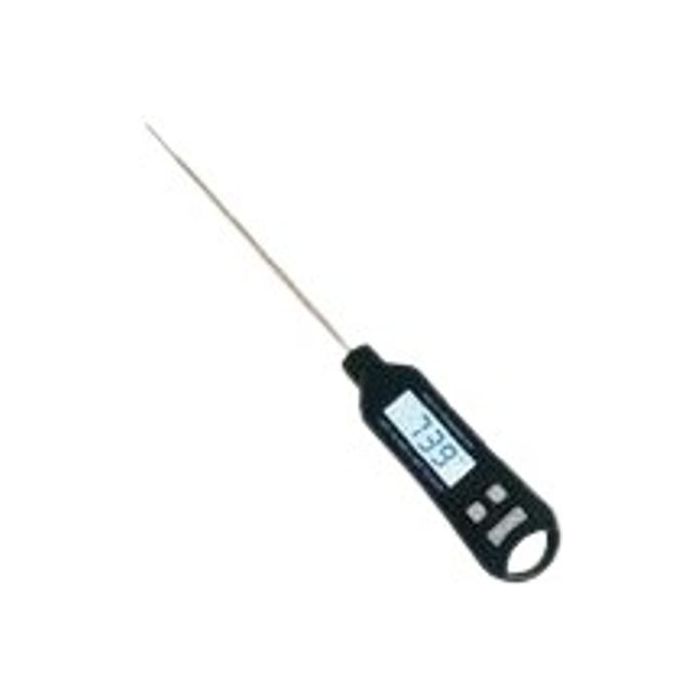
LDT-109 Pocket Digital Thermometer
Every bitumen and asphalt test depends on temperature: binder heating, mixing and compaction temperatures, the 60 °C Marshall bath, and mould pre-heating. The LDT-109 covers all of these with a fast-reading needle probe.
- -50 to +300 °C range, 0.1 °C resolution
- ±1 °C from -20 to 150 °C, otherwise ±2 %
- 130 × 3.5 mm probe with 1.7 mm needle tip
- Data hold, backlit LCD, ice-point (zero) calibration
Asphalt Penetrometers
Penetration is the depth a standard needle sinks into bitumen at 25 °C under a 100 g load for 5 seconds, read in tenths of a millimetre. It is the basis of penetration grading (for example 50/70 and 70/100) and a quick check on whether binder has hardened in storage or in the plant.
- Double digital asphalt penetrometer with electric lifting for repeatable needle positioning
- Automatic asphalt penetration apparatus that automates the timed test
- For ASTM D5 / EN 1426 penetration testing
Softening Point Meters (Ring & Ball)
The ring-and-ball test heats two bitumen discs, each carrying a steel ball, at a controlled rate in water or glycerol. The softening point is the temperature at which the softened binder sags a set distance. Higher softening points mean better resistance to deformation in hot weather.
- Fully automatic model detects the ball drop and records the temperature without operator judgement
- Automatic model with controlled heating for routine binder checks
- For ASTM D36 / EN 1427 ring-and-ball testing
Digital Display Asphalt Ductilometer
A ductilometer pulls a moulded bitumen briquette apart in a temperature-controlled water bath at a constant speed and measures how far it stretches before breaking. Ductility indicates the binder's cohesion and its ability to accommodate movement without cracking, and is used in some binder and emulsion residue specifications.
- Digital display
- For ASTM D113-type ductility testing (typically 25 °C at 5 cm/min)
Rotating Bituminous Membrane Oven (Rolling Thin Film Oven)
The rolling thin film oven (RTFOT) reproduces the short-term ageing bitumen undergoes in the asphalt plant. Glass bottles holding a thin, moving film of binder rotate in an oven at 163 °C with an air jet. The aged residue is weighed for mass change and re-tested for penetration, softening point or viscosity.
- For ASTM D2872 / EN 12607-1 short-term ageing
- Produces residue for penetration-grade and performance-grade (PG) binder testing

Saybolt Viscometer
A Saybolt viscometer times how long a fixed volume of liquid takes to flow through a calibrated orifice at a controlled temperature, giving viscosity in Saybolt seconds. In road materials it is used mainly on bitumen emulsions and cutback bitumens, where viscosity controls how the binder sprays, coats and penetrates.
- Constant-temperature bath with orifice tubes
- For ASTM D88 Saybolt Universal and Saybolt Furol viscosity; ask which orifices are supplied
Cleveland Open Cup Flash Point Tester
The flash point is the lowest temperature at which vapour above heated bitumen ignites briefly when a test flame passes over it. It sets the safe upper limit for heating binder in storage tanks and the asphalt plant, and is a standard line in bitumen specifications.
- Open-cup method for bitumen and heavier petroleum products
- For ASTM D92 / ISO 2592 Cleveland open cup testing
Mix design, compaction & volumetric equipment
Mix design finds the binder content and aggregate grading that give the target air voids and strength. The lab mixes trial batches at a set temperature, compacts specimens, measures their bulk density against the loose mix's maximum theoretical density, and tests Marshall stability and flow.

BH-20 20 L Laboratory Asphalt Mixer
A heated vertical mixer for preparing trial asphalt batches at controlled mixing temperature, so every specimen in a mix design starts from a uniform, fully coated mix. The planetary action (blade revolution plus rotation) coats coarse and fine aggregate evenly.
- 20 L mixing volume
- Heated bath from room temperature to 250 °C, ±0.5 °C
- Adjustable mixing time, 1 to 999 s
- Blade revolution 48 r/min, rotation 76 r/min
- 3 kW, 220 V; 1220 × 620 × 1320 mm
Digital Automatic Marshall Compactor
Compacts cylindrical asphalt specimens (101.6 mm diameter) by dropping a standard hammer onto the mix a set number of times per face, commonly 50 or 75 blows depending on design traffic. The automatic, digitally counted drop removes operator fatigue and blow-rate variation from the result.
- Automatic, digitally controlled compaction
- For ASTM D6926 Marshall specimen preparation
B Type Asphalt Mixture Gyratory Test Machine
A gyratory compactor applies a constant vertical pressure while the mould gyrates at a small fixed angle, kneading the mix in a way that resembles roller and traffic compaction. Specimen height is recorded with each gyration, so the lab sees how density develops, not just the final value.
- Density curve recorded gyration by gyration
- For gyratory compaction under AASHTO T 312 / EN 12697-31
- Suited to heavy-traffic and rut-resistant mix designs
Digital Constant Temperature Water Bath
Marshall specimens must be conditioned at 60 °C immediately before the stability test, and penetration samples at 25 °C. A digitally controlled bath holds the set temperature so results are comparable between batches and between laboratories.
- Digital temperature setting and display
- For Marshall conditioning (ASTM D6927) and binder test baths

Digital Marshall Stability Tester
Loads a conditioned Marshall specimen across its diameter at a constant 50.8 mm per minute. The peak load is the stability, and the deformation at peak load is the flow. Together they show whether a mix is strong enough without being brittle.
- Digital readout unit
- For ASTM D6927 Marshall stability and flow
Asphalt Mixture Maximum Theoretical Density Meter
Measures the maximum theoretical density (Rice density) of loose asphalt by removing entrapped air under vacuum in a pycnometer. Compared with the bulk density of a compacted specimen or core, it gives the air void content, the central number in both mix design and compaction acceptance.
- Vacuum de-airing of loose mix
- For ASTM D2041 / AASHTO T 209 maximum specific gravity
Binder content & field density equipment
Once a mix is in production, the plant and the contractor need fast checks that each load has the designed binder content and that the layer is compacted to the specified density.
Bitumen Content Furnace (Ignition Method)
Burns the bitumen off a weighed asphalt sample at high temperature and calculates binder content from the mass loss, applying a correction factor established for the aggregate in use. No solvents are involved, and the clean aggregate can be graded afterwards.
- Solvent-free binder content determination
- For ASTM D6307 / AASHTO T 308 ignition testing
Digital Display Asphalt Centrifuge Extractor
Separates binder from aggregate by washing the sample with solvent and spinning the bowl to throw the bitumen solution out through a filter ring. Binder content is calculated from the mass of recovered aggregate. Useful where aggregates lose mass on heating and make ignition results unreliable.
- Digital display
- For ASTM D2172 centrifuge extraction
Non-Nuclear Asphalt Density Apparatus
Measures the in-place density of a compacted asphalt layer electromagnetically, from the layer's dielectric response, and gives a reading in seconds. Because there is no radioactive source, there is no radiation licence, source storage or transport control to manage.
- Instant readings for compaction checks behind the roller
- Electromagnetic method of the type covered by ASTM D7113
- Correlate to cores from the same job for absolute values
Ignition furnace or centrifuge extraction?
← Scroll to see full table →
| Factor | Ignition furnace | Centrifuge extraction |
|---|---|---|
| Principle | Burns off binder; binder content from mass loss | Dissolves binder in solvent; spins it out of the sample |
| Solvent | None | Required, with handling, ventilation and disposal |
| Aggregate correction | Needs a calibration factor per aggregate source | Correction for fines lost in the extract |
| Best for | Routine plant control with stable aggregate sources | Aggregates that lose mass on heating; binder recovery work |
| Standard | ASTM D6307 / AASHTO T 308 | ASTM D2172 |
How to choose asphalt testing equipment
Start from the specification you have to comply with and the decisions your lab has to make, then work back to the equipment.
- Identify the governing specification. Road authority projects in South Africa generally reference the COTO Standard Specifications for Road and Bridge Works, SANS 3001 civil engineering test methods and Sabita Manual 35 / TRH 8 for asphalt design. The project specification tells you which binder tests, compaction method and acceptance tests apply.
- Decide Marshall or gyratory. A Marshall compactor, water bath and stability tester cover routine and light-to-medium traffic mixes. Heavy-traffic, rut-resistant and performance-based designs usually call for a gyratory compactor. Many labs keep both.
- Plan for volumetrics. Air voids drive mix performance, so a maximum theoretical density meter is needed alongside either compaction method, plus a balance and water bath for bulk density.
- Choose a binder content method. An ignition furnace for high-throughput, solvent-free plant control; a centrifuge extractor where aggregates are unsuitable for ignition or the aggregate must be recovered without heating.
- Cover the binder. Asphalt plants and binder suppliers need penetration, softening point and RTFOT as a minimum, plus flash point for safe heating. Emulsion and cutback users add Saybolt viscosity and ductility.
- Add field control. A non-nuclear density gauge lets the contractor set and check roller patterns immediately, with cores taken for formal acceptance.
- Don't forget temperature. Every test above depends on it. A fast probe thermometer such as the LDT-109 is the cheapest way to catch a wrong mixing, compaction or bath temperature before it spoils a set of results.
South African conditions
Heat and rutting. Asphalt surfaces in much of South Africa reach high temperatures in summer, so stiffness at high temperature matters. Softening point, RTFOT residue properties and the air void content of the compacted mix are the tests that most directly address rutting risk.
Binder specifications are changing. South Africa has been implementing a performance-grade (PG) bitumen specification alongside the long-established penetration grades such as 50/70 and 70/100. PG grading relies on rheometer testing of fresh and aged binder, but RTFOT ageing and flash point remain part of it, and penetration and softening point are still widely used for routine checks. Ask Ecotao if you need equipment for PG binder testing.
Remote sites. Plants and borrow-pit labs far from a central laboratory benefit from robust, self-contained equipment: non-nuclear density gauges avoid radioactive-source logistics, and ignition furnaces avoid solvent supply and disposal.
Asphalt and bitumen tests at a glance
← Scroll to see full table →
| Test | What it measures | Why it matters | Typical standard | Ecotao equipment |
|---|---|---|---|---|
| Penetration | Needle penetration at 25 °C, 100 g, 5 s | Binder consistency and grade | ASTM D5 / EN 1426 | Double digital penetrometer; automatic penetration apparatus |
| Softening point | Temperature at which a bitumen disc sags under a steel ball | High-temperature stiffness, rutting resistance | ASTM D36 / EN 1427 | Automatic and fully automatic ring-and-ball meters |
| Ductility | Elongation before a binder thread breaks | Cohesion and flexibility | ASTM D113 | Digital display ductilometer |
| RTFOT ageing | Mass change and property change after plant-type ageing at 163 °C | Binder durability through mixing and laying | ASTM D2872 / EN 12607-1 | Rotating bituminous membrane oven |
| Saybolt viscosity | Flow time through a calibrated orifice | Spraying and coating of emulsions and cutbacks | ASTM D88 | Saybolt viscometer |
| Flash point | Lowest temperature at which vapour ignites | Safe heating limit | ASTM D92 / ISO 2592 | Cleveland open cup tester |
| Marshall compaction | Specimens compacted by standard hammer blows | Mix design and production specimens | ASTM D6926 | Digital automatic Marshall compactor; BH-20 mixer |
| Gyratory compaction | Density development under gyratory kneading | Heavy-traffic and performance-based design | AASHTO T 312 / EN 12697-31 | B type gyratory test machine |
| Marshall stability & flow | Peak load and deformation at 60 °C | Mix strength and flexibility | ASTM D6927 | Digital Marshall stability tester; water bath |
| Maximum theoretical density | Density of loose mix with no air voids | Air voids and percentage compaction | ASTM D2041 / AASHTO T 209 | Maximum theoretical density meter |
| Binder content | Percentage of bitumen in the mix | Compliance with the job mix formula | ASTM D6307; ASTM D2172 | Ignition furnace; centrifuge extractor |
| In-place density | Density of the compacted layer on site | Compaction acceptance and roller control | ASTM D7113 | Non-nuclear density apparatus |
Marshall vs gyratory compaction
← Scroll to see full table →
| Factor | Marshall compactor | Gyratory compactor |
|---|---|---|
| Compaction action | Impact: hammer blows on each face | Kneading: constant vertical pressure while the mould gyrates |
| Output | Compacted specimen at a fixed compactive effort | Specimen plus a height/density record for every gyration |
| Specimen | 101.6 mm diameter | Typically 100 mm or 150 mm diameter |
| Strength test | Marshall stability and flow at 60 °C | Volumetrics; specimens for performance tests |
| Typical use | Routine design and plant control | Heavy-traffic and rut-resistant mixes |
Frequently asked questions
What tests are done on an asphalt mixture?
A typical asphalt mix design and quality-control programme covers three groups of tests. Binder tests on the bitumen: penetration, softening point (ring and ball), ductility, viscosity, flash point and short-term ageing in a rolling thin film oven. Mix design tests on compacted specimens: Marshall or gyratory compaction, bulk density, maximum theoretical (Rice) density, air voids, and Marshall stability and flow. Production and field tests: binder content by ignition furnace or centrifuge extraction, aggregate grading, and in-place density of the finished layer.
What is the difference between Marshall and gyratory compaction?
A Marshall compactor compacts a 101.6 mm diameter specimen with a set number of hammer blows per face (commonly 50 or 75), and the specimen is then tested for stability and flow. A gyratory compactor kneads the mix under a constant vertical pressure while the mould gyrates at a small angle, which models compaction under a roller and traffic more closely. Under AASHTO T 312 it applies 600 kPa at 30 gyrations per minute and records height with every gyration, so the lab can see how density builds up. Marshall remains common for routine work; gyratory compaction is preferred for heavy-traffic and rut-resistant mix designs.
How is the bitumen content of an asphalt mix measured?
Two common methods are used. The ignition method (ASTM D6307 / AASHTO T 308) burns the binder off in a furnace and calculates binder content from the mass loss, applying a calibration factor for the aggregate. It needs no solvent and is fast. Centrifuge extraction (ASTM D2172) dissolves the binder in a solvent and spins it out of the sample. It suits aggregates that lose mass on heating and leaves the aggregate available for grading, but it needs solvent handling and disposal.
What is maximum theoretical density (Rice density) and why does it matter?
Maximum theoretical density, often called Rice density after the test's originator, is the density the loose asphalt mix would have with zero air voids. It is measured by placing loose mix under vacuum in a pycnometer to remove entrapped air (ASTM D2041 / AASHTO T 209). Comparing it with the bulk density of a compacted specimen or core gives the air void content, which is the main control for durability and rut resistance in mix design and for compaction acceptance on site.
At what temperature is the Marshall stability test done?
Under ASTM D6927, Marshall specimens are conditioned in a water bath at 60 °C (30 to 40 minutes for standard specimens) and then loaded at 50.8 mm per minute until failure. The peak load is the stability and the deformation at peak load is the flow. A constant-temperature water bath and a thermometer to check the bath are part of the standard set-up.
What do penetration and softening point tell you about bitumen?
Penetration (ASTM D5 / EN 1426) measures how far a standard needle sinks into bitumen at 25 °C under 100 g for 5 seconds, in tenths of a millimetre. It describes consistency and gives penetration grades such as 50/70 and 70/100. Softening point (ASTM D36 / EN 1427) is the temperature at which a bitumen disc softens enough for a steel ball to sag through it. Together they indicate how stiff the binder is at service temperatures, which matters for resistance to rutting in hot South African summers.
What is a rolling thin film oven (RTFOT) used for?
A rolling thin film oven simulates the short-term ageing that bitumen undergoes during mixing and laying. Bottles containing a thin film of binder rotate in an oven at 163 °C with an air jet (85 minutes under ASTM D2872). The aged residue is then re-tested for mass change, penetration, softening point or viscosity to check how much the binder hardens during production. RTFOT ageing is also part of performance-grade (PG) binder testing.
What is the difference between a nuclear and a non-nuclear asphalt density gauge?
A nuclear gauge uses a radioactive source to measure density, so its owner needs a radiation licence, trained operators, and controlled storage and transport. A non-nuclear gauge measures density electromagnetically from the dielectric response of the asphalt layer (ASTM D7113). It contains no radioactive source, gives a reading in seconds, and is well suited to checking compaction behind the roller. It should be correlated against cores from the same job for accurate absolute values.
Does Ecotao supply asphalt testing equipment outside South Africa?
Yes. Ecotao supplies from Cape Town to laboratories, contractors and consulting engineers throughout South Africa and to Namibia, Botswana, Zimbabwe, Mozambique, Lesotho and Eswatini. Contact sales@ecotao.co.za or +27 21 911 5835 for a quotation and lead time.
Equipping an asphalt lab or plant?
Tell us which tests and specifications you need to cover and we'll put together a quotation for the binder, mix design and field equipment. Supplied across South Africa, Namibia, Botswana, Zimbabwe, Mozambique, Lesotho and Eswatini.
- Head office: +27 21 911 5835
- Zak: 086 142 8716
- Zaid: 082 390 3989
- sales@ecotao.co.za
- aqua@ecotao.co.za